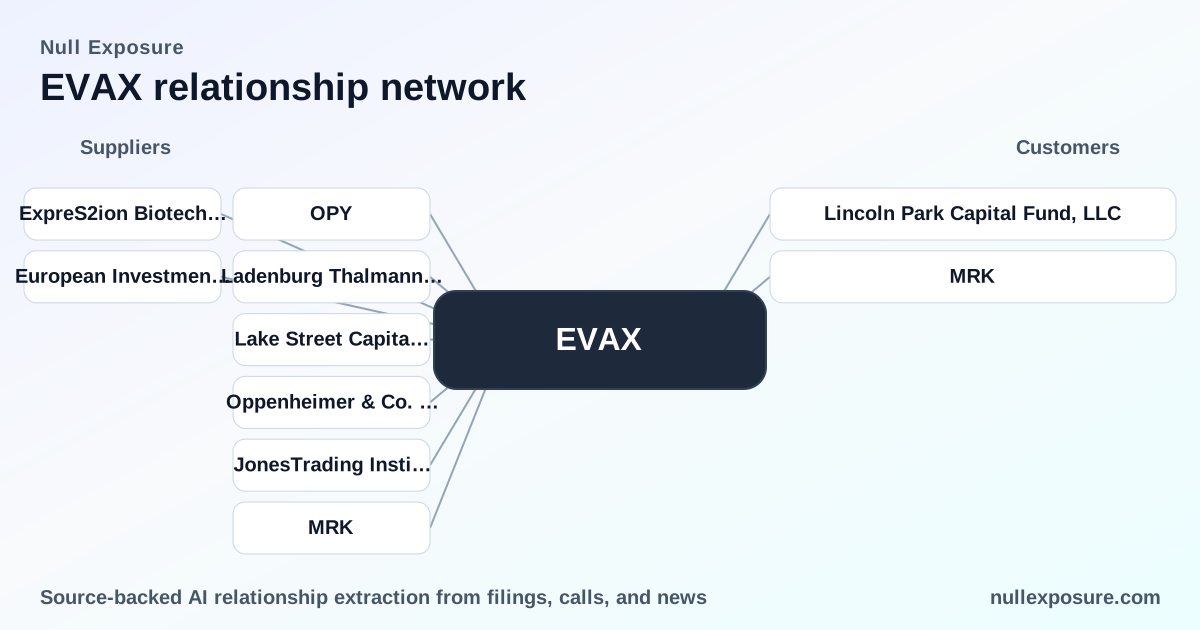
EVAX: Supplier relationships that shape a clinical‑stage AI immunotherapy play
Evaxion Biotech AS operates an AI-driven immunology platform to design and develop next‑generation vaccines and cancer immunotherapies, monetizing through collaborative R&D, licensing and milestone structures, and capital markets activity (ADS/secondary offerings and convertible financing). The company’s revenue today reflects early-stage program fees and grant income while balance sheet actions and strategic partners provide the primary paths to value realization. For investors assessing supplier and counterparty risk, the relationship map combines boutique underwriters, commercial biotech manufacturing partners, a strategic pharma collaborator, and a supranational lender — each element influences capital access, clinical execution, and commercial optionality.
Explore deeper supplier intelligence at https://nullexposure.com/.
What investors need to know up front
Evaxion is a clinical-stage, capital‑intensive supplier of AI‑derived antigen programs rather than a product revenue machine. Financials show negative EBITDA and net losses, modest trailing revenue (~$7.53m TTM), and limited institutional ownership, so external counterparties and capital providers play outsized roles in enabling R&D timelines. Key drivers for valuation are partner option economics, successful clinical readouts, and continued access to attractive financing.
How the partner map informs operational posture
Evaxion’s relationships fall into three functional buckets: capital markets intermediaries that enable liquidity, clinical/commercial partners that validate and supply program components, and public lenders that provide conditional balance sheet support. This mix reveals a company that contracts opportunistically with specialist underwriters for equity raises, outsources antigen production to technology providers, and integrates its candidates into larger pharma clinical frameworks.
- Contracting posture: Reliant on underwriter-led offerings and a capital on demand agreement to manage cash flow.
- Concentration and criticality: Partnerships with Merck and ExpreS2ion carry high clinical criticality; underwriting relationships concentrate funding capability in a small set of advisors.
- Maturity: Clinical‑stage with early commercial activity — mature enough to attract Big Pharma collaboration and EIB financing, immature as a standalone commercial supplier.
Relationship catalog — every counterparty and what it means
Oppenheimer & Co. Inc. — book‑running role in public offerings
Oppenheimer served as the sole book‑running manager in Evaxion’s initial public offering, then acted as sole book‑running manager again for a later follow‑on offering, establishing a recurring underwriting relationship that supports access to U.S. capital markets. According to a GlobeNewswire press release, Oppenheimer led the IPO pricing announcement in February 2021 and coordinated the follow‑on closing in November 2021. (GlobeNewswire, Feb 4, 2021; Nov 9, 2021)
Ladenburg Thalmann & Co. Inc. — lead manager for equity raises
Ladenburg acted as lead manager on Evaxion’s IPO syndicate and again on the November 2021 follow‑on, giving Evaxion a second consistent boutique underwriter for U.S. retail and institutional placements. GlobeNewswire documents list Ladenburg as lead manager on the IPO and the subsequent follow‑on offering announcements. (GlobeNewswire, Feb 4, 2021; Nov 9, 2021)
Lake Street Capital Markets, LLC — co‑manager on follow‑on financing
Lake Street participated as a co‑manager on Evaxion’s November 2021 follow‑on public offering, adding distribution capacity for that capital raise and indicating a syndicate‑based approach to larger equity placements. The co‑manager role is recorded in the GlobeNewswire follow‑on closing release. (GlobeNewswire, Nov 9, 2021)
JonesTrading Institutional Services LLC — capital on demand facilitator
Evaxion leverages a Capital on Demand Sales Agreement with JonesTrading to enable opportunistic ADS sales; regulatory filings referenced in a company announcement update the prospectus shelf to facilitate up to $45.5 million in ADS issuance under that facility. This sales agreement is cited in Evaxion’s prospectus filing updates. (TipRanks company announcement, FY2026)
Merck & Co. — clinical collaborator and supplier of Keytruda for a phase 2 trial
Merck provides checkpoint inhibitor Keytruda for use in an Evaxion phase 2 cancer vaccine study, representing a high‑value clinical collaboration that integrates Evaxion’s vaccine candidates into an established immuno‑oncology backbone. FierceBiotech covered Merck’s option deal and the Keytruda supply arrangement in its reporting on the partnership. (FierceBiotech, FY2024)
ExpreS2ion Biotechnologies ApS — antigen production and preclinical validation
ExpreS2ion produced antigens based on Evaxion’s AI‑identified targets and reported positive preclinical immunogenicity data for a CMV vaccine program, demonstrating external manufacturing and assay validation capacity for Evaxion’s platform outputs. The collaborative preclinical release was published via Cision/Expres2ion. (Expres2ion/Cision press release, FY2024)
European Investment Bank (EIB) — conditional loan and potential equity‑type conversion
Evaxion discussed conversion of €3.5 million of a €7 million EIB loan into an equity‑type instrument, indicating structured financing that can reduce near‑term cash servicing pressure while diluting equity if converted. The company’s FY2024 results and business update document the advanced discussions with the EIB. (GlobeNewswire business update, Apr 1, 2025)
Strategic read: what the relationship set implies for risk and upside
The combined map signals a firm that depends on capital markets intermediaries for funding, maintains clinical‑critical supplier links with ExpreS2ion and Merck, and uses structured public loans to bridge development milestones. Underwriting concentration implies execution risk if equity markets tighten; the Merck tie and ExpreS2ion validation materially de‑risk technical feasibility and commercial optionality.
Key investment implications:
- Upside: Partner option economics with Merck and meaningful follow‑on financing capacity support re‑rating if clinical signals are positive.
- Risk: Heavy reliance on equity underwriters and ADS sales exposes the company to market liquidity cycles; EIB conversion would be an equity‑like event for shareholders.
- Operational: Outsourced antigen production and external drug supply create manageable operational scale but increase dependency on third‑party timelines.
For a granular counterparty risk assessment and active monitoring of new supplier events, visit https://nullexposure.com/ to see how these relationships fit into a broader supplier‑risk framework.
Closing action points for investors
Evaxion’s supplier set gives both runway and concentration risk: clinical validation via Merck and ExpreS2ion reduces scientific execution risk, while underwriter and capital‑on‑demand relationships define financing flexibility. Investors should track milestones from the Merck collaboration, updates to the JonesTrading facility, and any formal EIB conversion decision — each event will materially affect dilution and runway.
For a tailored briefing on Evaxion’s supplier exposures and event‑driven risk analytics, consult our platform at https://nullexposure.com/.