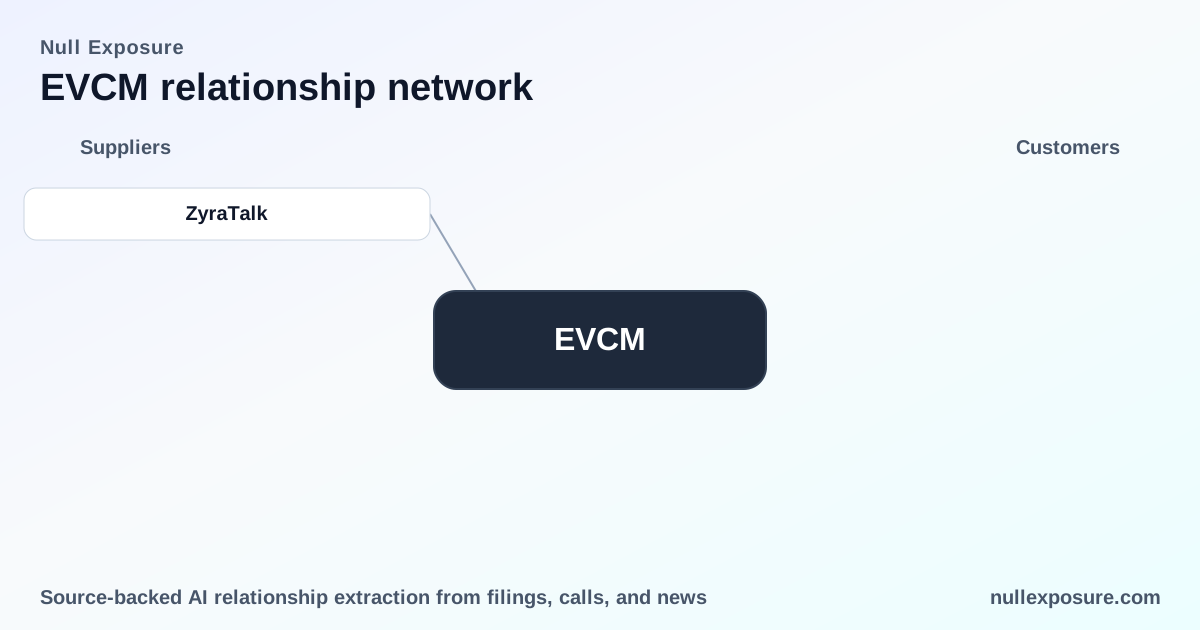
EverCommerce (EVCM) supplier snapshot: ZyraTalk and what it tells investors
Thesis — EverCommerce operates as a vertical SaaS platform for local and specialized service businesses, monetizing through recurring software subscriptions, value-added services, and strategic acquisitions that expand product capabilities and customer retention. The firm's supplier posture blends in-house product build with targeted M&A to obtain capabilities (for example, AI-driven customer engagement software), while operationally relying on external service providers for specialized functions such as cybersecurity testing and assessment. Investors should treat supplier relationships and disclosed third‑party controls as a driver of both scalability and operational risk.
Review the broader supplier map at https://nullexposure.com/ to contextualize these relationships against peers.
What the public relationships list contains — the short read
The supplier relationship results returned for EVCM include one named entity: ZyraTalk. The available signal documents this acquisition/activity in the public narrative rather than a traditional vendor agreement listing.
ZyraTalk — AI platform acquisition to bolster SaaS capabilities
EverCommerce acquired AI platform ZyraTalk to accelerate conversational and automation features within its SaaS stack; the move was reported alongside an expanded share repurchase authorization in January 2026, signaling management’s willingness to deploy capital for both product capability and shareholder returns. According to a Sahm Capital article dated January 10, 2026, the ZyraTalk acquisition was presented as a strategic bolt-on to EverCommerce’s SaaS offerings. (Sahm Capital, 2026-01-10: https://www.sahmcapital.com/news/content/how-mixed-guidance-ai-deal-and-buybacks-at-evercommerce-evcm-have-changed-its-investment-story-2026-01-10)
What these relationships say about EverCommerce’s operating model
The public record and extracted constraints point to several business-model characteristics that matter for supplier risk and operational resilience.
- Contracting posture: The ZyraTalk activity is an acquisition rather than a stand-alone long-term outsourcing contract, indicating a preference for in-sourcing select strategic capabilities via M&A when control and integration are important. At the same time, company disclosures describe the use of external providers for specialized security testing and assessments, showing a hybrid approach: build/acquire where strategic, outsource where specialized expertise is required.
- Concentration: The limited set of named supplier relationships in the returned results does not imply a supplier-concentrated sourcing model on its face, but the explicit use of external security providers is a sign of selective dependency on third parties for critical testing and assurance functions.
- Criticality: Cybersecurity controls and external security assessments are described as part of the company’s core risk-management program, classifying those third parties as high criticality for operational continuity and regulatory posture.
- Maturity: The company maintains an internal security team responsible for risk assessments, control management, and incident response, which implies a mature governance stance supplemented by external assessments rather than pure dependence on third parties.
These attributes should guide vendor diligence: strategic capabilities tied to customer-facing features (like ZyraTalk) are being internalized, while specialized risk-management activities remain outsourced under corporate oversight.
Constraints and company-level signals investors should note
EverCommerce’s cybersecurity risk-management disclosure explicitly lists the use of external service providers to assess, test, or assist security controls. This is a company-level signal (confidence level indicated in the source material) that:
- Confirms reliance on third-party security testing rather than exclusive in-house validation.
- Signals process orientation — there is a named security function and formalized assessment program, which reduces some execution risk but introduces supply‑chain dependency risk.
- Creates a measurable due-diligence vector: investors and counterparties should request attestation materials and SOC-type reports for those external providers.
Treat these constraint excerpts as governance evidence rather than a vendor ledger: they reflect how the company manages supplier risk, not an itemized supplier roster.
Visit https://nullexposure.com/ to compare how EVCM’s supplier posture stacks up against other vertical SaaS providers.
Risks and priority diligence items
The ZyraTalk transaction and the company-level security posture together create a clear list of investor priorities:
- Integration risk for bolt-on AI capabilities. Acquiring technology solves capability gaps quickly but requires successful integration into product, data, and sales motions; track product roadmap milestones and cross-sell uptake.
- Third‑party security dependency. External providers are used for testing and assessment; verify the depth and frequency of those engagements and obtain third-party audit reports.
- Operational concentration. While the public relationships list is sparse, critical functions (security, payments, hosting) often reside with a small set of providers — insist on supplier continuity plans and substitute options.
- Financial signaling. The ZyraTalk move was reported alongside a $50 million expansion of the share repurchase program, which communicates capital allocation priorities that intersect with M&A funding and supplier investment.
Practical next steps for investors and operators
For research teams evaluating supplier risk and the strategic value of relationships, take these actions:
- Request integration timelines, KPIs, and retention metrics tied to ZyraTalk capabilities to assess revenue and product impact.
- Obtain evidence of third-party security testing (SOC reports, penetration-test summaries, engagement frequency) and review contractual SLAs for critical suppliers.
- Validate contingency plans for critical outsourced services and check for supplier concentration in hosting, payment processing, and security assessment.
- Incorporate vendor control maturity into valuation scenarios: forecast downside from supplier failure and upside from successful integrations.
A succinct due-diligence checklist improves negotiation leverage and reduces execution uncertainty.
Final takeaways and where to go next
EverCommerce combines targeted acquisitions for product capability with selective outsourcing for specialized controls — a hybrid operating model that accelerates feature delivery while centralizing risk oversight. ZyraTalk represents a strategic move to own conversational AI capability, whereas the cybersecurity disclosures confirm ongoing reliance on external specialists for assurance.
For investors building exposure frameworks or stress-testing counterparty risk, focus on integration execution and third-party control evidence. To see a full comparative supplier map and vendor-risk framework, visit https://nullexposure.com/ and start a vendor exposure review. If you want a tailored supplier-risk briefing for EVCM or peer comparisons, head to https://nullexposure.com/ and request a tailored analysis.