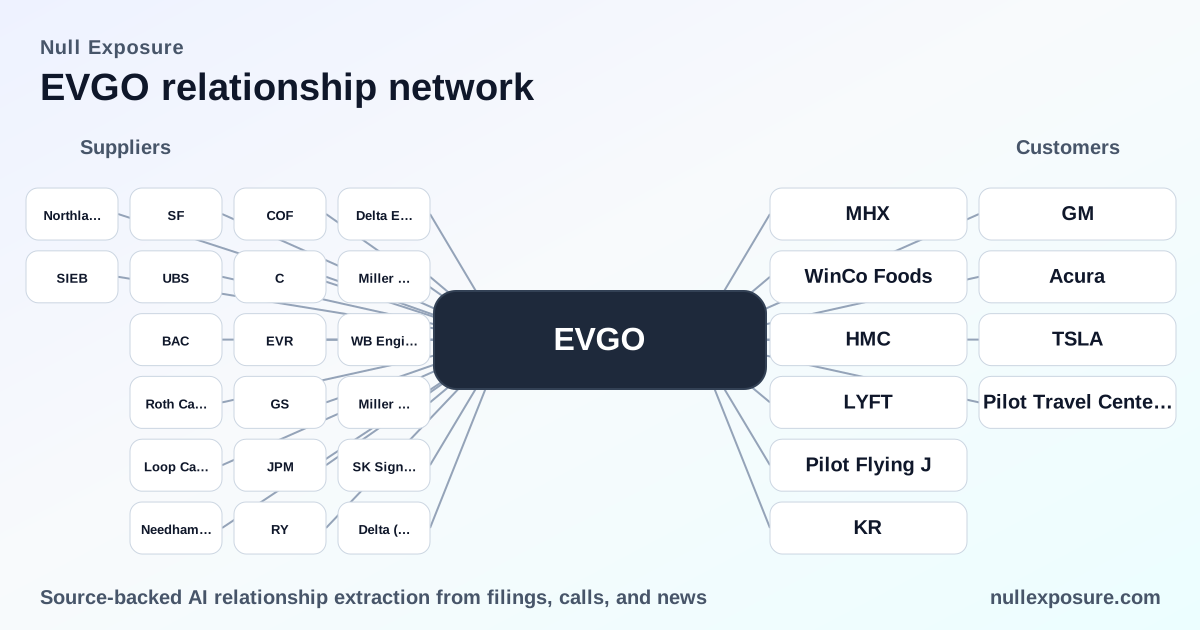
EVgo Inc (EVGO): supplier map and what investors should price in
Evgo operates and monetizes a fast-charging network by owning and operating DC fast chargers at retail and commercial locations, collecting usage and subscription revenue while capturing station-level margin through site selection, energy procurement and partnerships. The company funds network expansion through public markets and project financing, sources equipment and installation from a small set of vendors, and sells the story of a renewable-powered fast-charge footprint to OEMs, fleets and retail hosts. For investors, returns hinge on utilization growth, hardware supply resilience and capital markets access.
Learn more and track supplier risk at https://nullexposure.com/.
The business model in plain terms
Evgo drives revenue from charging session fees, subscription products and site-host arrangements while controlling gross margin through charger uptime, energy procurement and prefabrication-driven installation efficiency. Financials show $384.1M revenue TTM and negative operating leverage (operating margin TTM -6.48%; diluted EPS -$0.31), which makes capital efficiency and supplier reliability central to valuation. The company’s stated use of 100% renewable energy for its network is a commercial differentiator that depends on utility contracts and on-site energy arrangements.
Hardware and installation partners that determine deployment speed
Delta Electronics, Inc. (10‑K, FY2024)
Evgo has a formal charger supply agreement with Delta and used an initial purchase order under a General Terms and Conditions for Sale dated July 12, 2022, making Delta a primary equipment supplier. According to Evgo’s 2024 10‑K, Delta supplied 77.3% of Evgo’s charging equipment in 2024, underscoring concentration risk (evgo-2024-12-31).
Delta (Electronics Inc.) (news, FY2023)
Management previously disclosed supply constraints tied to Delta’s manufacturing transitions, which delayed deliveries into 2024, signaling that supply-chain timing from Delta has direct implications for rollout cadence (LA Business Journal coverage, FY2023).
SK Signet (news, FY2023)
Evgo told investors in 2023 that SK Signet was a principal supplier alongside Delta and that manufacturing moves pushed some deliveries out to 2024, making SK Signet part of the equipment-concentration picture (LA Business Journal, FY2023).
Miller Electric Company (news, FY2025)
Evgo’s partnership with Miller Electric accelerated installations and reduced average station installation costs by about 15%, reflecting consolidation of electrical contracting to speed rollouts and lower per-site capital expenditure (SahmCapital news release, Dec 2025).
Miller Electric (news, FY2024)
Industry coverage also credits Miller Electric with enabling Evgo’s prefabricated approach to fast-charging sites, a tactic that shortens on-site construction time and reduces schedule risk (CleanTechnica, Mar 2024).
WB Engineers+Consultants (news, FY2024)
WB Engineers+Consultants supported Evgo’s prefabrication strategy, providing engineering input that facilitates modular site construction and standardized deployment (CleanTechnica, Mar 2024).
Capital markets and underwriting relationships that funded growth
The following firms acted as book‑running managers, book‑running managers or co-managers in Evgo’s public equity offering; these relationships reflect capital markets access used to finance network growth.
Capital One Securities (FY2023)
Capital One Securities served as a co‑manager on Evgo’s public equity offering, part of the syndicate that provided primary market distribution (Latham & Watkins advisory release, FY2023).
Citigroup (FY2023)
Citigroup was one of the book‑running managers for Evgo’s offering, indicating institutional distribution support during the capital raise (Latham & Watkins advisory release, FY2023).
Evercore ISI (FY2023)
Evercore ISI acted as a lead book‑running manager, reflecting senior placement support in the underwriting syndicate (Latham & Watkins advisory release, FY2023).
Goldman Sachs & Co. LLC (FY2023)
Goldman Sachs was a lead book‑running manager on the equity offering, providing top-tier distribution and underwriting muscle (Latham & Watkins advisory release, FY2023).
J.P. Morgan (FY2023)
J.P. Morgan acted as a lead book‑running manager, a signal of major-bank support for Evgo’s access to institutional capital markets (Latham & Watkins advisory release, FY2023).
RBC Capital Markets (FY2023)
RBC served as a book‑running manager for the offering, contributing to syndicate breadth and distribution to institutional investors (Latham & Watkins advisory release, FY2023).
Stifel (FY2023)
Stifel participated as a co‑manager, supporting the equity placement to retail and institutional channels (Latham & Watkins advisory release, FY2023).
UBS Investment Bank (FY2023)
UBS was a book‑running manager in the offering, helping underwrite and distribute shares (Latham & Watkins advisory release, FY2023).
BofA Securities (FY2023)
BofA Securities acted as a book‑running manager, giving Evgo additional distribution capacity during the raise (Latham & Watkins advisory release, FY2023).
Roth Capital Partners (FY2023)
Roth Capital participated as a co‑manager in the syndicate, broadening retail and sector-focused coverage (Latham & Watkins advisory release, FY2023).
Loop Capital Markets (FY2023)
Loop Capital served as a co‑manager, contributing to the underwriting syndicate’s distribution network (Latham & Watkins advisory release, FY2023).
Needham & Company (FY2023)
Needham & Company participated as a co‑manager, indicating mid‑market placement support (Latham & Watkins advisory release, FY2023).
Northland Capital Markets (FY2023)
Northland Capital Markets was a co‑manager in the offering, helping reach specialized institutional buyers (Latham & Watkins advisory release, FY2023).
Siebert Williams Shank (FY2023)
Siebert Williams Shank acted as a co‑manager, rounding out the syndicate and retail distribution channels (Latham & Watkins advisory release, FY2023).
What the supplier constraints tell investors about operational risk
- High equipment concentration is the dominant vendor risk. Evgo disclosed that two vendors provided 87.9% of its total charging equipment in 2024, and Delta alone provided 77.3% of equipment that year—this concentration creates single‑point risks for deliveries, spare parts and firmware compatibility (company disclosures, FY2024).
- Energy procurement is centralized. Evgo purchases electricity for the majority of stations directly from local utilities accounting for roughly 94% of GWh throughput in 2024, which makes utility contracting and rate structure central to margin stability (company disclosures, FY2024).
- Operations depend on communications and third‑party services. Evgo relies on data carrier networks and third‑party software for session management, driver authentication and payments; outages or vendor failures are identified as material operational risks (company disclosures, FY2024).
- Relationship posture is service‑oriented and active. The supplier set functions as active service providers and installers supporting ongoing network operations and expansion; Evgo also engages third parties for cybersecurity assessments, indicating a mature vendor governance stance (company disclosures, FY2024).
If you track counterparty and delivery risk across the EV supply chain, you’ll find actionable signals in these supplier disclosures—explore deeper analysis at https://nullexposure.com/.
Investment takeaway and next steps
Valuation and upside for Evgo are conditional on execution against supplier concentration and installation efficiency. Prefabrication and partnerships with contractors like Miller Electric can compress build timelines and reduce per‑site capex, while heavy dependence on Delta and a small number of suppliers requires active mitigation (inventory buffers, dual sourcing, contractual protections). Capital markets relationships documented in 2023 provided the financing that enabled expansion; ongoing market access remains important given negative operating leverage and the need for the next phase of rollouts.
For portfolio managers and operators assessing counterparty exposure, prioritize: supply‑diversification plans, utility contracting terms tied to throughput economics, and contingency plans for carrier or software outages. For more supplier-mapped intelligence and to download the full relationship roster, visit https://nullexposure.com/.