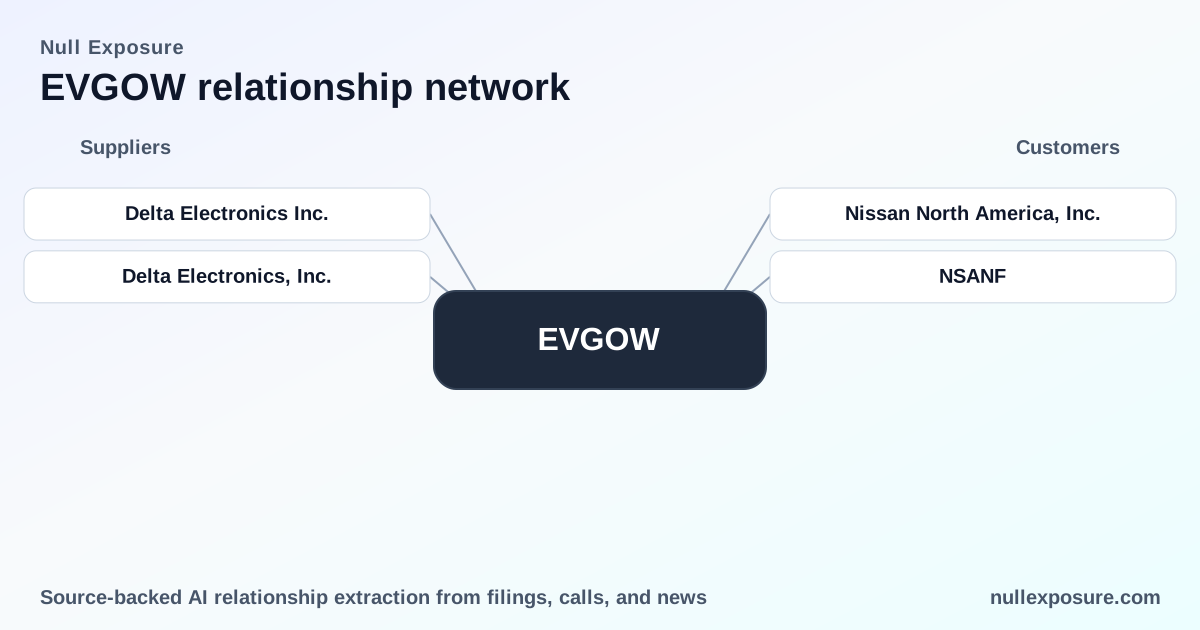
EVGOW: Supplier Concentration and What Delta Electronics Means for Investors
EVgo Equity Warrants (EVGOW) provide exposure to EVgo Inc., a network owner/operator that designs fast-charging stations and monetizes through charging sales, site-hosting agreements, and equipment deployment financed via capital partners. The company outsources charger manufacturing while retaining systems design and network operations, capturing recurring revenue from energy throughput and services and realizing capital upside when scaling deployed assets. For investors evaluating supplier counterparty risk, the critical signal is that EVgo’s hardware supply chain is highly concentrated and contractually committed, creating both operational leverage and single-vendor exposure.
Explore supplier risk models and counterparty mapping at NullExposure.
Quick company snapshot for investor context
EVgo’s most recent trailing-twelve-months figures show $384.1 million in revenue and $156.8 million in gross profit, with negative EBITDA of roughly $29.85 million, reflecting growth-stage margin compression as network scale and opex investments continue. The balance of outsourced manufacturing and in-house design places hardware vendors at the center of the capital deployment cycle: equipment supply determines installation pace, capital commitments, and near-term cash requirements.
The supplier relationships on record
Below are the supplier relationships disclosed in EVgo’s 2024 Form 10‑K that are material to the company’s charging equipment procurement.
Delta Electronics Inc. — procurement design leverage
EVgo states that its charging equipment procurement “leverages a design with Delta,” indicating a close operational relationship where EVgo’s station specifications are built around Delta’s product designs. This positions Delta as an important design-aligned hardware supplier in the network build-out. According to EVgo’s 2024 Form 10‑K, this design leverage is an active component of procurement strategy (FY2024, Form 10‑K).
Delta Electronics, Inc. — charger supply agreement and purchase order
EVgo disclosed a formal Delta Charger Supply Agreement that includes an initial purchase order under General Terms and Conditions for Sale of EV Charger Products, through which EVgo will purchase and Delta will sell chargers manufactured by Delta on specified delivery schedules. This contract-level disclosure confirms a transactional manufacturing relationship and committed purchase flow between EVgo and Delta. The arrangement and initial purchase terms are documented in EVgo’s 2024 Form 10‑K (FY2024, Form 10‑K).
What the supplier picture implies for EVgo’s operating model
The public filings and constraint excerpts describe a supplier model with distinct characteristics investors must price into valuations and downside scenarios.
- High concentration and criticality: EVgo reports that for the year ended December 31, 2024, two vendors provided 87.9% of total charging equipment, a concentration that creates single- or dual-vendor dependency for core hardware. This is explicitly called material and critical in the company’s disclosures.
- Manufacturer role, not just commodity buying: EVgo designs stations and specifies chargers in-house and outsources production to manufacturers, so suppliers act as contract manufacturers executing EVgo’s product specifications rather than simple commodity vendors.
- Active contractual commitments and spend profile: EVgo disclosed $41.6 million in outstanding purchase order commitments to contract manufacturers and component suppliers as of Dec 31, 2024 (of which $38.2 million was short-term), aligning with a spend band in the $10m–$100m range. This demonstrates locked-in near-term capital obligations to suppliers.
- Service-provider interactions beyond hardware: The company engages third parties for cybersecurity assessments and sources electricity from utilities for ~94% of its GWh throughput, signaling supplier relationships that span critical operational services as well as hardware.
These points collectively indicate a supplier posture where hardware vendors are strategically integrated, contractually committed, and operationally critical to EVgo’s deployment cadence.
Investment and risk considerations — what to watch
Investors should treat supplier concentration as a value driver and a tail-risk amplifier. Key considerations:
- Deployment risk equals revenue timing risk. If a primary supplier experiences capacity constraints or delivery delays, EVgo’s station rollout—and therefore energy throughput growth—will slow, directly affecting near-term revenue and utilization.
- Procurement commitments are capital exposures. The disclosed $41.6 million of purchase order commitments tightens working capital and limits flexibility to re-source quickly without potential cancellation or replacement costs.
- Counterparty performance is operationally material. Because EVgo specifies designs and relies on manufacturers to deliver to spec, supplier quality, testing practices, and software/firmware compatibility are as important as unit price.
- Concentration creates negotiation imbalance. With two vendors supplying most equipment, EVgo has limited leverage in the short term; this is a structural negotiation constraint until additional qualified suppliers are qualified and contracted.
For further vendor-level due diligence and scenario-modeling, see NullExposure.
Practical actions for investors and operators
- Stress-test models for supplier disruption: run scenarios where equipment deliveries slip 3–12 months and quantify impacts to revenue, capital expenditures, and cash runway.
- Monitor procurement disclosures: new purchase orders, amendments to the Delta Charger Supply Agreement, or announcements of alternate suppliers materially change the risk profile. EVgo’s 10‑K disclosures are the primary source for these signals.
- Validate counterparty capacity and dual-sourcing timelines: investors should seek evidence of alternative manufacturer qualifications or inventory buffers that would reduce single-vendor exposure.
Final assessment and recommended next steps
EVgo’s supplier relationships are both an enabler and an exposure. The company’s in-house design plus outsourced manufacturing strategy accelerates scale but concentrates execution risk with a small number of vendors. The contractual commitments and the concentration metric (87.9% of equipment from two vendors) convert that exposure into a measurable financial and operational constraint that must be incorporated into cash-flow and downside scenarios.
For portfolio teams building exposure limits or covenant language tied to supplier concentration, and for strategic operators evaluating resilience, NullExposure provides mapped supplier intelligence and scenario tooling—start your review at https://nullexposure.com/. If you want a targeted supplier risk brief or a counterparty resilience score for EVgo, visit NullExposure to request a tailored report.