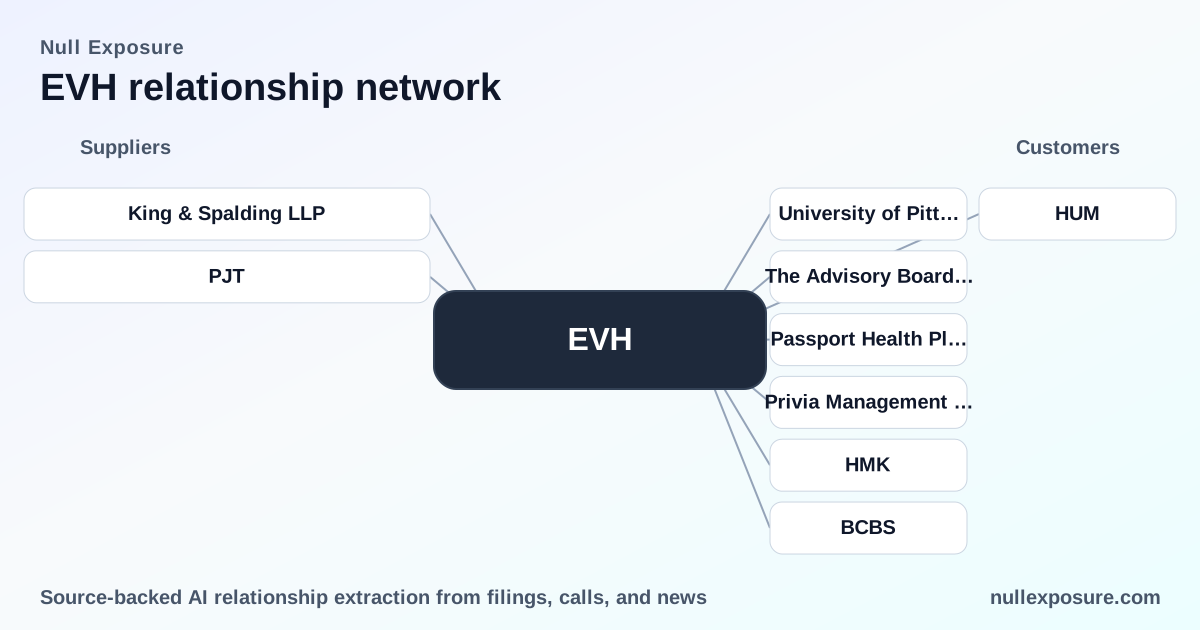
Evolent Health (EVH) — supplier relationships matter now that the company is in an active strategic process
Evolent Health operates a mix of technology-enabled services and care-delivery solutions for payers and providers and monetizes through recurring contract fees, platform hosting, and services tied to population health management. Recent activist engagement has put vendor and advisor relationships in the foreground: strategic and legal advisors are on the roster, and the company discloses that third parties host and operate its core platforms — an operational dependency investors should price into risk and valuation models.
Explore supplier profiles on NullExposure
What the business looks like to an investor
Evolent reports $1.876B in revenue (TTM) with a market capitalization near $337M, but bottom-line metrics are challenged — diluted EPS of -$5.07 and negative profit margins. The business is capital-light on balance sheet but service-intensive: revenue per share and gross profit indicate scale in contracts, while operating margin compression and elevated EV/EBITDA reflect market skepticism about near-term profitability and the path to margin recovery. For investors, the company’s monetization depends on two vectors: selling ongoing management services and platform-hosting arrangements, and winning or retaining large payer/provider contracts that produce recurring revenue.
Recent advisor and legal relationships — what was disclosed
Evolent disclosed a cooperation agreement with Engaged Capital that also named external advisors. These relationships are directly relevant to governance and potential strategic outcomes.
-
PJT Partners is serving as exclusive strategic advisor to Evolent, instructing the company on engagement strategy and options related to the activist approach; this is reported in a PR Newswire release from March 9, 2026. (Source: PR Newswire, March 9, 2026 — https://www.prnewswire.com/news-releases/evolent-health-announces-cooperation-agreement-with-engaged-capital-301197260.html)
-
King & Spalding LLP is serving as legal advisor to Evolent, handling the legal workstream tied to the cooperation agreement described in the same PR Newswire release. (Source: PR Newswire, March 9, 2026 — https://www.prnewswire.com/news-releases/evolent-health-announces-cooperation-agreement-with-engaged-capital-301197260.html)
These named advisor relationships are transactional and governance-critical: strategic and legal advisors often indicate either a run-the-business strategic review, preparation for significant transactions, or defense/offense planning in activist negotiations.
Supplier posture and platform reliance — company-level signals
Evolent’s public disclosures state: “We rely on third-party vendors to host and maintain our technology platforms, including Identifi® and CarePro™.” That single admission functions as a high-value signal about the company’s operating model.
-
Contracting posture: Evolent outsources platform hosting and maintenance, which reduces fixed-cost capital intensity but increases dependency on vendor uptime, security, and contractual terms. Outsourcing supports faster scaling but transfers critical operational risk to suppliers.
-
Concentration and criticality: When core products are hosted externally, a small number of vendor relationships can become single points of failure. Investors should treat platform-hosting suppliers as high-criticality vendors that materially affect revenue continuity and regulatory/compliance exposure.
-
Maturity and sophistication: Outsourced hosting implies the firm focuses internal resources on product development, integration, and client relationships rather than operating data centers. This is consistent with a modern SaaS-plus-services operating model across healthcare, but it requires mature vendor governance and SLAs.
-
Commercial leverage: Vendor agreements can be a lever in transactions; strategic buyers or activists will scrutinize transferability of contracts, change-of-control provisions, and termination rights.
Collectively, these signals justify treating supplier risk as a first-order input in operational due diligence and valuation adjustments.
Analyze supplier risk with NullExposure
How the advisor and supplier dynamics affect valuation and risk
The presence of PJT and King & Spalding in the activist process elevates the probability of near-term strategic outcomes — asset sales, management changes, accelerated cost reduction, or negotiated restructurings. Each outcome interacts with supplier realities:
- If Evolent pursues a sale or carve-up, change-of-control clauses with hosting vendors could trigger renegotiation risks or transition costs that compress deal value.
- If the company pursues restructuring, vendors could be renegotiated for savings, but service disruptions would create revenue risk given the platform-hosting dependence.
- Strategic advisors increase the chance of a value-maximizing process, but legal advice indicates complexity and potential contestation.
Financially, the company’s price-to-sales of ~0.18 and EV/EBITDA of ~88x reflect market stress; resolving governance and clarifying supplier continuity would be a material de-risk that could support a re-rating. Conversely, evidence of brittle vendor agreements or immature vendor management would justify further downside.
Actionable steps for investors and operators
- For investors: request vendor schedules and major contract summaries, focusing on termination rights, change-of-control clauses, and SLA penalties for the Identifi® and CarePro™ platforms. These items materially affect cash flow under stress scenarios.
- For operators: prioritize vendor governance and transition plans; build redundancy or contingency routing for critical platform functions to reduce single-point dependence.
- For diligence teams: model scenarios where vendor renegotiation requires one-time cash payments or introduces migration costs; stress-test revenue retention under a 30–90 day outage.
Closing recommendations
Evolent’s strategic advisor and legal advisor appointments are significant and timely signals; combine that governance signal with the company-level disclosure that core platforms are hosted by third parties to treat supplier risk as a central input in any investment thesis. Investors should demand contract-level transparency and contingency plans before assuming a recovery in margins or enterprise value.
For a deeper look at Evolent’s supplier footprint and comparable supplier risk profiles, visit NullExposure for curated supplier intelligence: Explore supplier profiles on NullExposure.
Final note: active governance processes create both upside (faster strategic resolution) and downside (deal friction, vendor complexity). Position accordingly and prioritize vendor continuity in valuation scenarios. Start your supplier review at NullExposure