EVI Industries: distribution-led cash flows with concentrated supplier exposure
EVI Industries operates as a specialist distributor, lessor and servicer of commercial and industrial laundry equipment and boilers across the U.S., Canada, the Caribbean and Latin America. The company monetizes through equipment sales, finance and operating leases, rentals, parts and recurring service contracts—a blended hardware-and-service model that produces steady gross margins and recurring aftermarket revenue. For investors assessing vendor risk and supplier continuity, the key dynamic is EVI’s role as an aggregator of manufacturer brands combined with material concentration among a small set of suppliers. Learn more at https://nullexposure.com/.
How EVI makes money and why operating posture matters
EVI’s financial profile shows a mid‑sized industrial distributor with recurring cash generation: trailing revenue of roughly $404 million and gross profit of about $123 million. EBITDA and margins are positive (EBITDA ~$19.7 million; operating margin ~3.3%), and the company captures upside through installations, maintenance and leasing that extend the revenue life of installed equipment. The balance between outright equipment sales and leases/rentals is central to predictability of cash flow and asset utilization.
The company’s lease footprint is a structural feature of the operating model. EVI leases warehouse, distribution and administrative facilities typically for three-to-ten year terms, while also recognizing short‑term leases of 12 months or less on a straight‑line basis. This mix establishes a contracting posture that combines medium‑term real estate commitments with flexibility for short‑lived leases, supporting both scale and local service presence.
Geographically, procurement is explicitly global: EVI buys from both domestic and foreign manufacturers. That global sourcing supports assortment across multiple end markets but produces vendor concentration risk that is material to procurement continuity and margin stability.
Supplier concentration and contractual signals you should weigh
- Material supplier concentration: Purchases from four manufacturers accounted for approximately 72% of product purchases in fiscal 2025 and 73% in fiscal 2024, a clear signal that supplier disruption or pricing action by one of the top vendors would be immediately consequential to gross margins and inventory turns. This is a company‑level constraint that drives vendor negotiation leverage and risk exposure.
- Manufacturer list and channel role: EVI purchases across a defined set of large manufacturers (including American Dryer, Chicago Dryer, Cleaver Brooks, Girbau S.A., Dexter, Fulton, Maytag, Whirlpool and others), underscoring EVI’s role as a dealer/aggregator rather than a producer. The presence of named global manufacturers defines product breadth and replacement sourcing options.
- Contract maturity: The combination of multi‑year property leases and long‑standing distribution arrangements signals a mature operating footprint with embedded fixed costs—supportive for service coverage but increasing operating leverage in a down cycle.
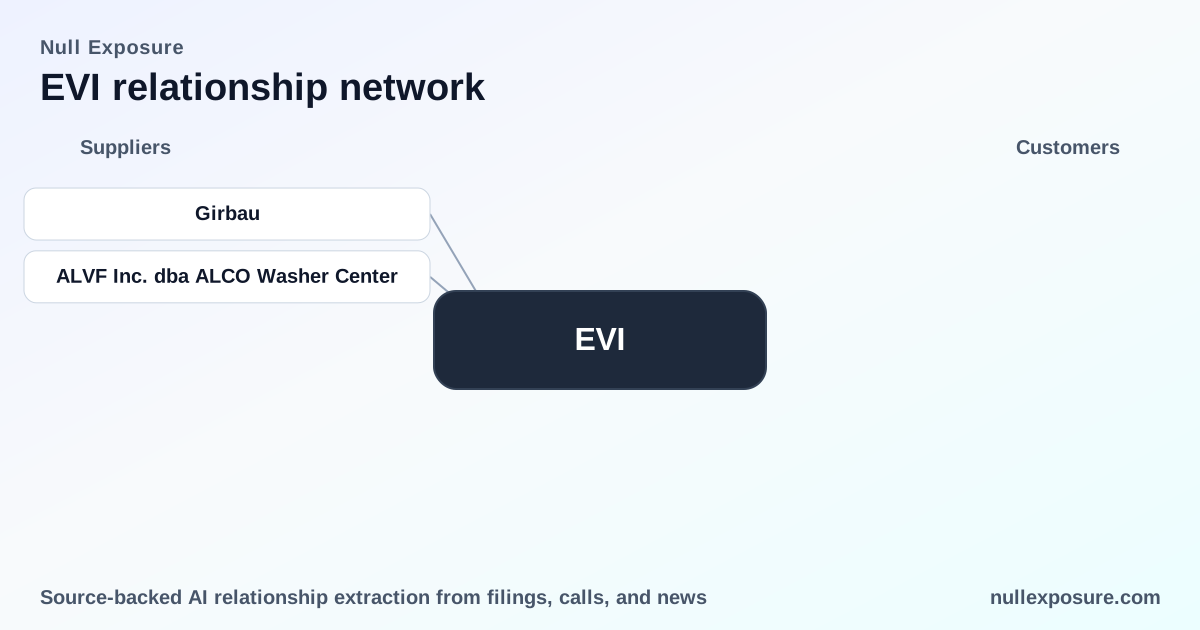
Supplier relationships tracked (what the record shows)
Girbau — EVI’s distribution relationship with Girbau was initiated in 2018 through a named channel (GNA) and the CEO has described it as “pivotal to each companies’ growth,” underscoring the strategic importance of Girbau-branded equipment within EVI’s product offering (reported in FY2025). Source: American Coin-Op (news report, first seen 2026-03-09) — https://americancoinop.com/node/130852.
ALVF Inc. dba ALCO Washer Center — EVI executed a definitive agreement to acquire ALVF Inc., a Pennsylvania-based distributor and service provider for commercial laundry equipment that serves on‑premises and vended segments; this transaction expands EVI’s regional distribution and service footprint (reported in FY2023). Source: American Laundry News (news report, FY2023, first seen 2026-03-09) — https://americanlaundrynews.com/node/124708.
What those relationships mean for operations and risk
Girbau is explicitly named among EVI’s major manufacturers and the 2018 distribution agreement establishes a strategic vendor partnership that drives both equipment assortment and aftermarket parts flows. The acquisition of ALCO Washer Center is an example of EVI using M&A to vertically deepen local service capabilities—translating to higher recurring revenue per installed unit and improved cross‑sell of finance and parts.
These two items together illustrate EVI’s dual approach: secure exclusive or prioritized distribution relationships with key manufacturers while buying regional scale through bolt‑on acquisitions to control installation and service economics. That combination improves unit economics but increases exposure to the pricing and supply decisions of a handful of manufacturers.
Learn more about supplier exposure and third‑party relationship mapping at https://nullexposure.com/.
Investment takeaways and operational flags
- Valuation and capital structure signals: Market cap near $291 million, EV/EBITDA ~14.3 and a trailing P/E of ~58 alongside a forward P/E of ~7.5 indicate market expectations for near‑term earnings improvement or lumpy base effects; use forward assumptions carefully. EVI trades at a premium to sales but with room for upside if service and leasing income scale.
- Ownership and governance: Insider ownership exceeds 59%, with institutions owning roughly 43%, creating concentrated control dynamics that influence capital allocation decisions.
- Operational red flags: Supplier concentration (72–73% from four manufacturers) and long‑term real estate leases (3–10 year terms) create exposure to supplier pricing and secular demand swings in hospitality and commercial laundry segments.
- Operational strengths: Broad geographic footprint, recurring service revenue from leases and maintenance, and selective acquisitions (ALCO Washer Center) that increase local service density and customer retention.
Next steps for due diligence
For investors and operators evaluating a supplier relationship with EVI, prioritize:
- Contract-level reviews of distribution agreements (duration, exclusivity, minimum purchases).
- Service margin trends and attachment rates for parts and maintenance.
- Vendor concentration stress tests against procurement scenarios.
For a concise vendor-risk briefing and relationship map tailored to capital allocators, visit https://nullexposure.com/.
Conclusion: EVI combines distribution scale, leasing and service revenue in a resilient commercial model, but material supplier concentration and fixed leasing commitments are the dominant operational risks that will determine margin resilience under stress. Conduct counterparty diligence on Girbau and other top suppliers and validate post‑acquisition integration metrics from deals like ALCO Washer Center before underwriting upside.