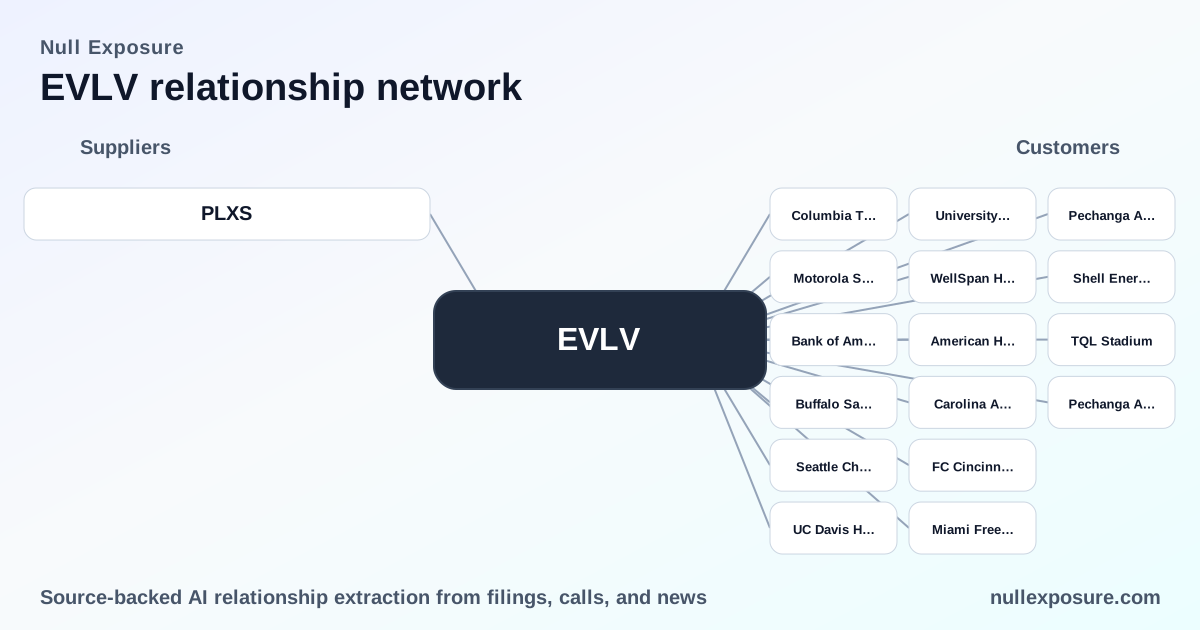
Evolv Technologies (EVLV): supplier relationships, manufacturing posture, and what investors should price in
Evolv Technologies sells AI-driven, contactless security screening systems and monetizes through hardware sales and the licensing of its intellectual property to contract manufacturers and distributors, collecting hardware license fees alongside product revenue. The company’s operating model leans on third‑party manufacturing and licensed distribution to scale physical production while retaining proprietary AI and sensor IP. Investors evaluating supplier risk should view Evolv as a technology owner that outsources physical production and critical services rather than a vertically integrated hardware manufacturer.
Learn how we map supplier exposure and supplier-driven risk at https://nullexposure.com/.
What investors need to know about the Plexus relationship
- According to a Yahoo Finance press release on March 9, 2026, Evolv entered a strategic contract manufacturing partnership with Plexus Corporation, positioning Plexus as a production partner to expand capacity and global reach. (Yahoo Finance, March 9, 2026)
- Management reiterated the strategic intent on the 2025 Q3 earnings call on March 8, 2026, saying the Plexus collaboration enhances production capacity, global reach, and operational resilience, signaling a deliberate de‑risking of single‑source constraints and an attempt to accelerate fulfillment. (Evolv 2025 Q3 earnings call, March 8, 2026)
How the supplier map actually looks (Columbia Tech and others)
Evolv’s commercial model uses a mix of licensing and contract manufacturing. The company disclosed a Distribution and License Agreement with Columbia Tech (a wholly owned subsidiary of Coghlin Companies) that establishes Columbia Tech as Evolv’s primary contract manufacturer and a licensed distributor for sale‑through channels. Under that arrangement, Columbia Tech pays Evolv a hardware license fee for each system it manufactures and sells, and at times contracts directly with the Company’s resellers to fulfill purchase demand. This is an explicit company filing disclosure describing the March 2023 agreement and subsequent manufacturing setup. (Company filing, Distribution & License Agreement, 2023)
Additional manufacturing signals in filings note:
- Primary manufacturing is US‑based, with Columbia Tech holding international quality certifications such as ISO 9001:2015, indicating production standards consistent with North American manufacturing practices. (Company filing disclosure)
- Evolv uses a second source for a key sensor component, which reduces single‑component concentration risk but leaves the overall manufacturing chain materially dependent on contract partners. (Company filing disclosure)
- The company relies on third‑party service providers for data storage and processing and engaged a large national advisory firm in January 2025 to strengthen internal control activities around significant accounts and disclosures. This highlights outsourced operational services and an active program to improve governance and control. (Company filing disclosure, Jan 2025)
Operating and contracting posture — what the constraints tell investors
The disclosures and constraint excerpts collectively describe a supplier posture with these defining characteristics:
- Licensing rather than captive manufacturing: Evolv retains IP and licenses hardware manufacturing to third parties, generating license fees and enabling scaled production without equivalent capital investment.
- Moderate supplier concentration with mitigation steps: Columbia Tech is the primary contract manufacturer, creating concentration risk, but Evolv maintains a secondary supplier for a key sensor component and has now added Plexus to broaden manufacturing capacity.
- Geographic concentration in North America for primary manufacturing, which reduces exposure to offshore logistics risk but concentrates physical risk in regional events (earthquake, storm, etc.) identified in filings.
- Contract maturity and formality: Distributor licensing agreements and formal manufacturing partnerships (e.g., the March 2023 Columbia Tech agreement and the 2026 Plexus deal) indicate formal, multi‑year commercial relationships rather than ad‑hoc supplier purchases.
- Service dependency and governance focus: Outsourced service providers handle data and critical processing; the company’s engagement of a national advisory firm in 2025 signals management attention to control remediation and operational resilience.
- Real lease exposure in the $10m–$100m band: Total future minimum operating lease payments were disclosed at $19.6 million as of December 31, 2024, indicating non‑trivial fixed obligations that investors should include in cash‑flow and liquidity modeling. (Company filing, FY2024 lease disclosures)
Risk and opportunity framework for underwriting supplier exposure
Evolv’s supplier strategy creates a distinct set of investment considerations:
- Upside: accelerated capacity and lower CapEx burden. Licensing production to Plexus and Columbia Tech allows Evolv to scale hardware shipments rapidly while conserving balance sheet capital. The Plexus deal explicitly targets production capacity and global reach. (Evolv press release, March 9, 2026; 2025 Q3 earnings call, March 8, 2026)
- Downside: operational concentration and execution risk. Columbia Tech remains the primary manufacturer; a single regional disruption could interrupt shipments until alternate lines scale. The company’s own filings identify natural‑disaster and supplier disruption as principal risks.
- Governance and data risk are material. Evolv processes personal data and relies on third‑party storage/processing; remediation work started in 2025 improves the risk profile but investors should validate control outcomes.
- Financial leverage in operational commitments. Lease obligations in the tens of millions create fixed costs that compress flexibility during downturns; include the $19.6M operating lease exposure in stress tests.
Key investor takeaways:
- Plexus partnership reduces single‑source production risk and is growth‑oriented; treat it as a positive operational inflection that should accelerate order fulfillment if executed to plan.
- Columbia Tech remains strategically critical due to its role as the primary contract manufacturer and licensee; continue to monitor manufacturing output and any capacity constraints.
- Operational and data governance improvements are underway, but investors should require evidence of remediation effectiveness and third‑party control audits.
For more supplier risk intelligence and to see how these relationships impact valuation scenarios, visit https://nullexposure.com/.
Practical diligence steps before sizing a position
- Obtain the Plexus and Columbia Tech contract summaries or key terms: lead times, exclusivity, termination rights, minimum purchase commitments, and IP licensing mechanics. These clauses materially affect revenue conversion and exit options.
- Request third‑party audit results or SOC reports for Columbia Tech, Plexus facilities, and the data processors that hold sensitive operational data. Governance remediation work initiated in 2025 requires validation.
- Model order‑to‑revenue conversion under constrained capacity and accelerated capacity scenarios; include the $19.6M operating lease obligation in free‑cash‑flow sensitivity tests (company filing, Dec 31, 2024).
Concluding recommendation: treat Evolv as a technology owner with outsourced manufacturing risk that is actively being addressed via strategic contracts; the Plexus partnership materially strengthens the production story, but Columbia Tech’s ongoing primacy and the company’s outsourced services require targeted due diligence before adding exposure. Learn more about supplier-driven valuation and scenario analysis at https://nullexposure.com/.