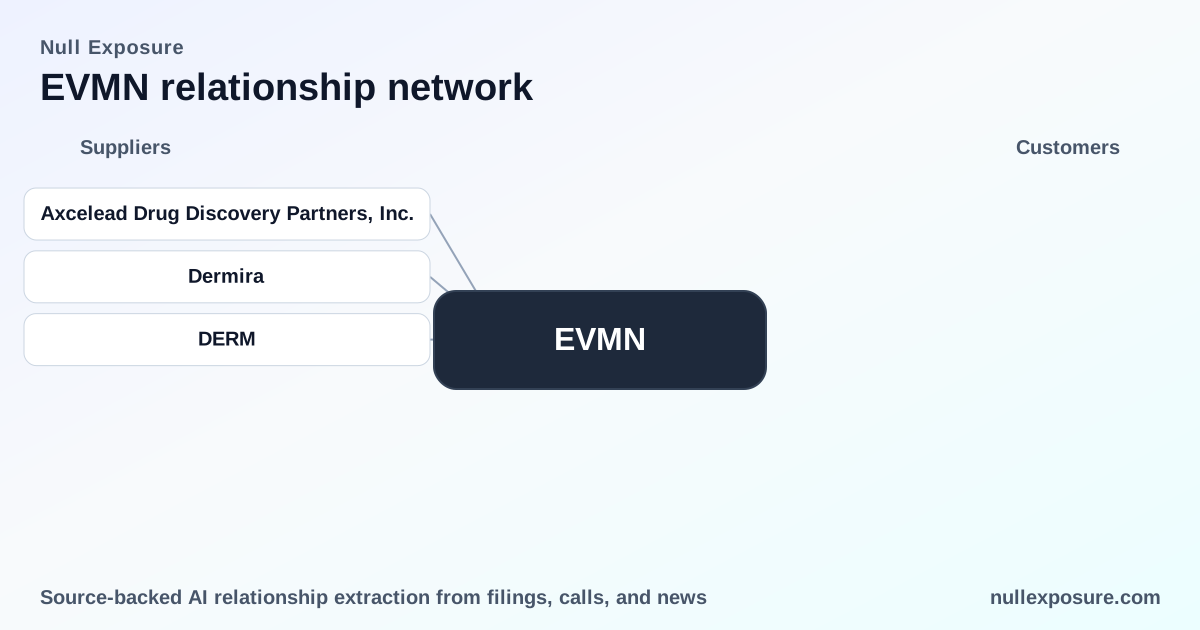
Evommune (EVMN) — supplier relationships, strategic constraints, and what investors should price
Evommune is a clinical-stage biotechnology company that builds value by acquiring and advancing licensed small-molecule and biologic programs targeting chronic inflammation; it monetizes through clinical development progress, later-stage partnering or commercialization, and the potential milestone and royalty flows that come from successful out-licensing or product launches. The company today is pipeline-driven rather than revenue-driven, relying on in-licenses and strategic sourcing of R&D assets to populate a concentrated development portfolio. For a deeper supplier-risk view and transaction-ready intelligence, visit https://nullexposure.com/.
How Evommune sources its pipeline and why that matters to investors
Evommune’s operating model is license-and-advance: management secures exclusive rights to preclinical or early-clinical programs from third parties, funds development through venture and public capital, and intends to capture value by derisking assets and executing exits or internal commercialization. That structure compresses balance-sheet operating expense relative to a full-stack discovery organization but creates high upstream concentration and counterparty dependency because a handful of licensors supply the company’s core intellectual property and clinical candidate inventory.
Financially, the company is small but well-capitalized for its stage: market capitalization is approximately $745 million with trailing revenue of $13.0 million and negative operating margins; institutional ownership is high at roughly 90%, which signals professional investor conviction but also potential concentration in shareholding dynamics.
Supplier relationships and the assets they deliver
Below I list every relationship captured in the available results and summarize the commercial or R&D relevance of each source.
Axcelead Drug Discovery Partners, Inc.
Evommune obtained a PKC theta inhibitor program through an exclusive partnership with Axcelead, which broadened the company’s reach into immune-mediated inflammatory indications. According to Evommune’s Series A press release on PR Newswire (FY2021), the PKC theta asset was acquired as part of deal activity that helped assemble the chronic inflammation pipeline. (PR Newswire, 2021)
Dermira
Three development programs in Evommune’s portfolio originate from an exclusive agreement with Dermira — a wholly owned subsidiary of Eli Lilly — delivering assets that address innate inflammation (IRAK4/TrkA), Th17-mediated pathways (RORγt), and chronic pruritus (MRGPRX2). Evommune announced these license arrangements in a public release in FY2021 that framed the three programs as core to its development strategy. (PR Newswire, FY2021)
Dermira, Inc. (DERM) — formal licensing announcement
Evommune publicly stated it executed an exclusive license agreement with Dermira, Inc. to develop and commercialize three inflammatory disease programs, underscoring a formal upstream sourcing channel from a major pharmaceutical parent (Lilly). This in-license was disclosed in a separate Evommune press release in FY2021 that details exclusivity and program scope. (PR Newswire, FY2021)
Dermira programs highlighted in industry press
Industry coverage noted Evommune took the three programs from Dermira as a foundational step following seed and Series A funding; reporting emphasized that ex-Dermira founders leveraged the in-licenses to build Evommune’s pipeline and attract investor capital. (FierceBiotech coverage of the Series A round, FY2021)
Constraints and company-level signals investors must price
Although there are no discrete constraint documents supplied, the relationship activity itself and available financials generate clear company-level operating signals investors should use in valuation and risk assessment:
- Contracting posture: Evommune operates as an exclusive in-licensee; contracts are structured to transfer development and commercialization rights rather than a joint discovery model. This creates a supplier-dependency posture: Evommune controls development downstream but relies on upstream licensors for intellectual property and pre-existing data packages.
- Concentration: The pipeline is concentrated around a small number of upstream providers (notably Dermira/Lilly and Axcelead). Concentration increases binary risk—the success or impairment of a single licensed program can materially move enterprise value.
- Criticality: Licensed programs are core to Evommune’s value creation thesis; these supplier relationships are not peripheral vendor services but mission-critical IP sources that determine clinical stage progression and partnerability.
- Maturity: The licensed assets are early-stage development programs; the company’s financials (negative EBITDA, limited revenue) reflect a typical biotech development profile where value realization is tied to successful clinical milestones and future partnering or commercialization.
These constraints imply that operational execution (timely clinical progress, disciplined cash management, and robust license indemnities) and external partner dynamics (Lilly’s posture regarding Dermira assets, Axcelead’s rights) will drive valuation volatility.
Financial context and strategic implications for operators and investors
Evommune’s balance sheet and marketplace signals present a classic risk/reward profile for a clinical-stage innovator: high valuation multiple on modest revenue (EV/Revenue > 50), negative operating profitability, and strong analyst sentiment (consensus skewed to Buy/Strong Buy). Institutional ownership above 90% concentrates voting power and liquidity dynamics.
From a supplier-risk perspective, operators should prioritize:
- Contract diligence on exclusivity, milestone allocation, and indemnities in in-license agreements.
- Pipeline redundancy planning, because the company is dependent on a small number of upstream assets.
- Milestone financing options given the negative EBITDA profile; future financing rounds or partner deals are likely to shape dilution and timing.
If you want to explore supplier-level risk metrics, contract exposure, and how these licenses feed valuation models, start here: https://nullexposure.com/.
Actionable takeaways for investors and operating teams
- Value drivers are singular and concentrated. The Dermira licenses and the Axcelead partnership form the backbone of Evommune’s near-term value creation, so clinical readouts and partner negotiations tied to those programs will disproportionately move the stock.
- Operational execution is everything. With negative EBITDA and early-stage assets, delivery of clinical milestones or a strategic partnership is the primary path to de-risking the current valuation premium.
- Underwrite counterparty risk explicitly. Contracts with licensors need to be examined for reversion rights, data transfer completeness, and milestone backstops—these terms directly affect upside capture.
For tailored intelligence on supplier contracts and material exposure, see our coverage at https://nullexposure.com/.
Evommune’s model is straightforward: build value by assembling licensed inflammation programs, fund development, and monetize via partnering or commercialization. That clarity helps investors underwrite outcomes, but the combination of high upstream concentration and early-stage clinical risk means returns will be binary and event-driven.