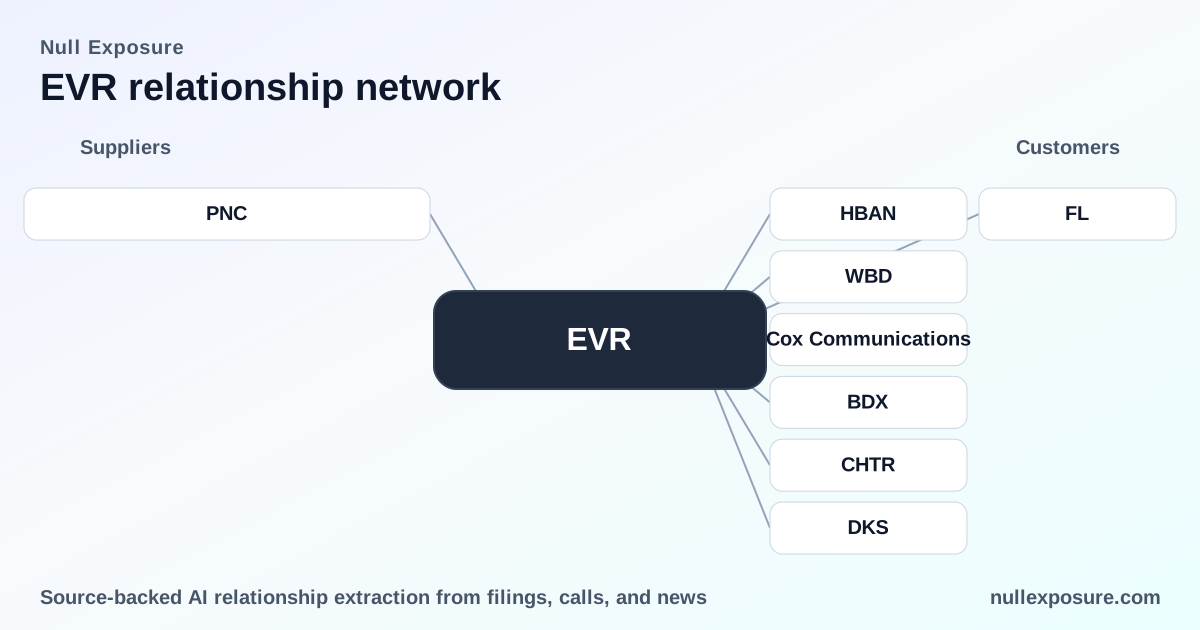
Evercore Partners (EVR): What the PNC credit line says about supplier posture and liquidity
Evercore is an independent investment banking advisory firm that monetizes client relationships through advisory fees, underwriting and wealth management fees, and partnership-style compensation for senior bankers. The firm’s profitability is driven by high-margin advisory work, leveraged human capital, and disciplined capital management; operating cash needs are primarily working-capital and short-term financing rather than heavy capital expenditures. Evercore preserves flexibility through short-duration liquidity arrangements such as committed revolving facilities, which support transactional cadence and capital distributions to partners and shareholders. For a focused supplier-risk view and supplier relationship scoring, visit https://nullexposure.com/.
The quick read for investors: credit capacity, not vendor dependence
Evercore’s balance of fee-based revenue ($3.856B TTM) and strong profitability (approx. 15.3% profit margin and 30.1% ROE as of the latest reported quarter) reduces reliance on any single external supplier for core operations. The company’s recent decision to increase a revolving credit facility to $225 million with PNC Bank reflects an active liquidity posture—a deliberate buffer that supports short-term working capital and transactional volatility. According to a TradingView news post referencing Evercore’s SEC 10‑K, the firm increased that line in FY2026 to ensure liquidity for working capital and other corporate activities (TradingView, March 9, 2026).
How Evercore structures supplier relationships (what matters for partners and operators)
Evercore’s supplier relationships are inherently different from an asset-heavy business. Suppliers for Evercore are concentrated in two functional buckets: financial counterparties (banks, lenders, clearing/settlement providers) and professional services (technology vendors, data providers, and specialized outsourcing firms). This operating model produces a set of observable supplier characteristics:
- Contracting posture: Short- to medium-term facilities and service agreements dominate; counterparty commitments are generally reassessed around transactional cycles and regulatory reporting.
- Concentration and criticality: Financial counterparties (credit providers, custodians) are critical but typically limited in number and negotiated on transparent commercial terms; a marginal increase in a single facility has outsized liquidity implications but limited operational lock-in.
- Maturity and stability: Banking relationships are mature and market-standard; they function as liquidity utility lines rather than integrated strategic suppliers.
- Supplier risk transfer: Evercore’s model transfers operational execution risk internally (senior banker-led workflows) while outsourcing scale-dependent services under manageable vendor contracts.
No supplier constraints were flagged in the source material. That absence is a company-level signal: Evercore shows no documented supplier-imposed restrictions that would constrain operations or capital deployment, reinforcing the view that supplier relationships are standard commercial arrangements rather than strategic chokepoints.
For a deeper supplier-risk scorecard tailored to financial services counterparties, see https://nullexposure.com/.
The PNC Bank relationship — a concise and actionable read
PNC Bank: Evercore maintained and increased a revolving credit facility with PNC Bank to $225 million in FY2026 to secure liquidity for working capital and other corporate activities; this is a standard bank-lending relationship intended to smooth short-term cash flow variability around deal cycles (TradingView reporting on Evercore’s SEC 10-K, March 9, 2026).
This single-sentence summary captures the essence: the PNC facility is a liquidity buffer, not a strategic vendor partnership. The documentation indicates conventional bank credit usage rather than supply-chain dependency.
What this means for investors and counterparty managers
The PNC arrangement and the lack of supplier constraints in filings translate into several operational and investment implications:
- Liquidity flexibility: A $225 million committed revolver provides meaningful short-term capacity relative to Evercore’s working-capital profile and supports capital-return activity without compelling asset sales.
- Low supplier lock-in: Evercore’s core business remains people-centric; vendors are replaceable and contracts are short enough to prevent long-term vendor concentration risk.
- Counterparty exposure profile: Relationships with banks like PNC are credit- and covenant-focused; monitoring covenant compliance and committed availability is crucial for counterparties and investors assessing downside scenarios.
- Operational resilience: High institutional ownership (approximately 89.7%) and strong profitability metrics support continued access to wholesale liquidity and capital markets if needed.
Investors evaluating Evercore as a counterparty should prioritize covenant terms, committed availability periods, and the interplay between liquidity facilities and partner compensation cycles.
Every supplier relationship found in the public results
PNC Bank — Evercore increased a revolving credit facility with PNC Bank to $225 million in FY2026 to ensure liquidity for working capital and other corporate activities, reflecting a conventional bank-lending relationship rather than strategic supplier dependence (TradingView coverage of Evercore’s SEC 10‑K, March 9, 2026).
This completes the full set of supplier relationships identified in the reviewed source material.
Tactical takeaways for operators managing EVR relationships
- Negotiate clear covenant mechanics and advance notice for any facility utilization tied to partner compensation or distributions; bank lines are Evercore’s primary supplier leverage point.
- For vendors seeking commercial relationships with Evercore, structure agreements for short renewal cycles and clear performance SLAs—the client’s agility is a competitive advantage.
- For lenders and counterparties, adopt monitoring dashboards focused on committed availability, draw patterns around deal closings, and partner compensation timing.
If you want a focused counterparty-risk profile, or to model supplier-concentration scenarios for financial firms like Evercore, explore our analytical tools at https://nullexposure.com/.
Final assessment and recommended next steps
Evercore presents as a low supplier-risk, high-margin advisory franchise whose principal external dependency is bank-provided liquidity. The updated PNC revolver reinforces a defensive liquidity posture appropriate for a deal-driven business with episodic large cash flows. For investors, the combination of strong operating margins, high ROE, and disciplined short-term liquidity management supports a constructive view on Evercore’s operational resilience—while underscoring the importance of watching covenant architecture and committed availability.
Actionable next steps:
- Review any available covenant language in the referenced FY2026 10‑K and subsequent credit agreements.
- Monitor revolver utilization and quarter-to-quarter changes in working capital around major advisory transactions.
- Engage with counterparties to validate settlement and custodial arrangements that support deal execution timelines.
For an investor-grade supplier risk briefing tailored to financial services counterparties, visit https://nullexposure.com/ and request a tailored report.