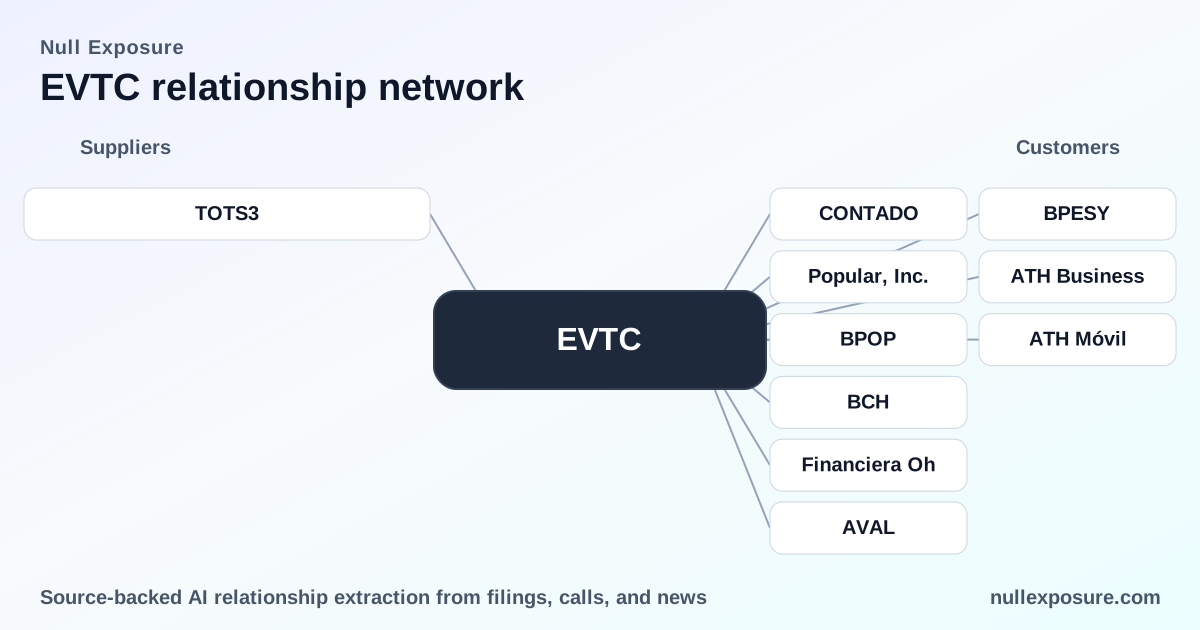
Evertec (EVTC) — supplier relationships and why the TOTVS deal matters
Evertec is a transaction-processing infrastructure company focused on Latin America and the Caribbean that monetizes through processing fees, software subscriptions, merchant acquiring margins, and value-added services tied to electronic payments. The company operates a capital-light processing network with recurring revenue characteristics, reporting roughly $932 million in trailing revenue and $262 million in EBITDA as of the latest quarter (2025-12-31). For investors evaluating supplier and partner exposure, Evertec’s growth and margin profile depend on strategic integrations and selective acquisitions that expand processing capability and product breadth. Learn more about supplier relationship intelligence and coverage at https://nullexposure.com/.
The one relationship that moves the needle right now
Evertec signed a Share Purchase Agreement to acquire Dimensa from TOTVS (TOTS3) for approximately R$950 million (about USD $181 million) — a deal announced in FY2026. This transaction is material because it represents an acquisition that expands Evertec’s product stack within Brazil, a core growth market for payments volume and software-driven merchant services. According to a TradingView report published March 9, 2026, Evertec agreed to acquire all outstanding shares of Dimensa from TOTVS for R$950 million (roughly USD $181 million).
Relationship catalog: the supplier and partner entries you need to know
TOTVS — share purchase agreement for Dimensa (FY2026)
Evertec entered a Share Purchase Agreement to acquire all outstanding shares of Dimensa from TOTVS for approximately R$950 million (about USD $181 million). According to a TradingView news report dated March 9, 2026, the deal targets software and services that will be integrated into Evertec’s Brazil operations to strengthen merchant and payments capabilities. (TradingView, 2026-03-09)
Why this TOTVS transaction matters for operations and margin
The Dimensa acquisition is a strategic bolt-on that accelerates product scope in Brazil, where scale and local software relationships drive incremental processing volume. Acquiring embedded POS/software assets is a direct route to higher take rates and stickier merchant relationships, which improves lifetime value and dilutes fixed network costs across greater volume. For operators, this transaction signals a deliberate move from pure processing toward integrated software-enabled payment services — a classic margin expansion play.
Company-level constraints and what they imply about Evertec’s operating model
There are no explicit contract constraint excerpts in the available supplier relationship records. Treating that silence as an observable company-level signal produces the following practical conclusions about Evertec’s business characteristics:
- Contracting posture — negotiated, long-duration commercial contracts. Evertec’s core processing business relies on multiyear agreements with banks, merchants and networks; the business monetizes through recurring fees and transaction volume rather than one-off sales, which creates predictable revenue but raises the importance of contract renewal and service-level performance.
- Concentration — regional concentration with diversified client types. The company’s footprint across Latin America and the Caribbean concentrates geographic exposure while diversifying across banks, retailers and fintech partners; this structure amplifies country-level regulatory and macro sensitivity while providing product-level resilience.
- Criticality — high operational criticality to customers. Payment processing is mission-critical for counterparties; outages or integration frictions produce immediate downstream revenue and reputational impacts, placing a premium on operational redundancy and vendor continuity.
- Maturity — established, cash-generative platform with strategic M&A. Evertec’s financials reflect mature margins (operating margin ~17.6%, profit margin ~15.2%) and positive free cash flow potential, enabling selective acquisitions like Dimensa to add product depth without diluting operational focus.
These company-level signals should guide counterparty diligence: prioritize service-level agreements, continuity planning, and regulatory risk mapping in the affected jurisdictions.
What this relationship changes about supplier risk and opportunity
- Risk: increased execution and integration risk in Brazil. Integrating Dimensa’s products and customer base creates execution risk and short-term costs; any failure to migrate clients or to preserve uptime would quickly impact transaction volumes and collection cadence.
- Opportunity: faster cross-sell and higher take-rates. Successfully integrating software-enabled merchant services unlocks cross-selling opportunities for value-added services (loyalty, analytics, lending referral), increasing revenue per merchant and improving margin mix.
- Regulatory view: more local footprint raises compliance requirements. Deeper operations in Brazil increase regulatory touchpoints and require robust local governance and compliance infrastructure.
These are actionable levers for investors and operators: stress-test integration plans, model incremental margin capture over a 24–36 month window, and require KPIs tied to client retention and processing volume post-close.
Read the documents and monitor the next milestones
- Monitor the completion timeline and any regulatory clearances tied to the TOTVS/Dimensa sale; those are the primary gating items to realize the strategic benefits described above.
- Watch post-close metrics: merchant retention, incremental take-rate, and processing uptime as leading indicators of integration success.
Learn more about supplier exposure analysis and ongoing monitoring at https://nullexposure.com/.
Investment implications — what investors should do now
- For investors with a multi-year horizon, the Dimensa acquisition strengthens Evertec’s product mix in a key market and supports higher recurring revenue per merchant, which justifies a strategic premium if integration proceeds on plan.
- For risk-averse holders, short-term volatility is likely around integration milestones and regulatory approval windows; position sizing should reflect execution risk.
- For operators and counterparties, insist on clear SLAs and transition plans where the acquired assets touch processing or settlement workflows.
Final recommendation: treat the TOTVS/Dimensa transaction as a value-accretive strategic step for Evertec, conditional on disciplined integration execution and regulatory clearances. For ongoing coverage and supplier relationship alerts, visit https://nullexposure.com/.