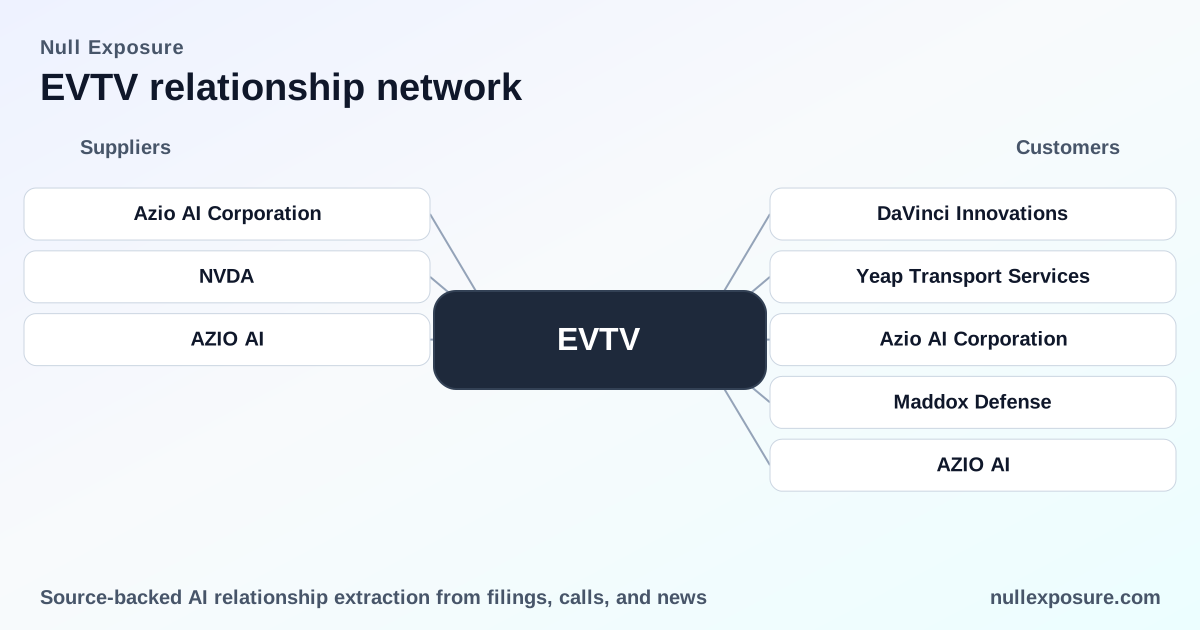
Envirotech Vehicles (EVTV) — supplier relationships, strategy implications, and near-term risk map
Envirotech Vehicles sells zero-emission electric vehicles in the U.S. and monetizes primarily through vehicle sales and distribution agreements with OEM partners and third‑party service providers; the company also sources components globally and contracts manufacturing capacity while reallocating capital toward on‑site compute infrastructure purchases disclosed in FY2026. Recent public filings and press releases show EVTV is actively purchasing AI compute hardware (ASICs and GPUs) and maintaining concentrated vendor exposure for vehicle components — a dual operating posture that combines vehicle manufacturing risk with a nascent infrastructure investment program. For a concise supplier risk feed and continuous monitoring, visit https://nullexposure.com/.
What the disclosed supplier activity actually means for investors
Envirotech is a small-cap OEM/assembler with loss-making operating economics (TTM revenue ~$3.7M, negative EBITDA). Supplier relationships drive both revenue fulfillment and capital intensity: components and manufacturing partners are critical to delivering vehicles, while new compute purchases indicate material non‑vehicle capital deployments that can change cash burn and operational priorities. Management is executing a three‑year contract manufacturing program domestically while continuing to source parts from APAC manufacturers, creating a mixed geographies and concentration profile that investors must price into valuation and liquidity assumptions.
- Key commercial takeaway: EVTV remains dependent on a small number of high‑value suppliers for inventory and has initiated strategic capital purchases in AI compute hardware that will materially affect cash needs and operational focus.
- Learn more about supplier-driven risk scoring on our homepage: https://nullexposure.com/.
Azio AI / AZIO AI — validation orders and a scalable infrastructure partnership
Envirotech placed an initial purchase order for twenty‑eight next‑generation ASIC compute systems from Azio AI as part of an infrastructure validation initiative, indicating a first‑stage deployment and vendor onboarding in FY2026. According to a PR Newswire release in March 2026, Azio AI described the order as part of a broader validation and scalability plan where Azio supplies and sells compute hardware to EVTV. A separate market note reiterated the same 28‑unit purchase and tied the announcement to a positive market reaction in February 2026. (Sources: PR Newswire, March 2026; Sahm Capital commentary, February 2026.)
Implication: This is an explicit vendor relationship for compute hardware and service validation — a new class of supplier for EVTV that introduces both technical integration risk and incremental capital commitments.
Nvidia — a large GPU order that alters revenue and capital expectations
Market coverage reported that an announced order for Nvidia GPUs was expected to bring $107 million in revenue to EVTV, a figure that materially exceeds its recent TTM revenue and would dramatically change scale if realized. The claim was published in a StocksToTrade news item in early 2026 linking EVTV’s stock move to the GPU order. (Source: StocksToTrade, FY2026 coverage.)
Implication: If validated by filings, a GPU order of that magnitude would transform EVTV’s revenue profile and capital requirements; until corporate disclosure corroborates order value and delivery terms, this announcement must be treated as a material business inflection point requiring verification.
All relationship citations and short plain-English notes
- Azio AI Corporation — Envirotech issued a purchase order for 28 next‑generation ASIC compute systems as part of an infrastructure validation initiative in FY2026, establishing Azio as a compute hardware supplier. Source: PR Newswire, March 2026.
- AZIO AI (company statement) — AZIO AI characterized its role as a supplier of compute hardware in a press release describing a scalable strategy designed for multi‑megawatt expansion with EVTV. Source: PR Newswire, March 2026.
- Azio AI Corporation (market coverage) — Independent commentary reiterated the Azio purchase order and linked the announcement to positive stock movement in February 2026. Source: Sahm Capital, February 2026.
- Nvidia — Market reports connected an announced GPU order to a projected $107M revenue impact for EVTV, a magnitude that would exceed current TTM revenues and materially alter investor expectations. Source: StocksToTrade news coverage, FY2026.
(Every item above corresponds to the relationships captured in public press and market reporting for FY2026.)
Operational constraints and what they tell you about business model posture
Envirotech’s public disclosures and filing excerpts reveal a supplier and contracting posture with the following characteristics:
- Long‑term domestic manufacturing commitment. The company documented a three‑year contract manufacturing agreement tied to its 580,000 sq. ft. Osceola, Arkansas facility, signaling a commitment to scale manufacturing capacity domestically and a move toward longer‑dated supplier contracts (company filings).
- Global sourcing with APAC manufacturing partners. Vehicles are manufactured by OEMs in China, Malaysia and the Philippines and parts are sourced globally, exposing EVTV to tariff risk and import complexity as noted in corporate disclosures.
- High supplier concentration and criticality. Inventory deposits totaled over $6.0M at year‑end 2024, with deposits to a single vendor accounting for 99% of outstanding deposits, a direct indicator of supplier concentration and critical single‑vendor risk.
- Service and lease provider relationships. The company has active lease arrangements with named providers — Alpha Bravo Charlie, Inc. for office space and SRI Professional Services for equipment leases — showing operational outsourcing of non‑manufacturing services (explicitly named in filings).
- M&A and earn‑out cash exposure. The acquisition of Maddox Industries in December 2024 included earn‑out payments up to $1M over six months, indicating contingent short‑term cash obligations tied to acquisitions (explicitly named).
- Spend profile: Most recurring smaller arrangements fall in the sub‑$100k band (e.g., equipment and office leases), while select contractual obligations and earn‑outs populate the $100k–$1M band.
These constraints paint a company‑level signal: EVTV operates at the intersection of capital‑intensive manufacturing and emergent compute infrastructure deployment, with concentrated supplier exposures and nontrivial short‑term contingent cash needs.
Risk and monitoring checklist for investors and operators
- Validate big ticket orders: Require formal filing confirmation for the Nvidia GPU order before modeling any $100M+ revenue scenarios. Market reports have made the claim; filings must corroborate delivery schedules and revenue recognition.
- Quantify supplier concentration: Reconcile the vendor representing 99% of deposits; concentration creates a single point of failure for inventory funded on deposit.
- Assess capital allocation to compute vs. vehicles: Track capex cadence for ASICs/GPUs and the depreciation or utilization plan — compute purchases change balance sheet and cash flow dynamics.
- Tariff and geographic exposure: Model tariff sensitivity given APAC OEM sourcing and cross‑border importation of parts.
- Short‑term cash obligations: Incorporate the Maddox earn‑out and lease liabilities into liquidity forecasts.
For an ongoing supplier risk score and monitoring-driven alerts tailored to these vectors, start here: https://nullexposure.com/.
Bottom line for decision‑makers
Envirotech is a small, loss‑making EV supplier that is transitioning capital into large compute purchases while remaining highly concentrated on a handful of critical suppliers for vehicle production. That combination creates asymmetric operational risk: a single large hardware supplier relationship can materially improve capability but also amplify funding and execution risk if supplier concentration or tariff exposure disrupts component flows. Investors and procurement teams must demand primary‑document confirmation of material orders, quantify counterparty concentration, and stress‑test liquidity for competing capital uses.
Final recommended actions: obtain documented confirmations of the GPU/ASIC purchase orders, require counterparty performance metrics for the vendor representing 99% of deposits, and pressure‑test cash runway assuming continued capex on compute hardware. If you want a structured supplier risk report and ongoing monitoring for EVTV, visit https://nullexposure.com/ for service options and tailored scoring.