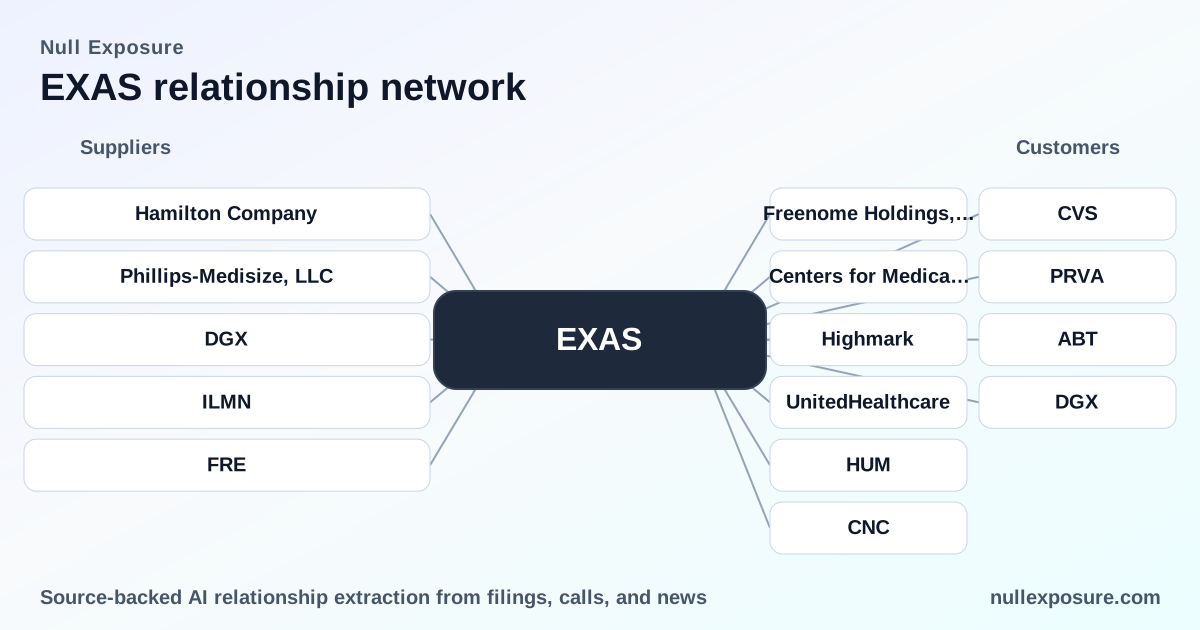
Exact Sciences (EXAS): Supplier Relationships that Drive Tests, Access and Risk
Exact Sciences builds and monetizes a vertically integrated diagnostics business by combining proprietary assays and sequencing-enabled tests with large-scale laboratory operations and outsourced manufacturing and access partnerships. The company generates revenue primarily from screening and diagnostic tests—most notably Cologuard—while pushing into multi-cancer early detection and MRD products; growth depends on maintaining laboratory throughput, reliable reagent and consumable supply, and broad patient collection access. For investors and operators, supplier relationships are strategic levers: they underwrite capacity, speed-to-market and regulatory compliance, but they also concentrate operational risk. Learn more at https://nullexposure.com/.
Operational snapshot and what matters to an investor Exact Sciences sits at the intersection of diagnostics innovation and industrial-scale lab operations. The company reported roughly $3.25 billion in trailing revenue and a large gross profit base but operates with negative net margins and significant R&D and commercialization spend, so supplier stability directly affects both revenue continuity and margin recovery. Supplier concentration on critical inputs and outsourced manufacturing is a structural feature of the operating model, not a timing anomaly.
A concise catalog of the company-level control environment Exact Sciences enforces vendor controls and incident reporting across critical third parties, with annual reviews of critical vendors and contractual cybersecurity reporting obligations for service providers. This company-level control posture signals mature vendor governance but also acknowledges that third-party incidents are a material vector for operational disruption (company filings, FY2025).
Read more about supplier risk and exposure at https://nullexposure.com/.
How these partnerships fit together and why they matter Exact’s business model strings together four operational dependencies: (1) test development and sequencing platforms, (2) consumables and lab automation, (3) kit manufacturing, and (4) patient access/collection. The supplier relationships disclosed in public filings and recent releases map neatly onto those dependencies. Below I walk through each named partner, its role, and the investment implications.
Supplier relationships (what the company has disclosed)
Hamilton Company — lab equipment and consumables
Exact states it relies on Hamilton Company to supply laboratory equipment and critical consumables such as racking and pipette tips that are necessary for clinical laboratory test execution across Cologuard and precision oncology workflows. This is a direct operational dependency: equipment and disposable consumables are mission-critical to test throughput and quality (Exact Sciences FY2025 Form 10‑K).
Phillips‑Medisize, LLC — sole-source manufacturer for Cologuard kits
Phillips‑Medisize is identified as the sole-source manufacturer for the Cologuard test kit, creating manufacturing concentration for Exact’s flagship product. Sole-source manufacturing elevates supply-chain risk and gives the supplier operational leverage over lead times and capacity scaling (Exact Sciences FY2025 Form 10‑K).
Quest Diagnostics — nationwide blood collection and access footprint
Exact has an agreement with Quest Diagnostics to enable blood collection at roughly 7,000 patient access sites across the U.S., including in-office phlebotomy and mobile at-home options; this extends patient access and reduces friction for sample collection as Exact rolls out blood-based tests like CancerGuard. Partnering with Quest materially increases distribution reach and is a commercial accelerant for new blood-based products (InvestingNews, March 2026).
Illumina — sequencing platform dependency for multiple tests
Exact discloses that its OncoExTra test is validated on Illumina’s sequencing platform and that MRD and the MCED tests launched in 2025 will similarly utilize the same platform; company commentary and recent press coverage note historical use of Illumina technologies for parts of Exact’s pipeline. This is a platform dependency for critical assay workflows, anchoring technology performance and throughput to Illumina’s instruments and reagent ecosystem (Exact Sciences FY2025 Form 10‑K; ad-hoc-news overview, March 2026).
Freenome — exclusive rights to blood‑based colon cancer screening technology
Exact announced it acquired exclusive rights to current and future versions of Freenome’s blood-based colon cancer screening tests and underlying technology, subject to regulatory approvals—an acquisition that secures IP and product roadmaps for blood-based colorectal screening and consolidates product development under Exact’s commercialization engine (Exact Sciences Q2 2025 earnings call).
What these relationships imply about contracting posture and concentration
- Contracting posture: Exact operates a mixed model of in-house lab operations plus tight, often exclusive third-party contracts (sole-source manufacturing and platform-specific validation). The company’s governance language about vendor incident reporting and annual reviews indicates a formal vendor oversight program, consistent with regulated-industry best practices (FY2025 filing).
- Concentration: Several suppliers occupy single points of failure—most notably Phillips‑Medisize for Cologuard manufacturing and Illumina for sequencing—so the company faces measurable concentration risk that can affect capacity and cost.
- Criticality: Suppliers map to non‑substitutable functions: consumables and automation (Hamilton), manufacturing (Phillips‑Medisize), sequencing (Illumina), and collection/access (Quest). These are core enablers of revenue, not peripheral vendors.
- Maturity: The presence of formal vendor reporting clauses and annual critical-vendor reviews is a sign of mature vendor governance; however, maturity in governance does not eliminate single-supplier operational or regulatory risk.
Risk vs. opportunity — what investors should model
- Upside levers: The Quest relationship materially accelerates patient access for new blood tests, reducing go-to-market friction and supporting volume ramp assumptions for MCED/MRD products. Control of Freenome technology strengthens the product pipeline and reduces dependency on external innovation partnerships.
- Downside levers: Sole-source manufacturing and platform validation constraints create outsized operational risk: supply interruptions, supplier pricing pressure, or platform performance issues would flow directly to throughput and revenue. These are not minor sensitivities; they are central to the business model.
Tactical takeaways for investors and operators
- Monitor supplier continuity indicators (capacity announcements, lead times, and contract renewals) for Phillips‑Medisize and Illumina as early warnings of margin or throughput stress.
- Validate Quest rollout metrics—collection utilization and conversion rates—because patient access is the fastest pathway to revenue realization for new blood-based products.
- Assess governance effectiveness by tracking vendor incident disclosures and remediation timelines; Exact’s contractual cybersecurity notification requirements are a positive control but require operational follow-through (company-level control signal, FY2025).
If you want deeper supplier-level intelligence and monitoring for EXAS, explore coverage and alerts at https://nullexposure.com/.
Conclusion and action items Exact Sciences has structured its commercial expansion on a hybrid model of proprietary assays plus strategic supplier partnerships that enable scale. These relationships are mission-critical: they accelerate market access and innovation while concentrating operational risk around a handful of suppliers. For investment models, treat supplier capacity and platform validation as financial levers—imbalances will show up quickly in throughput and margins.
For ongoing intelligence and supplier exposure tracking, visit https://nullexposure.com/ for tailored research and alerts.