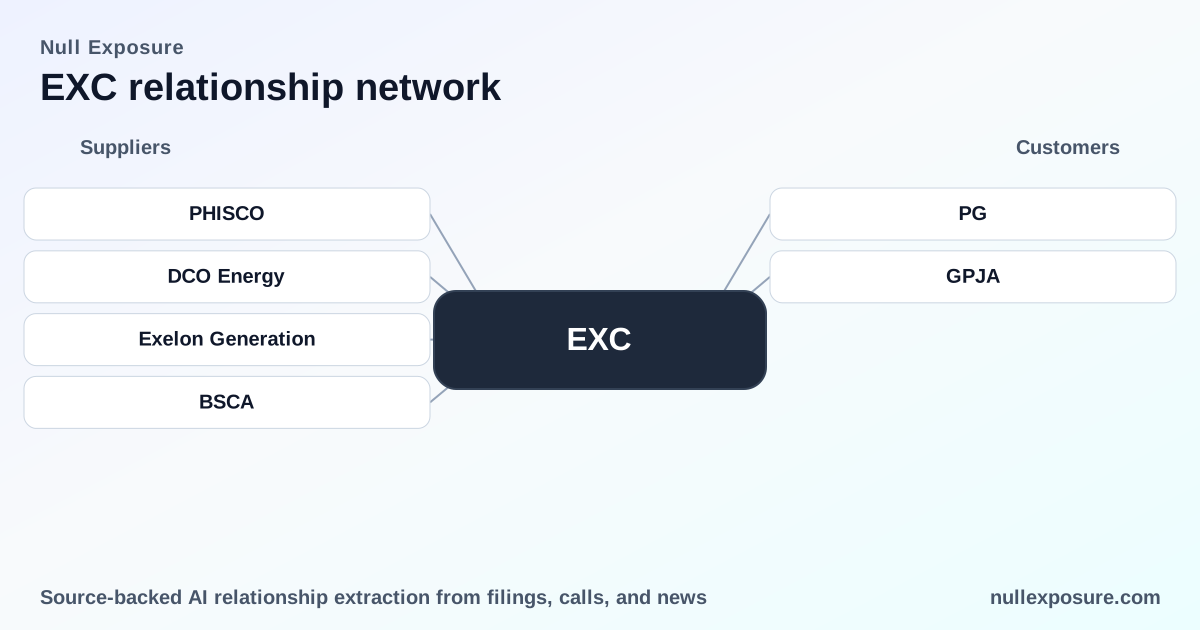
Exelon (EXC): Supplier posture, counterparties, and what investors should price in
Exelon operates and monetizes through a two‑pillar utility and generation model: regulated electric utilities that collect rate‑based cash flows, and a generation/wholesale business that captures margins in commodity markets and through long‑dated hedges and contracts. The company anchors cash generation in regulated utilities while layering merchant exposures and contractual hedges in generation and renewable procurement; corporate support functions and third‑party service relationships reduce operating friction but concentrate operational risk. Investors should evaluate counterparties for operational criticality, contract tenor, and the firm‑level commitment scale that sits on the balance sheet.
For a quick exploration of Exelon’s supplier relationships and their investor implications, visit the Null Exposure homepage: https://nullexposure.com/
Supplier map: a concise investor view
Exelon’s supplier footprint in the filings mixes internal affiliates that provide shared services and external firms that provided engineering, construction, or minority investments in generation projects. Key themes: long‑term hedging and renewable commitments, centralized procurement for utilities, and reliance on corporate support vendors that provide legal, HR, IT and supply management services. The relationships in public disclosures fall into two categories: internal service providers (high operational criticality) and project contractors/equity partners (limited operational scale but relevant to asset performance).
PHISCO — corporate support for Pepco, DPL, ACE
PHISCO delivers corporate support services to Pepco, DPL, and ACE within the Exelon group, which places it squarely in the internal service provider category; these services are operationally important to those utilities. According to Exelon’s 2025 Form 10‑K, “Pepco, DPL, and ACE also receive corporate support services from PHISCO.” (Exelon 2025 Form 10‑K)
Takeaway: PHISCO is an internal supplier whose continuity affects multiple utility subsidiaries’ operations.
BSC (BSCA) — corporate services and shared functions
Exelon Corporate receives a range of legal, HR, finance, IT, and supply management services from BSC, a centralized provider of corporate support functions, per the company’s 2025 Form 10‑K. The filing states Exelon Corporate “receives a variety of corporate support services from BSC, including legal, human resources, financial, information technology, and supply management services.” (Exelon 2025 Form 10‑K)
Takeaway: BSC is an essential shared‑services node; disruptions would create cross‑subsidiary operational friction and remediation costs.
DCO Energy — EPC contractor and minority owner in a renewable plant
A Constellation press release describing a partnership for a 50 MW renewable project notes that DCO Energy provided engineering, procurement and construction services and holds a small equity stake in the plant. The release states, “DCO Energy, which provided engineering, procurement and construction services, holds a small stake in the plant.” (Constellation Energy press release, 2017)
Takeaway: DCO’s role is project‑level: contractor plus minority investor in an asset where construction and performance risk are concentrated, not an ongoing corporate services dependency.
Exelon Generation — plant operator for a joint renewable facility
Constellation’s announcement also reports that an Exelon Generation affiliate “operates and maintains the plant, employing approximately 35 people,” placing Exelon Generation in the operator role for that facility. (Constellation Energy press release, 2017)
Takeaway: Exelon Generation is the operator for the project and carries the day‑to‑day operational responsibility and staff risk for asset performance.
What the company‑level constraints tell investors
The 2025 10‑K disclosures and related evidence establish clear company‑level operating constraints that shape supplier exposure and counterparty strategy:
-
Contracting posture and tenor: Exelon runs a mix of long‑term and shorter‑term contracts. The filings document 20‑year floating‑to‑fixed renewable energy swap contracts and long‑term renewable and REC commitments, signaling multidecade counterparty exposure and hedge accounting that creates long‑duration balance‑sheet items. The 10‑K includes detailed tables summarizing long‑term renewable and REC commitments as of year‑end 2025. (Exelon 2025 Form 10‑K)
-
Shorter‑term and spot procurement: For gas and merchant purchases, some utility subsidiaries purchase natural gas on terms not exceeding three years and also source electricity from PJM markets or approved bidders, indicating a layered procurement approach that blends long‑dated hedges with short‑term and spot market exposure. (Exelon 2025 Form 10‑K)
-
Financial scale and spend concentration: The registrants disclose liability balances in the hundreds of millions (the balance of the liability was $670 million as of December 31, 2025), which signals meaningful balance‑sheet commitments tied to hedges and other contractual obligations. (Exelon 2025 Form 10‑K)
-
Operational criticality and third‑party management: The company runs a centralized third‑party security team (CISS) to manage cybersecurity risks for vendors and evaluates providers through security assessments, contractual controls, and training — cybersecurity is explicitly flagged as a material operational risk that could affect results if realized. The 10‑K’s risk factors explain that cybersecurity threats could materially affect operations and financial condition. (Exelon 2025 Form 10‑K)
-
Relationship roles and stage: Disclosures classify suppliers both as buyers (procurement function) and service providers, with relationships characterized as active and managed under established policies for commodity hedging and vendor security. (Exelon 2025 Form 10‑K)
Collectively, these constraints indicate a mature, centralized procurement model with material long‑dated commitments and active operational dependency on internal shared‑services suppliers.
For practitioners tracking counterparty risk across Exelon’s supplier set, Null Exposure provides structured insight and monitoring tools — see https://nullexposure.com/
Investor implications: risk, concentration, and optionality
-
Counterparty risk is concentrated in internal providers. BSC and PHISCO are shared‑services suppliers; investors should treat failures or contract disputes with these entities as operationally broad and expensive to remediate. Operational continuity risk here is high.
-
Market and contract risk is long‑dated. Multi‑decade swaps and REC commitments create legacy exposures that lock in cash‑flow profiles and hedge accounting treatments; investors must price in the potential for mark‑to‑market volatility and regulatory interactions that change economics.
-
Project‑level suppliers are less systemic but operationally relevant. DCO Energy’s EPC role and Exelon Generation’s operator role in the referenced renewable plant concentrate construction and performance risk at the asset level rather than the enterprise level.
-
Cybersecurity and third‑party controls are firm‑level criticalities. Exelon’s articulated governance (CISS, vendor security assessments, contractual terms) is robust on paper; however, the 10‑K explicitly lists cybersecurity as a material risk, which elevates the importance of vendor controls across both internal and external suppliers.
Closing view and next steps for investors
Exelon’s supplier relationships reflect a dual‑track business model: internalized shared services that create operational concentration and external project contractors that carry discrete asset risk. Investors should underwrite both the longevity of long‑term commitments and the fragility of shared‑services dependencies when modeling downside scenarios.
For ongoing monitoring and a deeper supplier‑risk feed tailored to Exelon and its peers, explore Null Exposure’s platform: https://nullexposure.com/
Final takeaway: price Exelon for durable regulated cash flows, but also for material long‑dated contractual exposures and centralized operational counterparty risk.