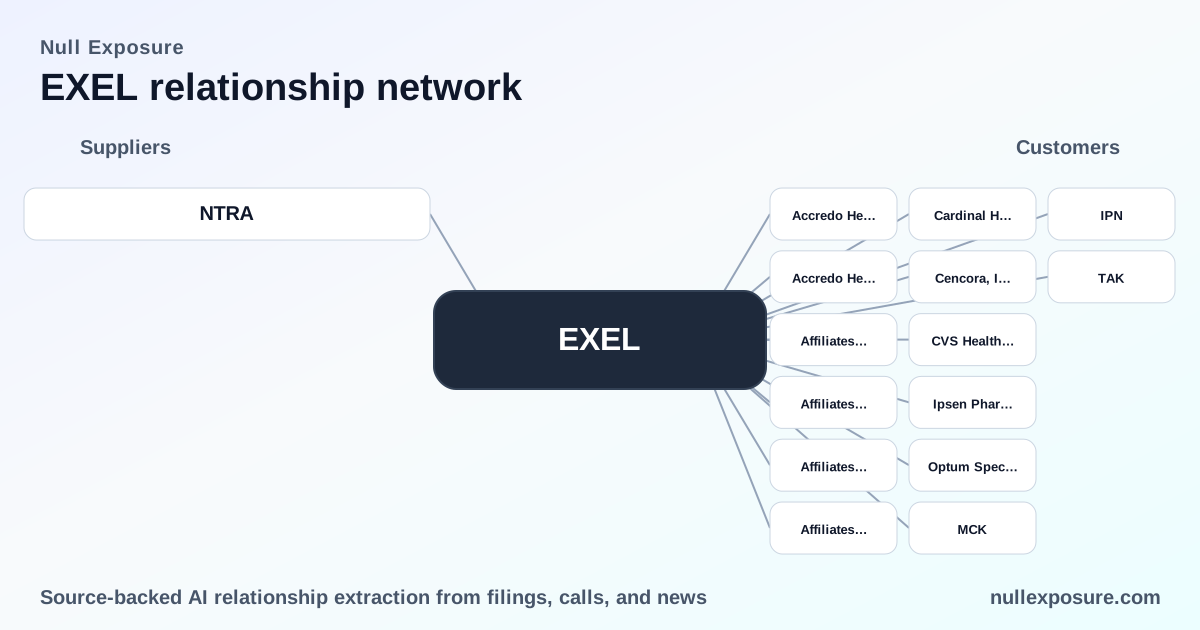
Exelixis (EXEL) — supplier relationships, operational constraints, and what investors should price in
Exelixis is an oncology-focused biopharma that discovers, develops and commercializes cancer therapeutics and monetizes through product sales, collaboration revenue and milestone/royalty streams tied to its pipeline assets. The company’s financial profile—roughly $2.32 billion in trailing revenue, a market capitalization near $11.0 billion, and mid‑teens reported P/E—reflects a commercial-stage biotech that scales by pushing clinical-stage assets to launch while outsourcing manufacturing and some operational functions. For investors evaluating EXEL as a supplier relationship counterparty, the interactions with diagnostic and manufacturing partners are central to both near-term commercialization plans (notably zanzalintinib) and long‑term margin stability. For a broader look at supply-side exposures and counterparty intelligence, visit https://nullexposure.com/.
Why supplier relationships matter for Exelixis’ commercial trajectory
Exelixis runs a capital‑efficient model: it retains R&D and commercial leadership while outsourcing GMP manufacturing, clinical assay work and selected services. That posture accelerates development timelines and limits fixed capital, but it also concentrates operational risk on a small set of third‑party providers. The company’s lease commitments and purchase obligations signal meaningful contracted spend that underpins manufacturing and facilities continuity—an important input when pricing operational risk into an equity valuation.
Key takeaway: Exelixis’ growth and margin profile are functionally tied to the performance and reliability of third‑party manufacturers and service providers—counterparties that are both strategic and financially material.
Detailed relationship breakdown — everything found in the record
- A PharmiWeb press release (FY2026) indicates that Natera will provide its Signatera™ assay to identify MRD+ patients for trial enrollment, supporting Exelixis’ zanzalintinib clinical programs. This links Exelixis’ trial execution and patient selection to a commercial molecular assay provider (PharmiWeb press release, February 2026).
- An Intellectia.ai analysis (FY2026) notes that Exelixis collaborates with Natera for clinical trials of zanzalintinib, alongside established commercialization partners such as Takeda and Ipsen in Japan, implying a layered partner model for both research and geographic distribution (Intellectia.ai, March 2026).
- An investor commentary from Sahm Capital (January 22, 2026) emphasizes that zanzalintinib’s expected first commercial availability in 2026 is supported by a new collaboration with Natera, placing diagnostic partnership activity squarely on the near‑term commercialization path (Sahm Capital analysis, January 2026).
Each of these items points to the same counterparty—Natera—but from different informational angles: trial assay capability (patient identification), program-level collaboration for clinical execution, and explicit support for commercial rollout timing.
Operational constraints and what they imply for supplier risk
Exelixis’ public disclosures and the relationship signals together paint a clear operating posture:
- Exelixis does not operate its own GMP manufacturing for key drug substance and drug product activities and instead relies on third‑party contract manufacturing organizations (CMOs) to conduct clinical and commercial production. This is a company‑level fact derived from corporate manufacturing disclosures.
- The company carries purchase obligations and lease commitments—$61.7 million due within one year for purchase obligations plus material longer‑term lease payments (notes showing roughly $28.5 million due in one year and $230.7 million over remaining lease terms as of December 31, 2025). Those figures indicate fixed contractual spend that constrains operational flexibility and creates a floor for supplier dependency.
- Relationship roles identified in disclosures include both manufacturer and service provider, and Exelixis reports ongoing monitoring of third‑party manufacturers to ensure compliance and capacity. That monitoring indicates the relationships are active and operationally critical, not dormant or purely advisory.
- Spend‑band signals categorize supplier commitments in the $10M–$100M and $100M+ bands, which means counterparty performance is financially meaningful to Exelixis’ cost base and product supply continuity.
Implication: Investors should treat Exelixis’ supplier network as operationally critical and financially material; disruptions or capacity shortfalls at major CMOs or diagnostic partners would directly affect launch timing, revenue recognition and margin trajectories.
Market implications and investor action points
Exelixis’ revenue base and margins are strong for an oncology biopharma (gross profit margin and operating margin materially positive), and the market is pricing a growth story that includes near‑term zanzalintinib commercialization. Supplier relationships with entities like Natera introduce two observable investment levers:
- Upside lever: Successful diagnostics collaboration speeds enrollment, shortens time‑to‑market, and improves label efficiency, enhancing peak sales potential and margin scalability.
- Downside lever: Manufacturing or contract performance disruptions create launch delays or inventory constraints, with immediate top‑line and multiple compression implications given the concentrated spend profile.
From a valuation standpoint, Exelixis trades on mid‑teens forward P/E and EV/EBITDA multiples consistent with a commercial oncology player with growth and execution catalysts. Investors should weight partner operational due diligence—contract lengths, redundancy clauses, and capacity commitments—alongside clinical readouts and regulatory milestones.
If you want a deeper supplier risk playbook or a counterparty heat map for EXEL, see the intelligence available at https://nullexposure.com/.
How to act on this signal set
- Underwrite launch revenue scenarios with sensitivity to a 3–6 month manufacturing disruption and a separate sensitivity for enrollment pace driven by diagnostic availability.
- Monitor counterparties’ public disclosures and capacity statements; any shift in purchase obligations or lease profiles would change fixed‑cost leverage and supplier dependency.
- Track clinical enrollment rates and the timing of diagnostic integration (Signatera™ usage) as a near‑term operational indicator for zanzalintinib commercialization.
For a concise supplier risk assessment tied to EXEL’s commercial timeline and financials, visit https://nullexposure.com/ and request the supplier exposure brief.
Bottom line
Exelixis operates a partnership‑centric, capital‑light model that translates scientific assets into commercial revenue through external manufacturing and diagnostic partnerships. That model compresses capital intensity and accelerates time to market, but it also concentrates operational risk on third‑party CMOs and service providers—relationships large enough to move the P&L. Investors should price in both the upside from faster, better‑targeted enrollments via diagnostic partners and the downside from supplier interruptions given the company’s contractual spend footprint.