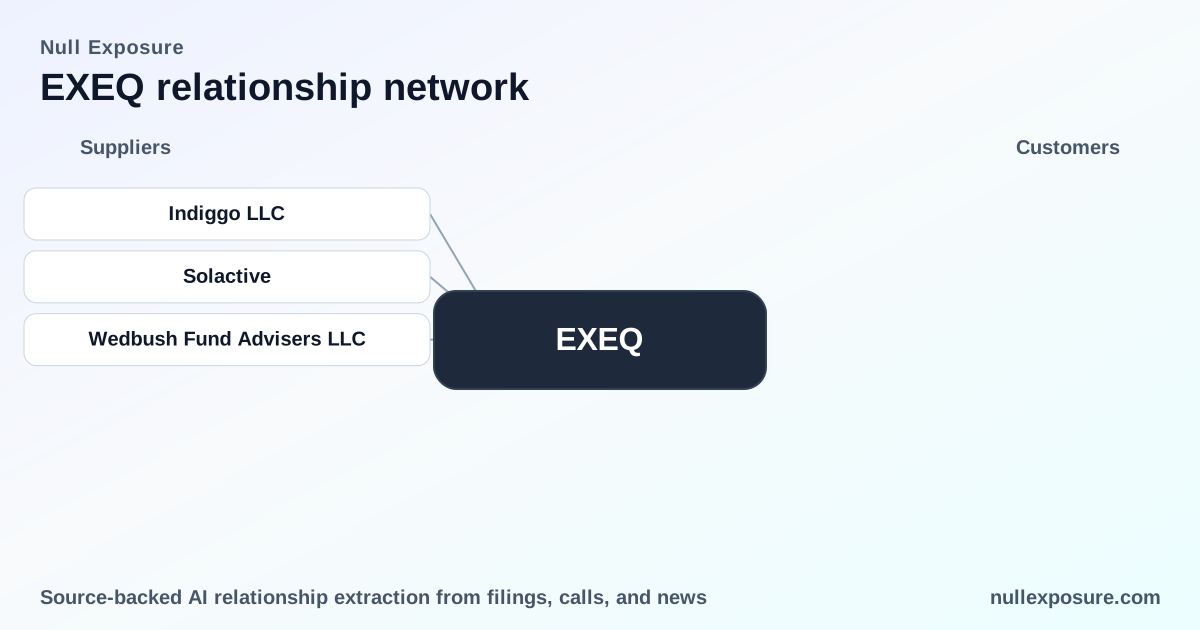
EXEQ supplier map: the three partners powering Wedbush’s ReturnOnLeadership ETF
Thesis — EXEQ is a rules-based ETF launched under the Wedbush Series Trust umbrella that monetizes through fund management and operational fees by packaging a proprietary leadership quality strategy into an exchange-traded product. The product combines intellectual property from a boutique strategy developer, a licensed benchmark from an index provider, and Wedbush’s distribution and trustee infrastructure; investors evaluate EXEQ by assessing those supplier relationships for concentration, operational criticality, and commercialization capability.
Explore the full profile and supplier intelligence at https://nullexposure.com/.
Why supplier mapping matters for an ETF like EXEQ The commercial performance and operational resilience of an ETF are a direct function of its supplier set. EXEQ’s structure places outsized importance on a small number of external partners: a strategy owner that defines stock selection, an index provider that operationalizes those rules into tradable constituents, and the asset manager/issuer that runs the fund and interfaces with market makers and custodians. For investors and operators, that translates into a short supplier list where each relationship is operationally critical and commercially material to the product’s success.
Key takeaway: a compact supplier set means higher concentration risk but faster decision paths and clearer accountability.
Supplier relationships (covered exhaustively) Below are the relationships surfaced in public coverage for EXEQ. Each relationship is summarized in plain English and paired with the original reporting.
-
Indiggo LLC — Wedbush partnered with Indiggo as the strategy architect for the ETF. Indiggo supplies the leadership-quality methodology that selects the top 50 U.S. large-cap companies for the fund’s exposure. According to ETFGI’s report on the launch (Feb 2026), Wedbush Fund Advisers LLC partnered with Indiggo LLC to create the Wedbush ReturnOnLeadership® U.S. Large‑Cap ETF (EXEQ). Source: ETFGI (Feb 2026) — https://etfgi.com/news/stories/2026/02/wedbush-launches-core-etf-partnership-indiggo-making-corporate-leadership
-
Solactive — Solactive provides the licensed index that EXEQ tracks and converts Indiggo’s leadership signals into a rules-based, tradable benchmark. Reporting describes the ETF as tracking the Solactive Indiggo ReturnOnLeadership® US Large‑Cap Index, which operationalizes leadership dimensions into selection and weighting rules. Source: Benzinga coverage of the launch (Feb 2026) and ETFGI (Feb 2026) — https://www.benzinga.com/etfs/new-etfs/26/02/50625350/ai-picks-the-bosses-wedbushs-new-exeq-etf-bets-on-corporate-leadership-to-beat-the-market and https://etfgi.com/news/stories/2026/02/wedbush-launches-core-etf-partnership-indiggo-making-corporate-leadership
-
Wedbush Fund Advisers LLC — Wedbush Fund Advisers is the advisor/issuer behind the Wedbush Series Trust vehicle that launched EXEQ, responsible for fund governance, distribution, and the commercial interface with investors. Public launch notices frame the ETF as a Wedbush vehicle launched in partnership with Indiggo and tracking Solactive’s index. Source: ETFGI (Feb 2026) — https://etfgi.com/news/stories/2026/02/wedbush-launches-core-etf-partnership-indiggo-making-corporate-leadership
Operating-model signals and company-level constraints The data payload contains no formal constraints or contractual excerpts. Treat that absence as a company-level signal: no supplier constraints were published alongside launch coverage, which is consistent with a recently introduced product that has not yet accumulated public regulatory filings or long-form provider agreements available in the press record.
From the relationship map we can state several company-level operating characteristics with confidence:
- Contracting posture: outsourced strategy and index licensing with in-house fund issuance, the standard ETF model that allocates intellectual property and index maintenance to third parties while centralizing distribution and compliance at the issuer.
- Concentration: high — three named counterparties are the fulcrum for investment selection, indexing, and fund operations; each relationship is singularly important to product continuity.
- Criticality: index and strategy partners are operationally critical because the product’s investable universe and rebalancing depend on externally defined rules and data.
- Maturity: early-stage — press reports date the launch to FY2026 and the trust financials do not present material operating metrics, implying an immature product lifecycle where AUM, liquidity, and fee economics remain to be established.
A practical implication: with an early-stage ETF and a compact supplier list, investors should monitor supplier performance and contractual protections closely as the fund scales.
Middle-of-article action: assess supplier docs at the outset For immediate due diligence, review Solactive’s index rulebook and the Indiggo methodology statement, then confirm Wedbush’s adviser disclosures. Start that review at https://nullexposure.com/.
Commercial and risk implications for investors and operators
- Concentration risk is the dominant structural exposure. If Indiggo and Solactive are the sole sources of the selection rules and index maintenance, any change in their licensing, methodology, or data inputs will drive portfolio composition changes and potential tracking disruption.
- Operational dependency on index governance. Index providers control rebalancing windows, corporate action treatments, and data quality—functions that directly affect execution costs and turnover.
- Distribution and liquidity are issuer-dependent. Wedbush’s capability to seed and market the fund determines the ETF’s ability to attract AUM and establish tight spreads; early-stage funds typically require active sponsor support to reach scale.
- Regulatory and contractual transparency is limited in press coverage. That places premium value on reviewing formal filings and the index/adviser agreements before making allocation decisions.
Actionable next steps for investors and operations teams
- Request and read the Solactive Indiggo ReturnOnLeadership® index rulebook and rebalancing calendar.
- Obtain Indiggo’s published methodology and any back-test or live-performance materials it offers.
- Review Wedbush Fund Advisers’ prospectus, adviser agreement, and any service agreements for fee structure and termination rights.
- Track initial AUM, creation/redemption activity, and bid/ask spreads over the first 90 days as leading indicators of market adoption.
Final CTA: for deeper supplier intelligence and monitoring of EXEQ relationships, visit https://nullexposure.com/ and subscribe to watchlist alerts, document captures, and curated relationship analysis.
Bottom line: EXEQ combines a boutique strategy owner, a third‑party index engine, and a traditional issuer model. That configuration can deliver differentiated exposure quickly, but it concentrates execution and governance risk into a few counterparties — a tradeoff investors should quantify before allocating capital.