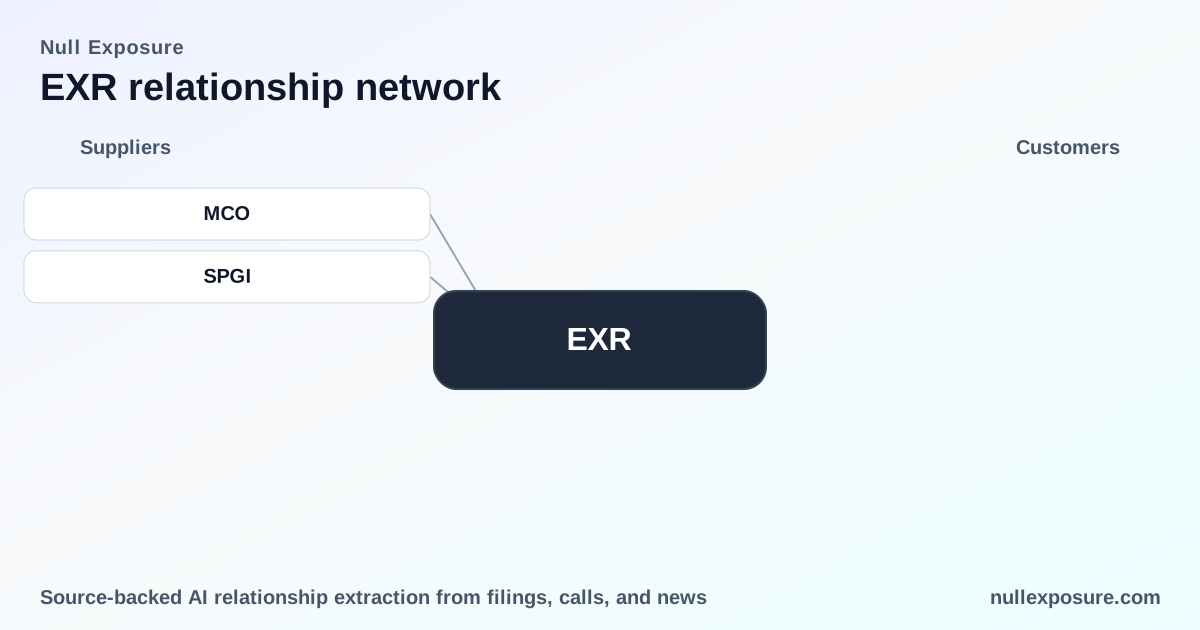
Extra Space Storage (EXR): Supplier relationships, credit posture, and what operators and investors should watch
Extra Space Storage operates and monetizes a portfolio of self-storage real estate, generating recurring cash flow from lease revenue, ancillary services, and fee-based offerings while distributing a large portion of net income through the REIT dividend model. The company’s operating model is cash-flow focused, capital-intensive, and levered to access to public and private credit markets; credit counterparties therefore function as critical suppliers of capital rather than traditional input vendors. For upstream due diligence and ongoing monitoring, see NullExposure for structured supplier intelligence: https://nullexposure.com/
How the company makes money is straightforward: own and manage storage properties, optimize occupancy and pricing, control operating expenses, and recycle capital through acquisitions and dispositions. Extra Space’s scale, operating margins, and payout policy convert real estate cash flows into a predictable income stream for shareholders. According to company disclosures through fiscal 2025, EXR reported roughly $3.45B in revenue (TTM) and $2.27B in EBITDA, with a market capitalization around $30.9B and a dividend yield of about 4.6%, underscoring the REIT’s cash-return orientation.
The revenue engine and contracting posture investors need to understand
Extra Space’s commercial posture is that of a long-duration, asset-backed operator. Contracts with customers are short-term (monthly leases) but the company’s economics are durable because of scale, marketing reach, and portfolio diversification. From a supplier and capital perspective:
- Capital suppliers (banks, bond investors, ratings agencies) are effectively the most significant counterparties because they set borrowing costs and covenant frameworks that determine growth and capital return flexibility.
- Concentration risk is managerial rather than vendor-driven: tenant churn and regional demand cycles matter, but supplier concentration (single-vendor dependency) is low for property-level operations.
- Criticality is high for credit relationships—ratings and credit lines materially influence transaction pace and cost of capital.
- Maturity of relationships is strong: as a large public REIT with investment-grade ratings, EXR has established, ongoing relations with major credit intermediaries.
These characteristics explain why market participants treat the company’s credit counterparties as suppliers: they influence financing terms, dividend sustainability, and acquisition capacity.
What the data says about EXR’s supplier relationships
Below I cover every supplier relationship captured in the results feed and what each means for operators and investors.
Moody’s: investment-grade affirmation and balance-sheet signal
Moody’s holds a Baa2 rating on Extra Space Storage, which communicates investment-grade credit quality and supports lower cost of borrowing relative to high-yield peers; this rating underpins EXR’s access to capital for acquisitions and portfolio refinancing. A March 9, 2026 news report summarized the ratings position, citing Moody’s Baa2 as evidence of balance-sheet stability. (Source: Bitget, March 9, 2026.)
S&P Global: BBB+ grade that corroborates market access
S&P Global assigns EXR a BBB+ rating, reinforcing the investment-grade narrative and corroborating S&P’s view on the company’s credit profile and liquidity position; this grade helps maintain broad institutional demand for EXR debt and supports favorable relative pricing. The same March 9, 2026 news report referenced S&P’s BBB+ assessment as a complementary signal to Moody’s. (Source: Bitget, March 9, 2026.)
Constraints and supplier risk signals at the company level
The feed contains no explicit supplier constraints flagged for EXR. That absence is itself a signal: no captured constraints implies no immediate, documentable supplier-side interruptions or covenant-triggered limitations were present in the monitored sources at the time of capture. Treat this as a company-level signal rather than an assurance—ratings agency coverage remains the dominant external influence on EXR’s contracting latitude.
From the operating model perspective, these points follow:
- Contracting posture: Conservative and credit-aware. Investment-grade ratings indicate management operates within metrics that preserve market access and financing optionality.
- Concentration: Supplier concentration is low; capital-supplier concentration matters more, but investment-grade ratings diversify funding channels.
- Criticality: Capital counterparties are critical—ratings upgrades or downgrades will have outsized operational impact.
- Maturity: Relationships with ratings agencies and lenders are mature and ongoing, consistent with a large public REIT.
What investors and operators should do with this information
Extra Space’s supplier landscape is dominated by credit-market counterparties. That leads to specific, actionable priorities:
- For investors: monitor ratings actions and debt issuance terms as part of core monitoring; shifts in Baa2/BBB+ status will directly affect funding costs and distribution policy. Track occupancy/margin trends that feed ratings metrics—net operating income and leverage trends matter more than short-term revenue variability.
- For operators and partners: treat financing counterparties as strategic suppliers; maintain transparent covenant compliance, stress-test cash flows for downturn scenarios, and prioritize liquidity buffers.
- For prospective counterparties (lenders, joint-venture partners): incorporate the company’s scale, EBITDA margin (~44.5% operating margin TTM) and dividend commitments into credit models; investment-grade ratings reduce but do not eliminate refinancing risk in stressed markets.
If you want structured monitoring of EXR’s supplier and credit counterparties, NullExposure curates this coverage and provides alerts: https://nullexposure.com/
Final read and recommended actions
Extra Space Storage operates a capital-sensitive business that monetizes through recurring storage revenue and disciplined capital recycling. The most consequential supplier relationships are with credit-market participants—ratings agencies and lenders—because they shape the cost and availability of capital. The feed captures two such relationships: Moody’s (Baa2) and S&P Global (BBB+), both affirming an investment-grade profile as of March 2026 (source: Bitget, March 9, 2026). Given the absence of documented supplier constraints in the monitored sources, focus diligence on credit metrics, dividend coverage, and operational cash flow to assess ongoing supplier risk.
For proactive monitoring, analytic workflows, and ongoing supplier-risk intelligence on EXR and comparable REITs, visit NullExposure and set alerts to track ratings movement and funding activity: https://nullexposure.com/