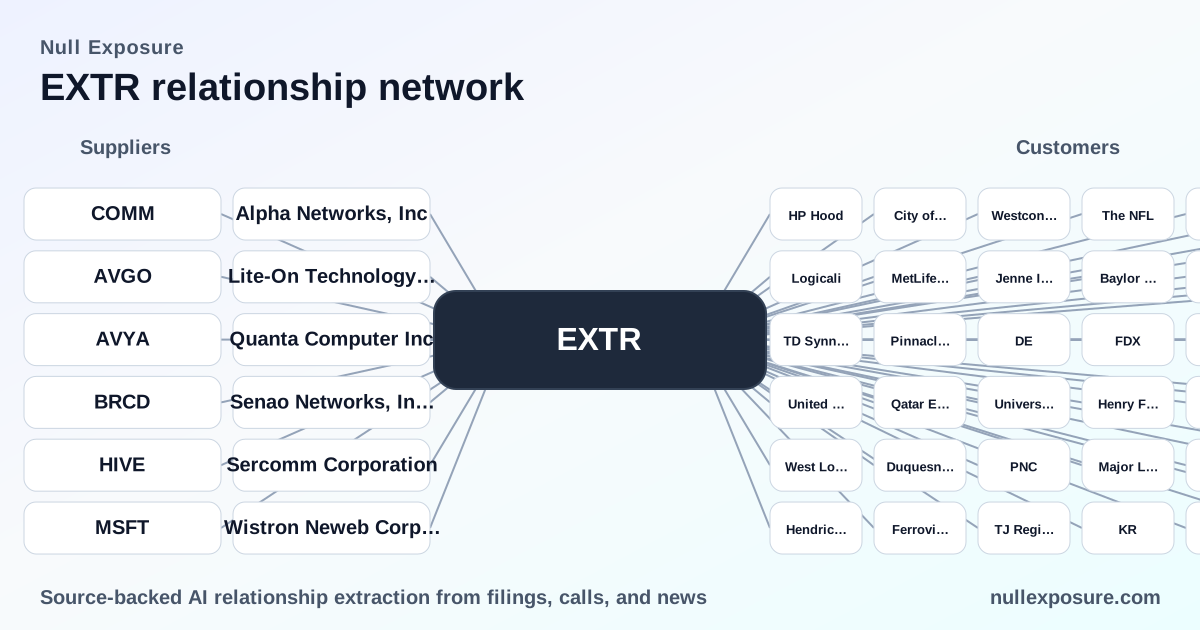
Extreme Networks (EXTR): Supplier Map, Manufacturing Risks, and Strategic Partners
Extreme Networks sells software-driven networking hardware and cloud-managed software to enterprise and service-provider customers and monetizes through equipment sales, recurring software subscriptions, maintenance contracts, and professional services. The company outsources manufacturing to contract partners in APAC while capturing software and services margin on top of that hardware base, creating a capital-light manufacturing footprint but concentrated supplier exposure. Learn more about supplier signals and relationship intelligence at https://nullexposure.com/.
Why suppliers matter for investors: revenue drivers vs. supply risk
Extreme’s product stack — switches, Wi‑Fi access points, and cloud management — relies on third-party fabrication and commodity components for cost structure and time-to-market. Gross margin dynamics tie directly to component sourcing and contract manufacturing arrangements, while recurring revenue from software and subscriptions supports higher operating leverage. The FY2025 filing discloses non-cancelable inventory purchase commitments of $45.4 million that will be consumed in fiscal 2026, which places supplier spend squarely in the $10m–$100m band and signals meaningful but manageable procurement exposure.
- Contracting posture: The company uses both long‑term and short‑term contractual arrangements—leases range from one to ten years, while short-term leases (<12 months) are not capitalized—indicating flexibility in facilities and equipment commitments.
- Geographic concentration: Contract manufacturers are located in Taiwan, Vietnam, and the Philippines, creating an APAC-centric manufacturing footprint.
- Role and stage: The relationships are predominantly manufacturing partners and are described as active, with partners procuring components on Extreme’s demand forecasts.
For a full picture of suppliers and to cross-reference filings and news, visit https://nullexposure.com/.
The manufacturing and partner roster disclosed in FY2025 and recent coverage
Below are every relationship referenced in the available results with concise, plain‑English summaries and source notes.
Alpha Networks, Inc
Extreme lists Alpha Networks among its primary contract manufacturers that build its products, confirming Alpha’s role in the company’s global supply chain. According to Extreme’s FY2025 10‑K, Alpha Networks is named explicitly as a manufacturing partner (FY2025 10‑K).
Lite‑On Technology Corp
Lite‑On is identified in the FY2025 filing as one of several contract manufacturers relied on to assemble Extreme’s hardware, indicating component and assembly responsibilities in the APAC footprint (FY2025 10‑K).
Quanta Computer Inc
Quanta Computer is included in the FY2025 disclosure as a manufacturing partner, which places Quanta in the set of external suppliers that execute production based on Extreme’s demand forecasts (FY2025 10‑K).
Senao Networks, Inc.
Senao Networks is named in the company’s 10‑K as a contract manufacturer, reflecting the multi‑partner approach Extreme uses to diversify fabrication and production capacity (FY2025 10‑K).
Sercomm Corporation
Sercomm appears in the FY2025 filing as a manufacturing partner, contributing to the company’s broad base of APAC manufacturing relationships (FY2025 10‑K).
Wistron Neweb Corporation
Wistron Neweb is listed among the contract manufacturers in the FY2025 10‑K, reinforcing that Extreme uses multiple suppliers across Taiwan, Vietnam, and the Philippines to meet production needs (FY2025 10‑K).
CommScope (Ruckus — rumored acquisition)
Industry reporting in March 2026 indicates Extreme is looking at purchasing CommScope’s enterprise networking division, Ruckus, which would materially expand Extreme’s portfolio and potentially change its supplier footprint and channel relationships (SDxCentral, Mar 2026).
Broadcom (component sourcing)
Earnings‑call coverage notes that Extreme identified and qualified a new source of DDR4 memory chips that Broadcom had already qualified, demonstrating active component sourcing work and supply‑chain substitutions to maintain production (InsiderMonkey transcript and Investing.com earnings transcript, Mar 2026).
Avaya (historical acquisition context)
Reporting on the Ruckus rumor reiterated that Extreme previously acquired Avaya’s networking business, which is relevant context for how Extreme integrates legacy product lines and supplier relationships after acquisitions (SDxCentral, Mar 2026).
Brocade (historical deal)
Coverage notes the 2017 acquisition of Brocade’s data‑center networking business for $55 million, underscoring Extreme’s history of inorganic expansion that alters supplier and product mixes (SDxCentral, Mar 2026).
Aerohive (acquisition precedent)
The Aerohive acquisition in 2019 for $272 million is cited as the company’s last major enterprise‑networking acquisition prior to the Ruckus rumor, a precedent for how Extreme scales through M&A (SDxCentral, Mar 2026).
Microsoft (third‑party integrations)
CRN reporting describes Extreme integrating products from third‑party vendors, including Microsoft, especially around AI enhancements to simplify network management—illustrating software and platform partnerships that complement hardware supply chains (CRN, 2025).
Constraints and what they imply about operating model health
The filing and coverage produce several actionable operating signals that investors should treat as company‑level constraints rather than attributes of any single supplier.
- Contract duration mix: Leases range from short terms to ten years, meaning Extreme balances long‑term facility commitments with the flexibility of short leases. This reduces fixed overhead risk while allowing scale.
- APAC manufacturing concentration: With contract manufacturers in Taiwan, Vietnam, and the Philippines, geopolitical or logistics disruptions in APAC would materially affect production lead times and cost.
- Manufacturer role: Partners procure components per Extreme forecasts, which shifts inventory risk into the manufacturing pipeline and requires accurate demand planning.
- Spend profile: Non‑cancelable purchase commitments of $45.4 million place near‑term supplier spend in the $10m–$100m band — material enough to constrain replacement sourcing but not so large as to create single‑supplier lock‑in.
- Relationship maturity: Described as active with non‑cancelable commitments, indicating existing, operational supplier contracts rather than nascent or exploratory arrangements.
Investment implications and next steps
Key takeaway: Extreme operates a lean manufacturing posture that preserves software recurring revenue upside but concentrates execution risk in a handful of APAC contract manufacturers and component suppliers. Component swaps (e.g., DDR4 sourcing tied to Broadcom‑qualified parts) demonstrate active supply‑chain management, while potential M&A (Ruckus/CommScope) could reset supplier composition and broaden channel exposure.
If you evaluate supplier risk for portfolio positioning or operations due diligence, use the supplier disclosures and recent market coverage as a starting point and monitor changes from potential M&A or supply‑chain disruptions. For a deeper supplier risk report and cross‑document correlation, visit https://nullexposure.com/.
For an investor‑grade supply‑risk brief tailored to EXTR — including payment terms, concentrated vendors, and change‑of‑control effects from M&A — explore our research hub at https://nullexposure.com/.
Final call to action: run a consolidated supplier exposure scan and track any announced acquisitions or component shortages at https://nullexposure.com/ to maintain an edge in portfolio risk assessment.