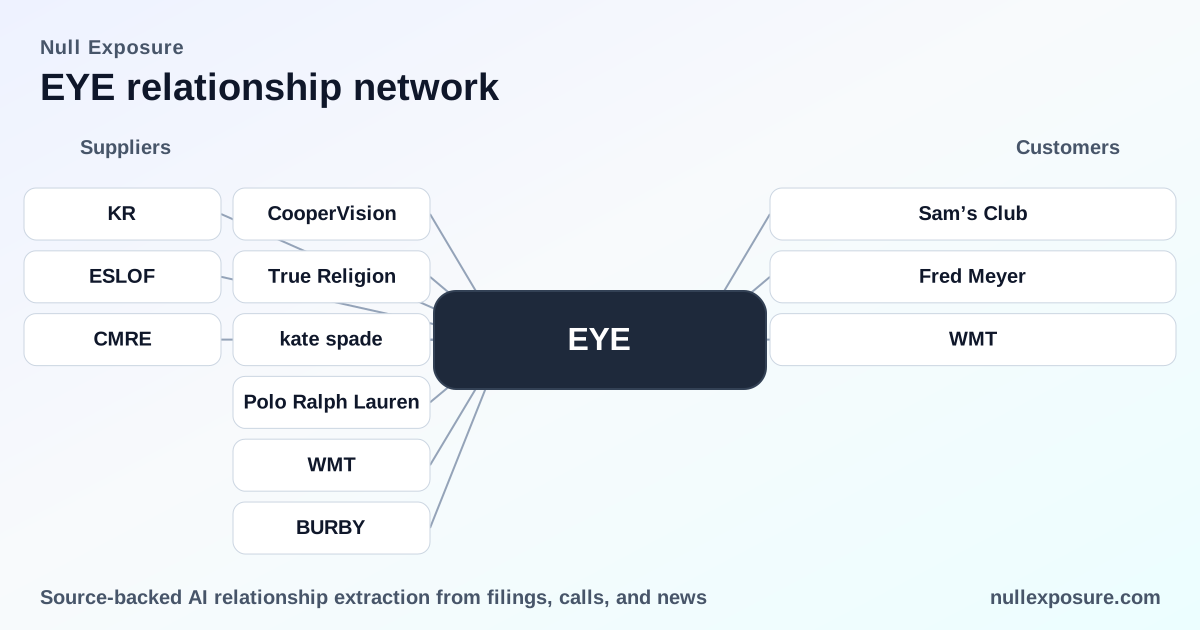
National Vision (EYE) supplier map — what operators and investors need to know
National Vision runs a high-volume optical retail business anchored in four retail banners and e-commerce, monetizing through eyewear sales, contact lenses, private‑label merchandise and branded-frame assortments sold at scale across stores and online. Revenue comes from product margins (lenses, frames, contacts), optical services and private‑label sourcing, while strategic supplier contracts and long lease commitments shape cost structure and operational leverage. For an investor-focused supplier risk profile and ongoing monitoring, see the full platform at https://nullexposure.com/.
Why suppliers and contracts drive the economics here
National Vision’s model is retailer-first: large‑format distribution of branded and private‑label optical goods through America’s Best, Eyeglass World, Vista Opticals and DiscountContacts.com. That model requires stable supply of lenses, frames and contact lenses and a predictable real‑estate footprint. Key operating signals from company filings and public commentary: long-term leases (typically five to ten years), long-term supplier contracts with certain partners, and an outsourcing posture for manufacturing and payment compliance.
- The company reports noncancelable store leases of five to ten years with renewal options, which locks in fixed occupancy and amplifies the importance of sales productivity per location.
- National Vision holds long-term supplier agreements with named partners (Essilor and CooperVision are called out) and relies on overseas factories for private‑label manufacturing.
- Payment handling and PCI compliance are covered by third‑party service providers, indicating reliance on vendors for critical operational controls rather than in‑house systems.
These characteristics produce a contracting posture that is capital‑intensive, moderately concentrated on a small set of strategic suppliers for lenses and contacts, and operationally dependent on outsourced manufacturing and services.
The supplier roll call — who supplies what and why it matters
Below I cover every relationship mentioned in the supplier results with the clear, investor‑oriented takeaway and source for each.
CooperVision
National Vision sells contact lenses including private‑label lines that are manufactured by CooperVision (e.g., Sofmed and Natural Eyes HydraWear). This is a direct manufacturing relationship for contact lenses and private‑label supply. According to the company’s FY2024 Form 10‑K, CooperVision manufactures some private‑label contact lens products for National Vision.
Essilor
Essilor has the sole and exclusive right to supply certain eyeglass lenses under an agreement that runs through May 2026, making Essilor a strategically critical lens supplier whose contract expiration is material to operations. This detail is stated in National Vision’s FY2024 Form 10‑K.
Walmart
National Vision disclosed termination of an Amended and Restated Supplier Agreement with Walmart that dated back to January 17, 2017; the 10‑K records the termination and related contractual unwind. The FY2024 Form 10‑K documents the termination of the Walmart master supplier arrangement and the associated master services agreement.
Burberry
Burberry is one of several premium fashion brands National Vision is rolling out as branded frame launches in its stores, positioned to drive higher‑priced frame sales. A TradingView/Zacks coverage note (March 9, 2026) lists Burberry among planned frame launches at America’s Best.
True Religion
True Religion is included in the company’s planned frame launches, representing a premium/fast‑fashion licensing arrangement to diversify frame assortment and margins. A TradingView/Zacks note (March 9, 2026) references True Religion as part of the branded frame slate.
kate spade
kate spade frames are included among the branded launches slated for the year, aimed at broadening customer appeal and supporting ASP expansion in frames. This is reported in the TradingView/Zacks summary on March 9, 2026.
Polo Ralph Lauren
Polo Ralph Lauren is another licensed frame brand National Vision will carry in America’s Best assortments, contributing to the strategic emphasis on brand‑led frame sales. TradingView/Zacks (March 9, 2026) includes Polo Ralph Lauren in the announced lineup.
Costa
Costa is listed alongside other lifestyle brands for branded frame launches, indicating National Vision’s push into sport/outdoor premium frames as part of assortment diversification. This appears in the TradingView/Zacks piece dated March 9, 2026.
Fred Meyer
National Vision operates Vista Opticals inside select Fred Meyer stores and on select military bases, confirming a retail distribution partnership that expands footprint without sole‑ownership of locations. CityBiz (March 9, 2026) and MarketScreener (FY2025 coverage) describe the company’s multi‑brand retail operations that include Vista Opticals inside Fred Meyer.
What the constraint signals mean for valuation and risk
Interpret supplier constraints as company‑level structural facts that drive both upside and downside:
- Contracting posture: long‑term and binding. National Vision’s long leases and long‑term supply agreements (explicitly named for Essilor and CooperVision) create operating leverage but also fixed obligations that accentuate downside when traffic or margins compress. The FY2024 10‑K documents both lease terms and named long‑term supplier contracts.
- Concentration risk: lens supply and private‑label manufacturing. The exclusive lens arrangement with Essilor and the reliance on a handful of manufacturers for private labels concentrate execution risk in a small number of suppliers. If the Essilor agreement is not renewed on favorable terms after May 2026, cost of goods and service continuity are primary near‑term risks.
- Criticality and maturity: some relationships are strategically critical and active. Essilor’s exclusive supply through May 2026 is a mature, active commercial commitment; manufacturing relationships and third‑party PCI services are operationally critical despite being less visible in headlines.
- Usage‑based obligations exist in pockets. Certain military store leases have variable, percentage‑of‑sales rent provisions, which partially offset fixed rent exposure but introduce variability in expense recognition tied to sales cadence.
These factors should be priced alongside the company’s current financials: Revenue TTM ≈ $1.99B, gross profit ≈ $1.17B, and a thin reported net margin near 1.5%, reflecting the low‑margin, high‑volume nature of the business and the leverage embedded in supplier and lease structures.
For a concise supplier risk dashboard and ongoing alerts on named contract expirations and partner changes, visit https://nullexposure.com/.
Investment takeaway and monitoring plan
National Vision’s supplier ecosystem blends strategic exclusivity (Essilor), branded frame partnerships (Burberry, kate spade, Polo Ralph Lauren, Costa, True Religion), in‑store distribution partners (Fred Meyer), and manufacturer relationships (CooperVision and overseas private‑label factories). Investors should prioritize three monitoring items:
- Essilor renewal negotiation and any change to lens exclusivity (contract runs through May 2026). This will directly influence gross margin on lenses.
- Execution of branded frame launches and their effect on average selling price and same‑store sales, which are key to unlocking margin expansion under current lease commitments.
- Operational resilience of private‑label manufacturing and third‑party PCI/service providers, since outsourced manufacturing and payment handling are core to cost control and compliance.
For ongoing surveillance of contract expirations, supplier concentration, and supplier‑driven margin risk, revisit the supplier intelligence hub at https://nullexposure.com/ — it’s the quickest way to track material supplier events and filings.
Investors and operators should treat National Vision as a retail operator whose margin profile and valuation will be determined as much by supplier negotiations and lease economics as by same‑store sales trends.