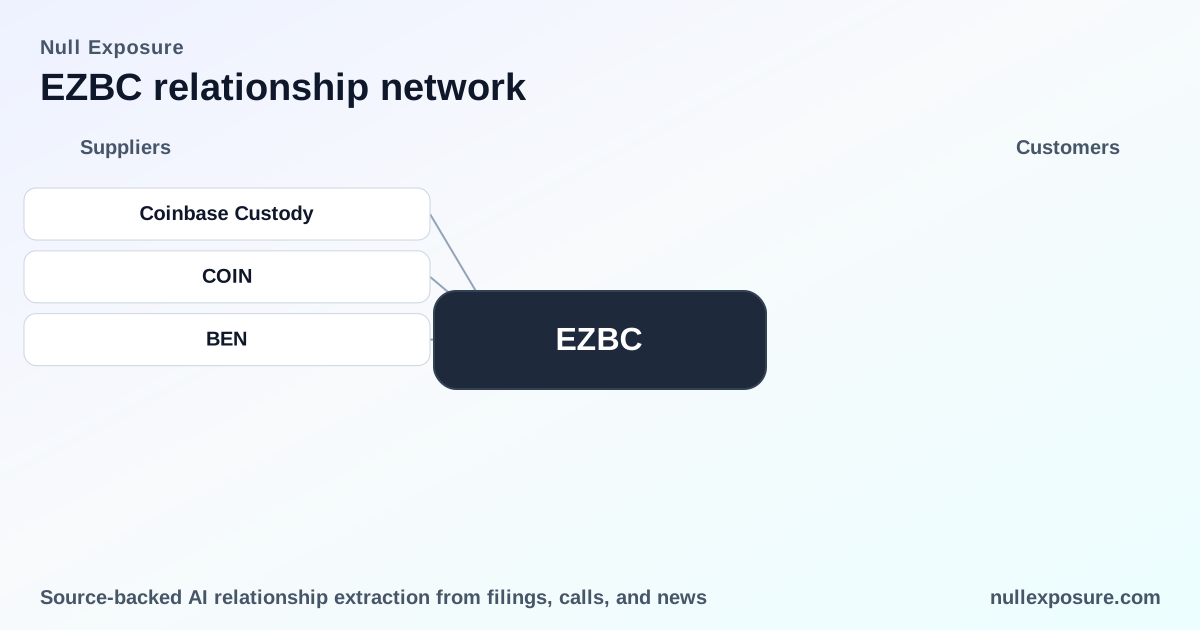
EZBC supplier landscape: Coinbase custody, Coinbase trading, and Franklin Templeton — what investors need to know
EZBC operates as Franklin Templeton’s Bitcoin trust within the Digital Holdings Trust structure, delivering institutional exposure to spot Bitcoin by holding real BTC in custody and monetizing through sponsor and management fees charged to the trust. The fund’s economics are driven by asset inflows and the unitary fee paid to the sponsor; operational continuity depends on a small set of service providers that perform custody, prime brokerage, administration and cash custody. For a concise view of counterparties and implications for supplier risk, visit https://nullexposure.com/.
The supplier roster in plain English
Coinbase Custody — the Bitcoin custodian at the center of operations
Coinbase Custody is explicitly named as the Fund’s Bitcoin Custodian and is responsible for safekeeping the trust’s bitcoin holdings in the Vault Balance. This is a critical, single-point operational dependency. According to the Fund’s FY2025 Form 10‑K, the Fund is dependent on Coinbase Custody for custody functions and related operational continuity (FY2025; Form 10‑K).
Coinbase (Coinbase Inc.) — prime broker and trading counterparty
Coinbase Inc., an affiliate of Coinbase Custody, serves as the Fund’s Prime Broker and facilitates buying, selling and settlement of bitcoin for cash creations, redemptions and extraordinary liquidations. Coinbase is the trading engine for the trust’s inflows and redemptions and is contractually critical. Market writeups also note that the trust is backed by real BTC held in custody by Coinbase (SimplyWallSt narrative, March 2026).
Franklin Templeton — the sponsor and manager distributing ETF exposure
Franklin Templeton acts as the Sponsor and brand behind EZBC, packaging the trust for traditional investors and distributing shares tied to the underlying bitcoin holdings. Franklin Templeton provides the institutional wrapper and distribution platform, and the trust is one of several digital asset offerings from the firm. CoinDesk reported in November 2025 that Franklin Templeton manages EZBC alongside other digital asset funds, and market reporting in March 2026 noted incremental inflows — the Digital Holdings Trust added $13.98 million (CoinDesk Nov 24, 2025; MEXC March 2026).
What the supplier mix signals about EZBC’s operating model
The counterparty list reveals a concentrated, service-heavy operating model with three structural characteristics that investors must weigh.
- Concentration and criticality. The trust’s operational continuity is concentrated around Coinbase Custody and Coinbase Inc.; the FY2025 10‑K states that failure by Coinbase Custody or Coinbase Inc. could render the Fund unable to operate or force liquidation. That language elevates counterparty risk from theoretical to contractually material (FY2025; Form 10‑K).
- Managed custody and geography. Private keys are held in cold storage across the United States and Europe, indicating a geographically diversified custody posture but limited location transparency for security reasons; the index administration and benchmark oversight include UK‑regulated entities as well, reflecting a cross‑jurisdictional service footprint (evidence: cold storage in US and Europe; CF Benchmarks Ltd. FCA oversight).
- Mature institutional scaffolding. BNY Mellon serves as Administrator, Cash Custodian, Marketing Agent and Transfer Agent, which adds a mature, regulated layer of operational governance that offsets some execution risk associated with a concentrated custody/prime broker pair (FY2025; Form 10‑K).
These elements combine into a contracting posture that is service-provider centric and operationally critical: Franklin Templeton outsources core functions (custody, prime brokerage, administration) to specialized providers rather than vertically integrating them. That reduces internal execution burden but creates vendor concentration and single‑point risk where Coinbase Custody/Inc. are involved.
Cost and spend profile as an operational signal
Fees accrued for the fiscal year ending March 31, 2025 were reported at ($720,559) after waiver, placing typical annual counterparty spend in the $100k–$1M band — a signal that the fund is material but not at the scale of a systemic custodial mandate, and that fee levels are consistent with a fund-level outsourcing model (FY2025 financial disclosures).
(If you want a structured supplier risk brief for board review or investment memos, explore more at https://nullexposure.com/.)
Relationship-by-relationship details (concise, sourced)
- Coinbase Custody: The FY2025 Form 10‑K states the Fund is dependent on Coinbase Custody for safekeeping the Fund’s bitcoin and to operate Creation/Redemption activity; failure of the custodian could prevent operations or force liquidation (FY2025; Form 10‑K).
- Coinbase (Coinbase Inc.): An affiliate of Coinbase Custody, Coinbase Inc. serves as the Prime Broker, facilitating purchases, sales and settlement of bitcoin tied to the Fund’s cash creations and redemptions (FY2025; Form 10‑K). A SimplyWallSt narrative (March 2026) reiterated the trust holds real BTC in custody with Coinbase.
- Franklin Templeton: Franklin Templeton is the Sponsor and distributor of the Digital Holdings Trust products including EZBC; market coverage (CoinDesk, Nov 2025) describes Franklin’s multi‑product digital asset lineup, and market reports (MEXC, March 2026) note recent inflows to EZBC consistent with active distribution and productization (CoinDesk Nov 24, 2025; MEXC March 2026).
Investor implications and recommended actions
- Monitor counterparty concentration to Coinbase. The contract language in the FY2025 filing makes Coinbase Custody/Inc. a contractually critical vendor; investors should treat operational disruptions or regulatory actions affecting Coinbase as direct risks to NAV and liquidity.
- Factor administrative strength into counterparty risk. BNY Mellon’s roles as Administrator and Cash Custodian provide a governance buffer that reduces operational fragility relative to a trust lacking such institutional support.
- Watch flows and fee sensitivity. The fund’s fee profile and reported accruals suggest moderate operational spend; large inflows or sudden redemptions could stress the custody/prime broker relationship and should be stress‑tested in scenario analysis.
For a tailored supplier risk extract and monitoring plan, start at https://nullexposure.com/ and request the EZBC supplier brief.
Final assessment
EZBC presents a clear tradeoff: institutional wrapper and distribution via Franklin Templeton, and mature administration through BNY Mellon, combined with concentrated operational dependence on Coinbase Custody and Coinbase Inc. for crypto custody and prime brokerage. That structure generates attractive go‑to‑market distribution for spot Bitcoin exposure while concentrating operational and regulatory risk in a small set of providers — a configuration investors must price into diligence, counterparty limits, and stress testing. For more detailed counterparty scoring and monitoring resources, visit https://nullexposure.com/.