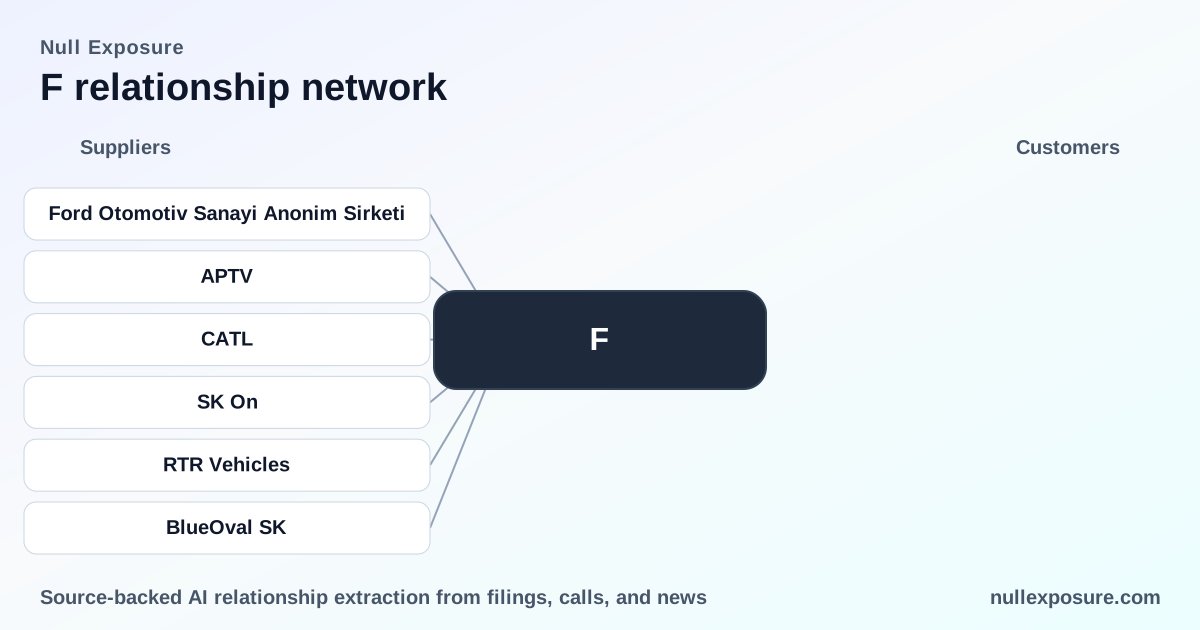
Ford (F) — supplier relationships that define production and electrification risk
Ford is a global automaker that monetizes through vehicle sales, services, and increasingly through electrification and battery supply arrangements; the company acts primarily as a large-scale buyer and integrator, entering long-term purchase commitments and joint ventures to secure critical components and battery capacity. Revenue depends on tightly managed supplier networks and multi-year offtake commitments that lock capital but protect manufacturing continuity. For investors and operators, the supplier map is both a growth lever and a concentration risk that demands active stewardship.
Explore the supplier profiles and contractual signals driving Ford's execution at https://nullexposure.com/.
Why supplier relationships matter to Ford's strategy
Ford is transforming from a product-centric OEM into a vertically coordinated industrial platform where battery access, module technology partners, and regional manufacturing joint ventures materially affect margins, capital intensity, and time-to-market for EVs and commercial vehicles. The company purchases components globally, signs long-term offtake and manufacturing commitments, and participates in joint ventures that internalize some parts of the supply chain. These arrangements reduce input volatility but increase committed spend and counterparty concentration.
Key high-level takeaway: Ford’s supplier posture is deliberately contractual and long-horizon—trading more flexibility for capacity and specification certainty. This has implications for cash flow timing and counterparty exposure.
The supplier roster — what to know, relationship by relationship
Ford Otomotiv Sanayi Anonim Sirketi (Ford Otosan)
Ford Otosan is a Turkish joint venture with Ford holding 41% alongside Koc Group and public investors; it is the sole supplier of Transit, Transit Custom, Transit Courier and the Puma for Europe, and the exclusive distributor in Türkiye, making it strategically critical for Ford’s European commercial vehicle line. This is disclosed in Ford’s FY2025 Form 10‑K. (Source: Ford 2025 10‑K)
Aptiv plc (APTV)
Aptiv is described in market coverage as a “pick-and-shovel” supplier that sells into multiple automaker ecosystems including Ford, placing it as a diversified electronics and systems vendor that supplies components across EV and ICE platforms. This positioning gives Aptiv steady volume exposure without dependence on any single OEM. (Source: ad-hoc-news coverage, March 2026)
CATL
CATL’s technology is part of Ford’s battery strategy through licensing arrangements and technology access; Ford’s management stated they are “working with CATL, licensing their technology, but in our own place,” signaling a non‑equity technology and supply relationship rather than full ownership. This was reported in a March 2026 Detroit Free Press article based on Ford commentary. (Source: Detroit Free Press, March 6, 2026)
SK On
SK On is a South Korean battery supplier that partnered with Ford in 2021 to produce EV batteries; the relationship evolved into broader manufacturing collaboration as Ford sought to lock battery capacity for planned EV volumes. The historical JV origin and ongoing manufacturing role were noted in March 2026 reporting. (Source: Detroit Free Press, March 6, 2026)
RTR Vehicles
RTR Vehicles is a specialty partner that co-developed an off-road Bronco variant, representing Ford’s strategy to leverage niche suppliers for performance and brand extensions rather than core volume production. The collaboration was described in reporting on product launches and recalls. (Source: Autos/Yahoo coverage, March 2026)
BlueOval SK
BlueOval SK is the manufacturing joint venture formed with SK On, built around an $11.4 billion investment to construct multiple large battery factories and secure domestic battery manufacturing scale for Ford’s electrification push. This JV is a capital-intensive, high-importance supplier relationship for EV production capacity. (Source: Detroit Free Press, March 6, 2026)
What the contractual and operational constraints reveal
Ford’s public disclosures and reporting highlight a coherent supplier operating model:
- Contracting posture: long-term, binding commitments. Ford reports multi-year offtake agreements and purchase contracts that include fixed or minimum quantity purchase requirements—this is an explicit element of its strategy to secure raw materials and battery supply. (Source: Ford 2025 10‑K)
- Global supply footprint with concentrated critical nodes. The company sources components globally through a complex supplier network; that global reach reduces single-country risk but centralizes some critical components in partner facilities and JVs. (Source: Ford 2025 10‑K)
- Criticality of suppliers to production continuity. Ford discloses that supplier failures or shortages have disrupted operations historically, and that such suppliers are critical to meeting production schedules and specifications. (Source: Ford 2025 10‑K)
- Material and committed spend is significant and back-ended. Ford lists purchase obligations due across multiple years (for example: $2.3 billion due in 2026 and longer‑term commitments), and estimates offtake commitments through 2035 totaling about $4.7 billion under current forecasts—this reflects both capital exposure and secured capacity. (Source: Ford 2025 10‑K)
- Active, manufacturing-focused relationships. Many supplier arrangements are active and embedded in manufacturing segments (Ford Blue, Model e, Ford Pro), underscoring inventory, warranty and field-service linkages that transmit supplier performance into operating results. (Source: Ford 2025 10‑K)
These constraints form a single company-level signal: Ford is deliberately trading cash certainty and capital commitments for production security and competitive timing in EVs—an approach that stabilizes output but compresses short-term financial flexibility.
Explore deeper supplier analytics and contractual signals at https://nullexposure.com/ to benchmark counterparty risk and exposure.
Investment and operational implications
- Upside: Secured battery capacity (BlueOval SK, SK On, licensed CATL tech) supports EV volume growth and reduces execution risk on launches; joint ventures such as Ford Otosan lock regional volume and protect margins on commercial vehicles.
- Downside: Large, long-term purchase obligations and concentrated JV dependencies create material counterparty and cash‑flow risk, especially if demand or product mix shifts. Warranty and recall exposure with specialty partners (e.g., RTR Vehicles for performance variants) adds operational variability.
- Credit and capital: The company’s capital allocation must balance large capex commitments to suppliers and JVs with margin compression in ICE-to-EV transition—watch committed spend schedules and off-take phasing closely.
Final takeaways and recommended next steps
Ford’s supplier architecture is an intentional trade: lock capacity and technology via long-term contracts and JVs, accept higher committed spend, and pursue scale in EV production. For investors and procurement leaders, the priority is monitoring counterparty execution, the schedule of purchase obligations, and regional concentration in critical components.
- For a comparative review of supplier counterparty exposure across large industrial firms, visit https://nullexposure.com/.
- To evaluate how Ford’s supplier commitments affect near‑term liquidity and long-term margin trajectory, review their FY2025 10‑K procurement disclosures and JV filings, and cross-reference with recent reporting on battery JV investments.
Make supplier diligence part of the investment thesis: track JV performance, offtake fulfillment, and the timing of capital commitments—these are the variables that will determine whether Ford’s supplier strategy delivers durable competitive advantage or creates leverage risk.