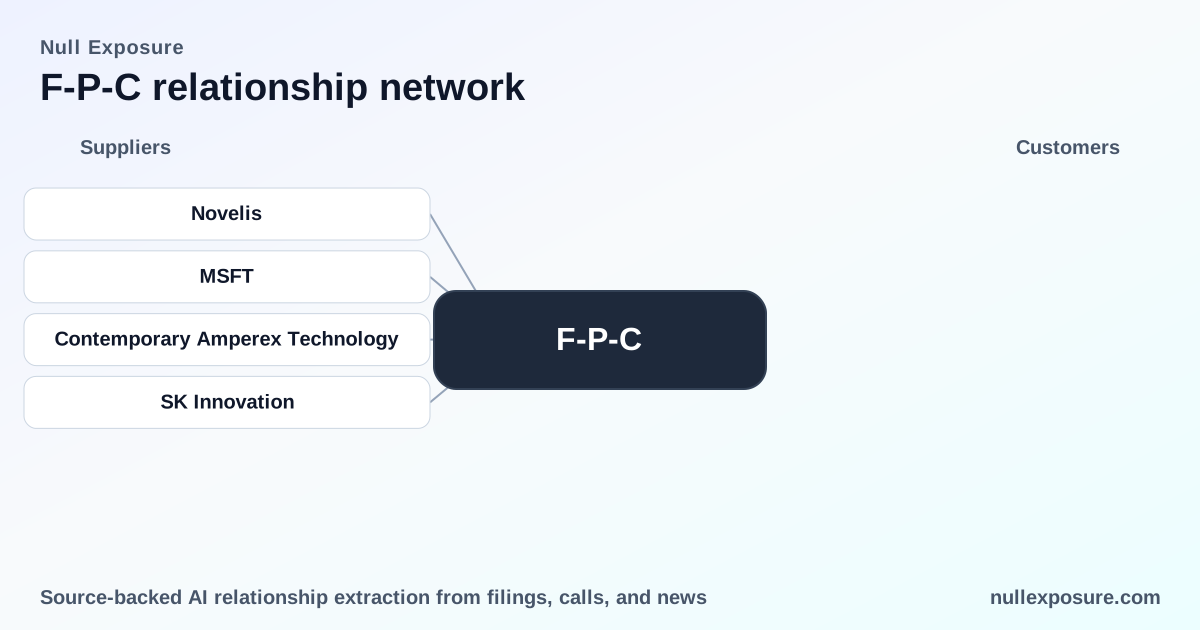
F-P-C: Strategic suppliers, single-source risks, and what investors should price in
Ford (traded here as F-P-C for the preferred instrument) operates as a capital-intensive manufacturer and integrated mobility business that monetizes through vehicle sales, parts and service revenue, captive finance, and strategic industrial partnerships that underpin EV transition and high-volume pickup production. For investors and procurement operators, the supplier map is a direct input into margin durability, production continuity, and capital allocation risk — particularly where a small number of suppliers provide critical metals, batteries, or plant-level capacity. Learn how those supply links translate to balance-sheet and operational exposures at https://nullexposure.com/.
Market-facing takeaways up front:
- Concentration of critical input supply is the dominant operational risk. Material and battery partners determine production throughput for high-margin trucks and EV programs.
- Supplier relationships range from decades-old platform suppliers to fast-moving battery joint ventures; that mix creates asymmetric operational and contract risk.
- News flow shows clear idiosyncratic shocks (plant fires, technology friction) that translate to near-term earnings volatility.
Why supplier mapping matters for preferred-equity and debt investors Investors in F-P-C need to overlay supplier dependency on cash-flow timelines and covenant windows. Preferred holders price in coupon coverage and recovery assumptions that are directly sensitive to production stoppages or sustained input-cost inflation. Procurement posture — whether Ford holds long-term fixed contracts, multi-sourcing, or single-source arrangements — changes how quickly cost inflation can be passed to end customers. For deeper supplier intelligence and counterparty risk analytics, visit https://nullexposure.com/ to see curated supplier profiles.
Key supplier relationships and what they mean for Ford
Novelis Novelis is identified repeatedly in recent coverage as a primary aluminum supplier to Ford, especially for pickups and SUVs, and the company is a material source for F-150 production. Multiple outlets reported that a fire at a Novelis aluminum facility (Oswego cited in coverage) created a tangible hit to Ford’s supply chain, with analysts estimating as much as a $1 billion potential impact to Ford’s results. According to a Detroit Free Press article dated December 2, 2025, Novelis is the main aluminum supplier for Ford’s pickups and SUVs; Automotive News and other reports in October–December 2025 flagged the plant fire and linked it to meaningful production and earnings disruption. (Sources: Freep, Dec 2, 2025; Automotive News and Wibqam coverage, Oct–Dec 2025; Tikr commentary, FY2025)
Microsoft Microsoft’s historical role is as a software and infotainment supplier: Ford adopted Microsoft-based Sync and the MyFord Touch system, which generated customer and operational friction historically. A 2013 USA Today piece documented the aggravation around those Microsoft-based systems, underscoring that technology partnerships influence customer satisfaction and warranty/repair cost flows long after initial deployment. (Source: USA Today, Jan 29, 2013)
Contemporary Amperex Technology (CATL) Ford has entered a strategic battery partnership with Contemporary Amperex Technology (CATL) to localize EV battery production in Michigan, reflecting the company’s pivot to securing battery capacity domestically. CNBC coverage in February 2024 described the Ford–CATL partnership to create an EV battery plant in Michigan and referenced the broader timeline of capacity announcements made in 2023. This partnership is a structural element of Ford’s EV roadmap and impacts capital expenditure scheduling and vehicle gross margins over the next decade. (Source: CNBC, Feb 6, 2024)
SK Innovation SK Innovation participates as a battery-partner developer tied to Ford’s Blue Oval City project in Stanton, Tennessee, representing another node of the battery supply chain and localized manufacturing. Coverage in 2021 described Blue Oval City as a Ford partnership with SK Innovation, which anchors EV battery and vehicle assembly capacity in Tennessee. This relationship is part of Ford’s strategy of multiple battery partnerships to diversify supply and manage capacity ramp risk. (Source: Detroit Free Press, Nov 30, 2021)
How these relationships translate to business model constraints and operating posture Even though no formal constraint documents are provided in this payload, the observable supplier map implies a company-level operating posture that balances strategic, long-term supplier contracts with high capital expenditure and selective multi-sourcing. Several company-level signals are evident:
- Contracting posture: Ford operates a mix of long-term strategic partnerships (battery JVs, aluminum agreements) and legacy OEM supplier contracts; that structure supports scale but can lock the company into capacity exposures during shocks.
- Concentration: The aluminum supply appears concentrated enough to create single-plant sensitivity; battery capacity is being intentionally diversified but still concentrated regionally as plants ramp.
- Criticality: Suppliers provide mission-critical inputs (aluminum for flagship pickups, batteries for EV programs) that directly affect production volume and margin; outages translate to outsized earnings impacts.
- Maturity: Relationships span mature OEM suppliers and longstanding technology vendors to newer, fast-scaling battery manufacturers; risk profiles differ by vintage and contract terms.
These signals imply that operational interruptions, especially in concentrated input flows, are first-order drivers of short- to medium-term credit and payout risk for preferred holders and other stakeholders.
Risk implications for investors and procurement operators
- Short-term shock exposure: Plant-level incidents and concentrated supply can create sudden earnings volatility; preferred coupons and protections need stress testing under multi-week production disruption scenarios.
- Margin squeeze risk: Input-cost passthrough is constrained in competitive vehicle markets; battery and metals inflation compresses gross margins if not covered by design wins or price increases.
- Counterparty and geopolitical exposure: Overseas battery suppliers and global metals markets introduce FX, trade, and regulatory considerations that affect capital deployment and timing.
- Technology and warranty risk: Historical friction with infotainment suppliers demonstrates that software and systems partners create ongoing warranty and brand risk beyond initial hardware spend.
Actionable recommendations
- Conduct scenario analysis on production-loss durations tied to single-plant outages; prefer capital structures that reflect realistic recovery curves.
- Prioritize monitoring of near-term supplier news flow (plant incidents, capacity announcements) as leading indicators for cash-flow stress.
- For procurement teams, accelerate contractual remedies and secondary-sourcing clauses on mission-critical inputs.
If you want a structured supplier-risk scorecard built from this map and comparable OEMs, see the detailed profiles at https://nullexposure.com/ for modeling templates and counterparty heat maps.
Conclusion and next steps The supplier landscape around F-P-C conveys material concentration and criticality risk even as Ford diversifies battery supply through partnerships like CATL and SK Innovation. Novelis’ role in aluminum supply and the documented plant fire illustrate how single-node failures can create multi-hundred-million-dollar shocks to production and earnings. Investors should price in both the upside of secured battery capacity and the downside of concentrated raw-material exposures when assessing coupon coverage, recovery prospects, and preferred-equity valuations.
For a deeper dive into supplier-level exposures and to receive tailored counterparty briefings, visit our research hub at https://nullexposure.com/ and request the Ford supplier dossier.