F-P-D (Ford) — Supplier relationships you need on your radar
Ford operates as an integrated automaker: it designs, manufactures and sells passenger vehicles, commercial trucks, parts and related financial services, and monetizes through vehicle and parts sales plus captive-finance income and service revenue tied to its installed base. For investors and operators assessing supplier exposure, the most consequential relationships are those that give Ford access to critical vehicle platforms and electrification technology that materially shorten time-to-market and reduce capital intensity in development. Learn more at https://nullexposure.com/.
Why one supplier relationship can move an OEM's economics
Platform-sharing and technology partnerships change an OEM’s cost structure and strategic optionality. When an automaker like Ford secures access to another manufacturer’s electric-vehicle platform, the company reduces R&D cash outflow, accelerates product rollout, and hedges regulatory and market transitions. That changes free-cash-flow timing and capital allocation for investors, and it shifts negotiating leverage between OEM and supplier in procurement and warranty risk.
The relationship set: what the public evidence shows
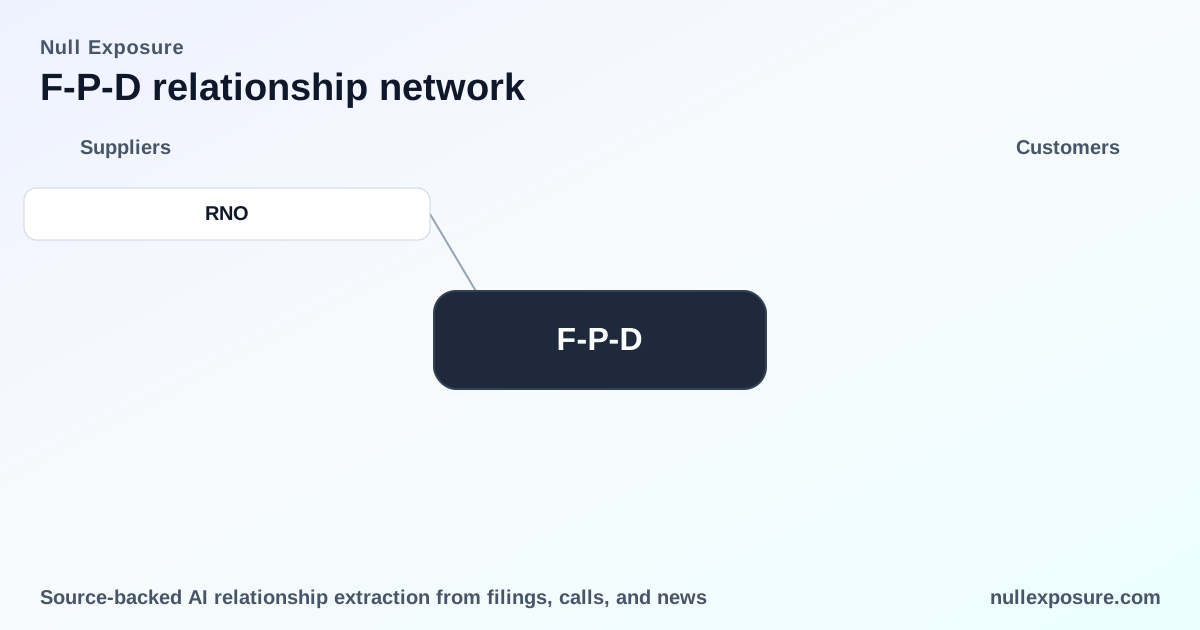
The available supplier-related evidence for F-P-D includes one explicit relationship mention: Renault. Below I summarize that relationship for investor use.
Renault — platform access for EV programs
Ford benefits from access to Renault’s EV platforms, which helps the automaker manage U.S. regulatory uncertainty and balance investment across internal combustion and electric technologies. This relationship was noted in a TradingView industry write-up referencing FY2023 and posted on March 9, 2026. (Source: TradingView idea referencing FY2023, published 2026-03-09).
How that Renault link changes the operational map
- Strategic acceleration: Access to Renault’s EV platforms materially shortens Ford’s development timeline for certain electric models, lowering near-term capital intensity and enabling faster market entry.
- Capital-allocation implications: Platform access shifts Ford’s cash needs from ground-up EV architecture development toward badge engineering, integration and manufacturing conversion costs — a different cash burn profile that investors should model separately from full in-house platform development.
- Regulatory hedge: With U.S. EV policy in flux, Ford’s dual-track commitment to ICE and EV technologies is capital-efficient when supplemented by platform-sharing; the Renault access reduces the firm’s binary exposure to a single regulatory outcome.
Contracting posture, concentration, criticality and maturity — company-level signals
There are no supplier-specific contractual constraints disclosed in the records reviewed for F-P-D. As a company-level signal, this absence indicates two practical points for investors and operators:
- Contracting posture: Ford operates with strategic supplier partnerships that are commercial and often platform- or technology-focused rather than simple transactional supply contracts. These arrangements tend to include licensing, joint-engineering and integration milestones rather than fixed-volume purchase-only contracts.
- Concentration: The public record here shows limited disclosed single-supplier concentration, but platform partnerships (like the Renault tie) are high-impact even if few in number; a single platform provider can be a high-consequence counterparty.
- Criticality: Shared EV platforms are highly critical to product roadmaps and regulatory compliance timelines. Loss or delay of platform access would have outsized implications for program timing and capital deployment.
- Maturity: Platform-sharing agreements typically reflect mid-term maturity — multi-year commitments with integration and IP-sharing dimensions — which requires long lead times for replacement or re-engineering.
Risk and upside for investors
- Upside: Platform access reduces upfront capex and shortens time-to-revenue for EV launches, which can materially improve near-term cash conversion if Ford converts technology access into volume quickly.
- Risk: Strategic dependence on an external platform supplier introduces execution risk—supply disruption, integration complexity, or IP disputes create program slippage. Regulatory shifts that change demand profiles for EVs versus ICE vehicles can revalue the benefit of such partnerships quickly.
- Operational monitoring: Investors should watch program-level KPIs (launch timing, unit cost targets, warranty trends) and counterparty stability indicators. Public mentions and industry commentary, like the TradingView note from March 9, 2026, are useful early-warning signals.
Explore supplier relationship signal intelligence and track counterparty links on the NullExposure platform: https://nullexposure.com/.
What operators should prioritize in supplier negotiations
Operators negotiating platform access should insist on:
- Clear integration milestones and penalties tied to performance and delivery schedules.
- IP and upgrade rights that protect future use and cross-model applicability.
- Cost-reduction targets and transparency on component sourcing to avoid second-order supplier concentration.
Bottom line — what this means for F-P-D investors
The Renault platform relationship is a strategically meaningful supplier tie for Ford because it accelerates EV readiness while allowing the firm to maintain dual-track investments in ICE and electric powertrains. For investors, the practical implications are straightforward: platform access changes capital timing and reduces the execution risk of EV programs when executed cleanly, but it also concentrates critical program risk in a smaller set of counterparty relationships. The TradingView notice referencing FY2023 (published March 9, 2026) captures this dynamic succinctly.
If you want ongoing monitoring of counterparty relationships and supplier-concentration risk for F-P-D and similar issuers, visit https://nullexposure.com/ for live coverage and analytical tools.
Final recommendations
- Treat platform-access relationships as value-creating but high-consequence; they warrant focused monitoring.
- Assign program-level probabilities for delivery and cost targets in valuation work rather than treating supplier access as binary.
- Maintain a rolling watch on public commentary and filings for new partnership disclosures and constraint information that would change the current assessment.
For deeper supplier intelligence and to map the full universe of counterparty links for F-P-D, start a subscription or request a briefing at https://nullexposure.com/.