DigiAsia Corp (FAAS) — Supplier relationships that move the business and balance sheet
DigiAsia Corp operates a payments-first platform in Indonesia, monetizing through merchant services, transaction fees, lending spreads and enterprise payment products while supplementing capital through targeted financing arrangements. The company drives revenue from digital payments and lending, scales distribution through partner integrations, and is actively pursuing treasury and capital partnerships to extend its balance sheet and product set. For an investor assessing vendor and capital counterparties, the nature and maturity of these relationships map directly to execution risk and upside.
Explore detailed supplier profiles and relationship signals at Null Exposure to prioritize diligence and counterparty monitoring.
How DigiAsia makes money and how partners fit into the model
DigiAsia is a Jakarta‑based platform business with a core payments, lending and remittance stack. Fiscal metrics show $57.7 million in trailing revenue and $55.5 million gross profit, while the company remains unprofitable at the net level (negative EBITDA and a -10.2% profit margin). Market capitalization is small — roughly $4.9 million — and insider ownership is concentrated at about 60.7%, which creates a governance and liquidity profile investors must weigh.
From an operating standpoint:
- Contracting posture: DigiAsia demonstrates an assertive, partnership-driven approach — integrating merchant and branchless banking technology while arranging third‑party financing to back strategic initiatives.
- Concentration: The company’s commercial scale and concentrated ownership suggest execution is sensitive to a limited number of strategic relationships and capital providers.
- Criticality: Supplier integrations that enable merchant onboarding and enterprise card services are operationally critical; capital partners funding treasury strategies are strategically critical to balance sheet flexibility.
- Maturity: Product integrations are commercializing, but balance‑sheet strategies (for example, a planned Bitcoin treasury reserve) indicate an early-stage, experimental maturity profile rather than a steady-state, diversified funding model.
No supplier-specific contractual constraints were disclosed in the available relationship notices; there are no explicit limitation excerpts reported for counterparty agreements in the materials reviewed.
Supplier and capital relationships that define FAAS execution
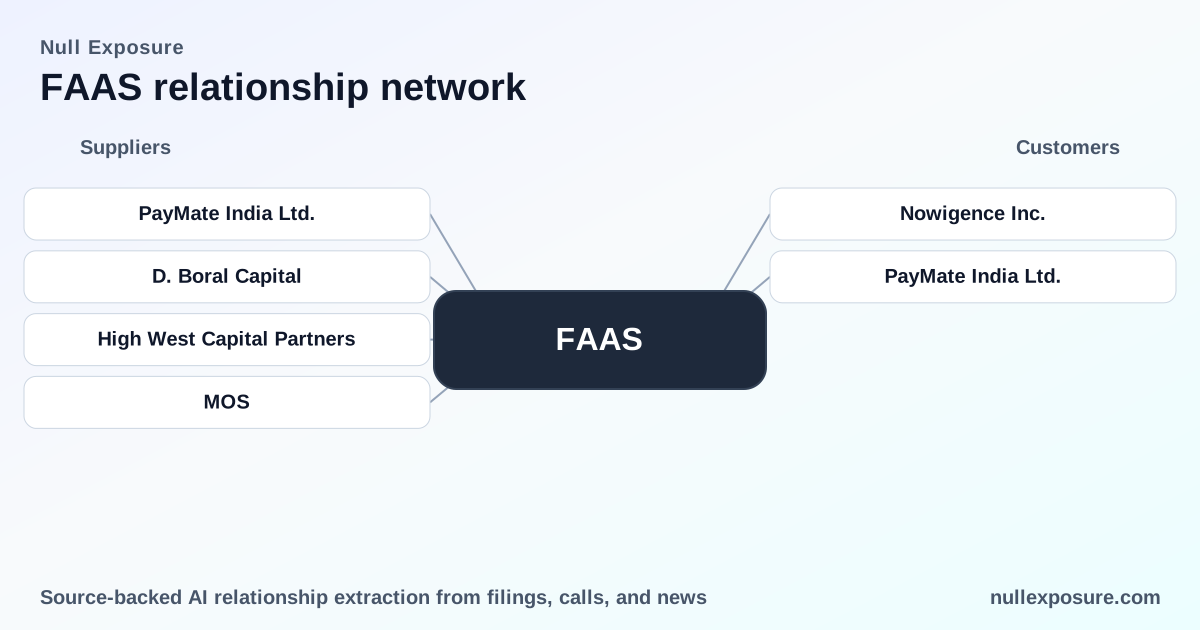
PayMate India Ltd. — enterprise card rollout across Southeast Asia
DigiAsia will roll out PayMate’s enterprise card platform across Southeast Asia, positioning the company to expand merchant and corporate payment services regionally and deepen payment rails for its customers. This initiative was announced in a Newsfile release on March 9, 2026, describing an expanded strategic alliance ahead of a proposed acquisition (Newsfile, 2026-03-09: PayMate and DigiAsia strengthening strategic alliance).
D. Boral Capital — placement agent for investor outreach on blockchain treasury strategy
DigiAsia appointed D. Boral Capital as a placement agent to engage institutional investors about blockchain‑aligned treasury strategies and potential public‑market exposure. The engagement was disclosed in a March 9, 2026 Newsfile release announcing an indicative termsheet related to non‑recourse debt to support a Bitcoin treasury reserve (Newsfile, 2026-03-09: Termsheet announcement).
High West Capital Partners — non‑recourse debt financing for treasury initiatives
DigiAsia signed an indicative termsheet with High West Capital Partners for up to US$3 million in non‑recourse debt financing to support its planned Bitcoin treasury reserve, creating a direct capital link to execution of that treasury strategy (Newsfile, 2026-03-09: Termsheet announcement).
MOS Utility Limited (MOS) — branchless banking integration to scale merchant onboarding
DigiAsia signed a strategic partnership to integrate MOS Utility’s technology to scale branchless banking across Indonesia, with a stated ambition to onboard over one million merchants as financial service agents and expand access to underserved communities (Newsfile, 2026-03-09: Strategic partnership expansion).
What these relationships imply about risk and optionality
Collectively, the counterparty set combines commercial integrations (PayMate, MOS) and capital providers (D. Boral, High West) — a structure that accelerates go‑to‑market capability while introducing funding dependency for tactical balance‑sheet initiatives.
Key operating implications:
- Revenue upside is tied to merchant and enterprise rollouts. Enterprise card adoption and MOS-driven branchless banking adoption are direct revenue levers; success depends on execution at scale.
- Funding dependency is explicit. The company’s pursuit of non‑recourse debt for a Bitcoin treasury reserve signals reliance on external capital for balance‑sheet strategies rather than internal free cash flow.
- Concentrated ownership and small market cap raise liquidity and governance considerations. With ~60.7% insider ownership and limited institutional holding, minority investors face lower free‑float liquidity and higher sensitivity to management decisions.
If you are conducting counterparty diligence, prioritize confirmation of integration SLAs with PayMate and MOS and the definitive terms of any financing with D. Boral and High West — these will materially affect cash runway and operational continuity.
For deeper supplier and risk analytics, visit Null Exposure to see relationship mappings and primary documents.
Tactical checklist for investors and operators
- Validate the commercial rollout milestones agreed with PayMate and MOS (merchant acquisition targets, revenue split, implementation timelines).
- Review the terms and covenants of the High West and D. Boral indicative termsheets when available — non‑recourse debt changes recovery mechanics and counterparty incentives.
- Monitor product adoption metrics (active merchants, transaction volumes, lending book growth) to align commercial progress with valuation assumptions.
- Factor in liquidity and governance risks from concentrated insider ownership when modeling downside scenarios.
Short summary bullets of immediate takeaways:
- Commercial partnerships drive top-line scalability; card and branchless banking integrations are the primary growth vector.
- Capital partnerships enable strategic treasury experiments; financing decisions will materially influence balance‑sheet risk.
- Company financials indicate early commercialization with limited market valuation; active diligence on execution cadence is required.
Final take
DigiAsia’s current supplier and capital relationships reveal a company scaling through partner integrations while actively managing capital to pursue opportunistic treasury strategies. For investors, the critical questions are execution on PayMate and MOS integrations and the final terms of external financing — those elements will determine whether strategic optionality converts into measurable value.
Run a focused counterparty diligence sweep and track milestone disclosure events. Learn more about relationship risk and document-based signals at Null Exposure.