Diamondback Energy (FANG): Supplier relationships and what they mean for investors
Diamondback Energy is a Midland, Texas–based oil & gas exploration and production company that monetizes through crude oil and natural gas production, royalty ownership, and periodic capital-markets transactions that unlock value from acreage or equity stakes. With a market capitalization north of $51.8 billion and trailing revenue near $14.3 billion (TTM), the company combines cash flow generation with active balance-sheet management — including asset sales and equity placements — to fund development and return capital. For investors and operators evaluating counterparties, the supplier posture and capital-marketing activity tracked here reveal where operational dependence, contractual rigidity, and capital access intersect. Learn more at https://nullexposure.com/.
How Diamondback contracts and where risk concentrates
Diamondback operates with long-term contracting behavior for key midstream services, relying on throughput and take-or-pay pipeline agreements to move produced volumes. This contracting posture creates predictable volumetric commitments and fixed-cost exposure that suppliers and lenders should price into counterparties’ credit and operational models. The firm also demonstrates high concentration effects: a reported business combination (Endeavor) accounts for a large share of consolidated assets and a meaningful share of revenue, which amplifies single-counterparty or acreage-basin risk for suppliers.
- Contract tenor and rigidity: evidence indicates long-dated pipeline commitments that transfer throughput risk to the company and reduce short-term renegotiation flexibility.
- Concentration and criticality: a single acquisition representing a majority of assets elevates counterparty exposure and supplier criticality.
- Spend scale: disclosed spend buckets and aggregated line items imply >$100m annual spend on services and capital items, making Diamondback a large counterparty for oilfield and midstream suppliers.
These company-level signals shape negotiation leverage: suppliers face a counterparty that is a high-spend, asset-heavy buyer with deep reliance on third-party drilling and completion service providers.
What public press shows about recent counterparties and advisers
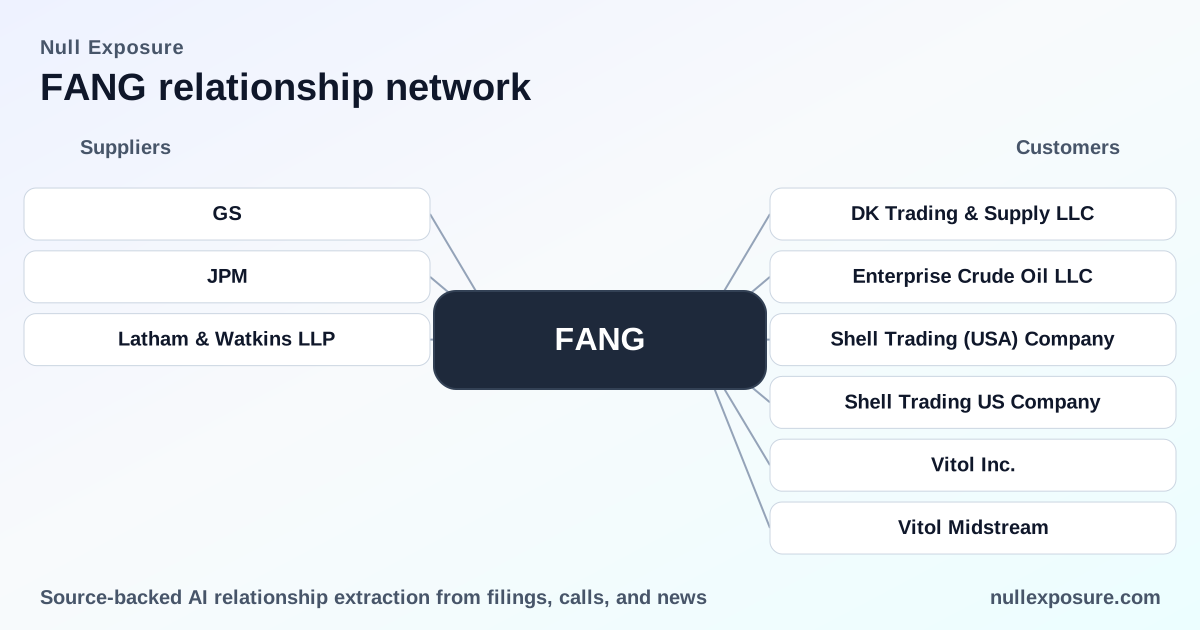
Below are the supplier and adviser relationships surfaced in recent public disclosures and press coverage, with concise plain-English summaries and source citations.
Goldman Sachs & Co. LLC
Diamondback used Goldman Sachs as a joint book-running manager on a secondary offering of Viper Energy Class A common stock, where Diamondback and other selling stockholders placed over 17 million shares in March 2026. This role positions Goldman as a capital-markets intermediary used by Diamondback when monetizing equity stakes. A GlobeNewswire press release dated March 3, 2026, documents Goldman Sachs’ joint book-running role in the offering.
Key takeaway: Goldman serves as a principal capital-markets underwriter for Diamondback’s equity monetizations (GlobeNewswire, March 3, 2026).
J.P. Morgan
J.P. Morgan acted alongside Goldman Sachs as a joint book-running manager in the same Viper secondary offering, providing distribution and execution capacity for the selling stockholders, including Diamondback. The engagement affirms Diamondback’s reliance on top-tier investment banks to execute large secondary placements (GlobeNewswire, March 3, 2026).
Key takeaway: J.P. Morgan provides execution and placement services for large equity transactions tied to Diamondback’s portfolio (GlobeNewswire, March 3, 2026).
Latham & Watkins LLP
Latham & Watkins served as legal counsel to Viper Energy and Diamondback in the secondary common-stock offering, handling corporate and capital-markets work led by partners across its New York and Houston offices. The law firm’s involvement highlights the use of elite transactional counsel for structuring and documenting capital-raising events (Latham & Watkins press release, March 2026).
Key takeaway: Diamondback retains major national law firms for high-stakes securities and transactional legal work (Latham & Watkins LLP announcement, March 2026).
What the relationship mix tells an investor about operating model and counterparty dynamics
The mix of underwriting banks and elite legal counsel in a single transaction is a clear indicator that Diamondback routinely accesses institutional capital markets to manage equity stakes and liquidity. That dynamic sits atop a field-level operating model where:
- Diamondback is both a large buyer and a user of third-party service providers: it purchases materials and services at scale while contracting independent drillers and completion crews for execution.
- The firm’s contracting posture is mature and bilateral: long-term pipeline throughput/take-or-pay contracts reduce short-term flexibility but secure transport capacity — a structural feature of E&P midstream economics.
- Counterparty criticality is high where suppliers provide midstream or rig services tied to committed volumes; disruption or cost escalation in those services would have immediate P&L consequences given the company’s scale.
For suppliers, that means negotiating around fixed-cost recovery and credit protections; for investors, it means modeling both steady cash flows and the downside from contract rigidity or single-counterparty concentration.
Explore deeper relationship mapping and supplier risk scoring at https://nullexposure.com/ to see how these factors could change investment or vendor strategy.
Operational constraints that affect supplier credit and contracting
Company-level disclosures surface several constraints that are material to supplier evaluation:
- Long-term contract exposure: Diamondback has committed to transport crude and gas under throughput and take-or-pay agreements, which locks in fixed obligations and places pressure on margins if commodity prices fall or volumes decline.
- High materiality of certain assets: an acquired business (Endeavor) represents roughly half of consolidated assets and a double-digit share of revenue in recent filings, creating concentrated asset and revenue exposure.
- Dual role as buyer and service customer: the company both purchases large volumes of oilfield services and relies on independent third-party service providers for drilling and completions, underscoring operational dependency on the service market.
- Large spend footprint: consolidated spend lines imply company-wide procurement in excess of $100 million annually, making Diamondback a strategic customer to suppliers in drilling, completions, and midstream services.
These are company-level signals that shape credit terms, collateral requirements, and contractual protections suppliers should seek.
Risk, opportunity and recommended next steps for investors and operators
Diamondback offers stable top-line scale and institutional access to capital, but it carries contractual rigidity and concentration risk that materially affect supplier exposures and recovery frameworks in stress scenarios.
Recommended actions:
- For credit officers: require contractual protections (step-in rights, reserve-based covenants) on large midstream or take-or-pay exposures.
- For strategic suppliers: structure pricing with vacancy or volume-flex clauses to offset sustained downside volume risk.
- For investors: incorporate the company’s market-cap scale and recent monetization activity into liquidity and dilution scenarios before underwriting long-term equity positions.
For a full supplier-risk profile and deal-level intelligence, visit https://nullexposure.com/ and sign up to access structured supplier relationship analysis.
Final verdict
Diamondback operates like a large, capital-market–active E&P firm: predictable scale and committed transport capacity, plus a reliance on external service providers and elite advisors for capital transactions. That combination creates attractive cash-generation prospects for investors while imposing clear counterparty and contract risk for suppliers. Prioritize contractual protections and monitor capital-markets activity as an early signal of portfolio rebalancing or liquidity needs. For tailored exposure analysis and to map counterparties across your portfolio, explore our platform at https://nullexposure.com/.