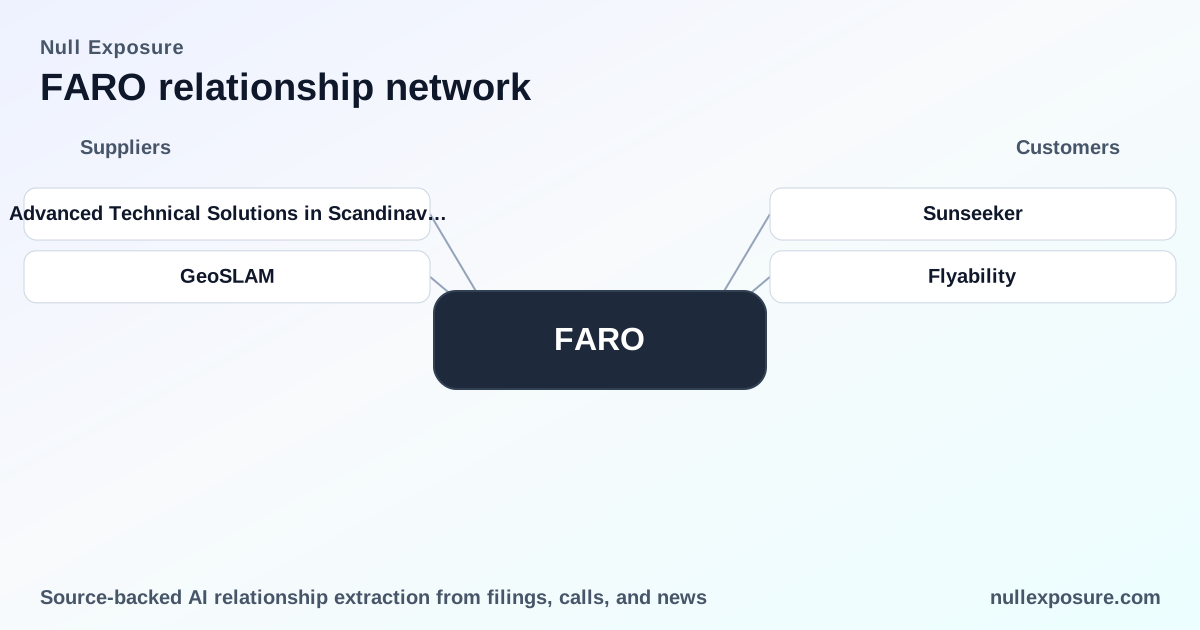
FARO: Supplier relationships that shape product reach and service density
FARO designs and sells high-precision 3D measurement, imaging and realization solutions and monetizes through hardware sales (scanners, arms), software subscriptions and lifecycle services delivered via a global channel and a small number of targeted acquisitions and partnerships. Its commercial model emphasizes product-led hardware sales supported by localized service hubs and specialist algorithm partners that extend product feature sets and differentiation.
Explore how these supplier and partner ties translate to market coverage and service continuity at https://nullexposure.com/.
Why supplier relationships matter for FARO investors
FARO's operating model blends manufactured capital goods with embedded software and field services. Supplier and partner choices directly affect unit economics, time to revenue for new products, and recurring service margins. When FARO acquires regional service providers or embeds third‑party algorithms into its product stack, the company is locking in distribution density and feature differentiation that support premium pricing and after‑sale revenue.
Visit https://nullexposure.com/ for deeper commercial intelligence on supplier exposure.
What the public record shows: two current, actionable relationships
The public relationships pulled from recent reporting are concentrated but strategic: one acquisition that boosts regional service capability and one technology partnership that enhances product differentiation. Each is material to how FARO sells and supports high‑touch hardware.
Advanced Technical Solutions in Scandinavia AB (ATS)
ATS was acquired and its Swedish facility will act as FARO’s Nordic sales and service center. This gives FARO a localized footprint for pre‑ and post‑sale service in the Nordics, reducing lead times for repairs and installations and strengthening recurring service revenue capability. According to ACHR News reporting on FARO’s FY2020 activity, the ATS Swedish facility is explicitly positioned as a Nordic sales and service center for FARO (https://www.achrnews.com/articles/160895-faro-acquires-ats-ab).
GeoSLAM
GeoSLAM supplies the proprietary SLAM algorithm that powers the FARO Orbis Mobile Scanner. Embedding GeoSLAM’s algorithm accelerates time‑to‑market for mobile scanning functionality and differentiates FARO’s product on point‑cloud capture performance. PBC Today reported on this integration in FY2023, noting the FARO Orbis Mobile Scanner is “powered by GeoSLAM’s proprietary SLAM algorithm” (https://www.pbctoday.co.uk/news/digital-construction-news/faro-orbis-mobile-scanner/134788/).
Operating model characteristics and company‑level signals
The constraint records provided include no explicit contractual restrictions or performance limitations. At the company level, this absence signals an orderly supplier footprint rather than a high‑constraint posture. From the relationship data and the nature of the ties, extractable operating model attributes are:
- Contracting posture: FARO acts as an integrator and consolidator—acquiring regional service providers and entering licensing/integration relationships for specialized software. Contracts are likely a mix of asset purchases (for service centers) and IP or licensing agreements (for algorithms).
- Concentration: The visible supplier set is small and strategic, not broad. FARO focuses on targeted relationships that solve discrete go‑to‑market or technical gaps rather than relying on a long tail of equivalent suppliers.
- Criticality: Both relationship types are highly critical: service hubs are essential to warranty and recurring revenue economics; embedded algorithms materially affect product competitiveness. Loss of either service capability or software partner would be noticeable to throughput and product positioning.
- Maturity: Relationships reflect a mature go‑to‑market: acquisition for structural coverage (service centers) and third‑party technology licensing for feature acceleration, consistent with a company that has moved beyond early R&D stage into scale.
Because the records did not include contracting constraints, these are company‑level signals rather than contract‑specific findings.
Investor implications: risks and opportunities
Investors should weigh the following distilled implications when assessing FARO supplier exposure:
- Positive: localized service density supports recurring revenues. The ATS acquisition enables faster field service response and tighter lifecycle management in the Nordics, which supports higher service attach rates and margin retention.
- Positive: third‑party algorithm partnerships accelerate product feature sets. GeoSLAM’s SLAM algorithm reduces FARO’s absolute R&D burden for mobile scanning and helps sustain product competitiveness without a full in‑house rebuild.
- Risk: dependence on a small number of strategic partners concentrates operational risk. With a focused supplier set, single‑point failures—loss of a technology partner or failure to integrate an acquired service operation—translate quickly into sales friction and warranty exposure.
- Operational insight: integration competence is a key value driver. FARO’s ability to operationalize acquisitions (convert a regional firm into a service center) and to embed external algorithms without degrading reliability matters as much as the underlying supplier capability.
For a more granular read on how these supplier ties affect earnings quality and service margins, see the supplier intelligence hub at https://nullexposure.com/.
Tactical recommendations for operators and procurement
- Prioritize contract provisions that secure continuity of algorithm licensing and ensure transition support on acquisitions.
- Monitor service KPIs in newly acquired regions for the first 12–18 months; integration lag often correlates with margin erosion.
- Hedge technology concentration by cultivating parallel algorithm evaluations or fallback service agreements.
Final takeaways and what to watch next
FARO runs a concentrated, strategic supplier posture that emphasizes service coverage and rapid feature augmentation via partnerships. That approach preserves margin and accelerates product availability but increases the value of execution on integration and contract continuity. Key items to track in upcoming quarters: service attach rates in the Nordics post‑ATS integration, renewal or expansion of any SLAM licensing terms, and disclosures around additional acquisitions or partnerships that would broaden supplier concentration.
If you evaluate supplier exposure as part of investment due diligence, detailed supplier mapping and contract review are necessary to quantify execution risk. Learn more about supplier risk and supplier-driven revenue levers at https://nullexposure.com/.
For ongoing, linked coverage and supplier profiles tailored to investors, visit https://nullexposure.com/.