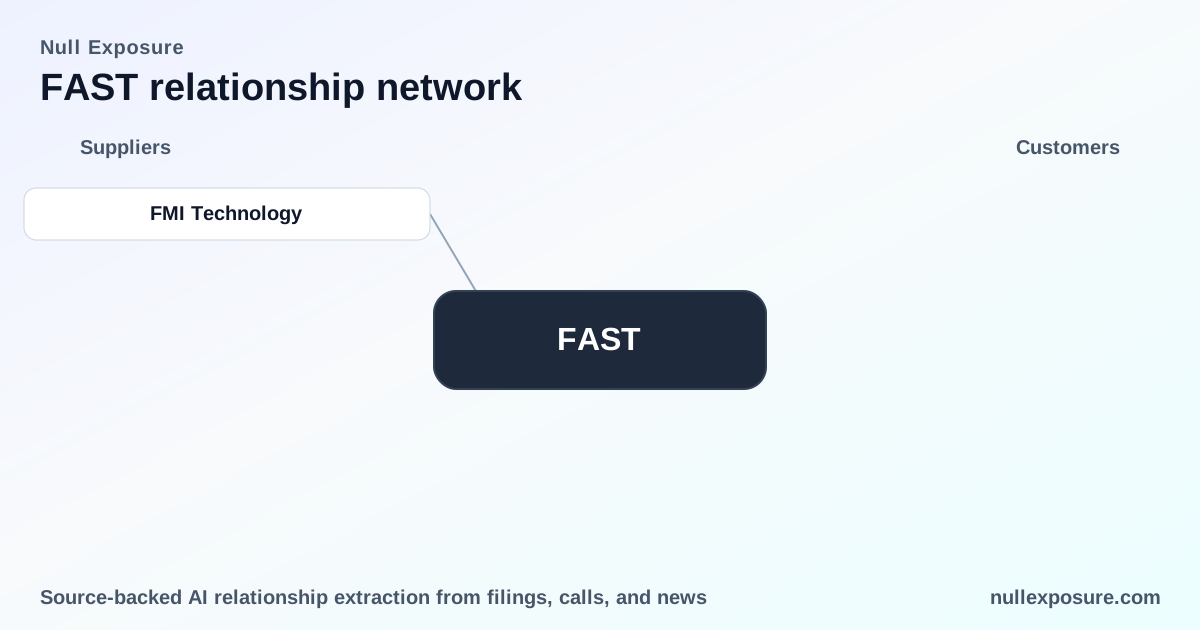
Fastenal’s supplier map: what investors and operators need to know
Fastenal operates and monetizes as a hybrid distributor-operator: 3,200 in-market locations and a field sales force convert local inventory intimacy into recurring product sales, vending/managed inventory contracts and digital-enabled services. The firm captures margin through product markup, value-added services (kitting, automated replenishment) and platform-driven transactions that reduce customers’ inventory touches — a model that scales with footprint and recurring supply relationships. For a deep supplier-risk and partner-performance read, see the Fastenal supplier dossier at https://nullexposure.com/.
Why supplier relationships determine Fastenal’s operating leverage Fastenal’s business model is fundamentally dependent on supplier breadth and local execution. The company sources commodity fasteners and proprietary private-label items at scale while selling services and replenishment solutions that lock in demand. Two traits matter for investors:
- Concentration by geography for certain product lines increases exposure to regional manufacturing cycles and trade dynamics. Fasteners and many private-label non-fastener products are largely sourced from Asia, with suppliers in China and Taiwan representing a significant portion of supply. This is a company-level disclosure for 2025.
- Mix of supplier sizes and roles improves flexibility in markets but complicates contracting: roughly 24% of inventory spend in 2025 was with small or certified/impactful businesses, signaling a deliberate portion of procurement targeted at smaller vendors and specialty producers.
- Import exposure is material operationally but was financially immaterial in 2025, when tariffs and import shipping cost effects on net income were described as immaterial.
- Supplier maturity and role include direct foreign producers and domestic intermediaries — Fastenal purchases both directly from foreign manufacturers and through domestic suppliers that source from abroad.
These characteristics create both resilience — via distributed local inventory and strong direct-to-customer channels — and vulnerability where product concentration or single-region supply dominates. For an operational risk dashboard built for investors and procurement teams, visit https://nullexposure.com/.
Every external relationship noted in media: what was reported and where Below I list each relationship mention found in the collection and give a concise, plain-English summary tied to the original reporting.
-
Finviz (March 9, 2026) — FMI Technology
FMI Technology is reported to have accounted for nearly half of Fastenal’s fourth-quarter sales through FMI or other digital platforms, highlighting that digital channels and automated services materially contributed to revenue mix in FY2026, according to the Finviz summary of Baird coverage. -
InsiderMonkey (March 9, 2026) — FMI Technology
InsiderMonkey relayed the same point from Baird research: about 50% of Q4 sales flowed through FMI Technology or alternative digital channels, underscoring the fast acceleration of automated and value-added digital services in Fastenal’s sales mix. -
Bitget (March 9, 2026) — FMI Technology
Bitget’s report repeated the market note that nearly half of fourth-quarter sales were completed via FMI Technology or other digital platforms, reinforcing that FMI is functioning as a major commercial channel for Fastenal’s service-driven revenue in FY2026.
How to read the FMI Technology signal All three items reference the same operational fact — FMI Technology and broader digital platforms drove a very large share of late‑FY2026 sales. That single signal is transformative for channel economics: a near-50% digital share changes customer stickiness, unit economics and the marginal value of in-market inventory. Investors should treat FMI Technology as a critical commercial partner rather than a peripheral vendor given this level of influence.
Supply constraints and company-level signals that shape risk Interpret the supplier constraints as company-level attributes unless a specific relationship is named.
- Contracting posture: Fastenal runs a hybrid contracting model — local purchasing authority through 3,200 locations plus centralized import arrangements — which supports fast fulfillment but requires tight governance on quality and compliance.
- Concentration risk: The supply base for fasteners and private-label non-fastener products is heavily concentrated in Asia, notably China and Taiwan, creating single-region exposure for key product families.
- Counterparty composition: With ~24% of inventory spend directed to small or certified/impactful businesses, Fastenal balances cost and resilience with supplier diversification and social procurement objectives.
- Criticality and maturity: Many suppliers are manufacturers (both direct foreign producers and indirect domestic resellers), implying that supplier relationships are operationally critical and anchored in established manufacturing channels.
- Tariff and shipping impact: For 2025, the company reported tariffs and shipping cost impacts on net income as immaterial, which softens near-term P&L sensitivity to trade shocks but does not eliminate operational risk.
What this means for investors and procurement teams Fastenal’s model gives it a durable franchise: local inventory plus digital channels equals recurring revenues and higher customer switching costs. But the supplier picture imposes three watch items you should track:
- Digital platform dependency: With FMI Technology and other digital platforms responsible for a major share of sales in FY2026, any operational or commercial disruption to that channel would have outsized revenue implications. Monitor digital channel retention and contract terms.
- APAC manufacturing concentration: Track supplier diversification plans, dual-sourcing initiatives, and inventory buffers for critical SKUs sourced from China and Taiwan to assess supply continuity risk.
- Small-supplier exposure: The 24% allocation to small/certified suppliers improves resilience and social procurement positioning, but it requires scaleable vendor management to control quality and delivery.
Actionable takeaways for investors and operators
- Investors: model a sensitivity case where digital-channel revenue growth reverses or slows and quantify the impact on recurring service margins; prioritize dialog with management on FMI Technology contract economics and renewal cadence.
- Operators and procurement leaders: accelerate supplier mapping for high-concentration SKUs, codify contingency plans for APAC-sourced fasteners, and standardize KPI reporting for the small-supplier cohort to keep quality and delivery performance visible.
For a structured supplier-risk scorecard and ongoing monitoring tools, explore our Fastenal coverage at https://nullexposure.com/.
Conclusion — positioning and monitoring Fastenal’s supply chain is the operational backbone of a services-led distribution model. The company’s growing digital channel — anchored by FMI Technology — reshapes revenue composition and elevates the strategic importance of digital partners, while APAC concentration and a meaningful small-supplier footprint create a mixed risk profile that is manageable but requires active oversight. Investors should prioritize transparency on digital-channel economics and supplier diversification plans when assessing Fastenal’s next chapter.
If you want a focused supplier-risk briefing or a custom monitoring dashboard for Fastenal, start with our homepage: https://nullexposure.com/.