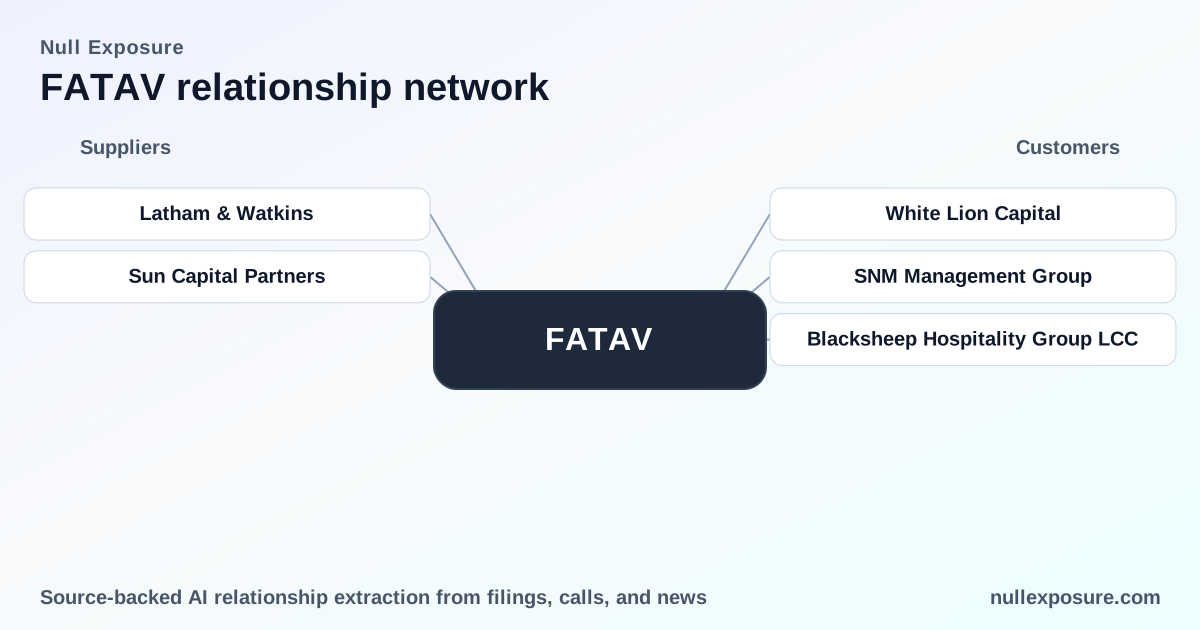
FAT Brands (FATAV) — supplier relationships and what they mean for investors
FAT Brands operates as a multi-brand restaurant franchising and brand-acquisition platform that acquires, develops, markets, and manages quick service, fast casual, casual and polished casual concepts worldwide. The company monetizes through brand acquisitions and franchising economics — licensing, franchise fees and royalties — supplemented by marketing and management services to franchise operators. For investors evaluating supplier and counterparty risk, the most relevant relationships are legal counsel tied to governance events and the private equity sellers from which FAT grows its portfolio. Learn more about supplier risk mapping and relationship signals at https://nullexposure.com/.
How FAT Brands makes money and why suppliers matter
FAT Brands is not a single-unit operator; it is an aggregator and franchisor. That structure concentrates value in brand-level intellectual property, franchise agreements and centralized services. Revenue flows principally from franchising and brand-level services, so relationships that affect governance, acquisition terms and brand integrations are strategically critical rather than operationally transactional. Suppliers and counterparties that touch legal disputes, acquisition sellers and brand transition services therefore carry elevated importance to investors.
If you want a consolidated view of how supplier relationships influence premium finance and credit exposure, visit https://nullexposure.com/ for tailored analysis and continuous monitoring.
What the public record shows about supplier and counterparty relationships
Below I summarize every relationship captured in the available news results and provide the source context for each mention.
Latham & Watkins — counsel cited in governance dispute
Fat Brands engaged Latham & Watkins in a governance matter where Ray Schrock, identified as an attorney with FAT Brands and the firm, told a court that governance changes were implemented quickly after an undisclosed stock sale was discovered. This reference highlights the role of external law firms in governance responses. (Restaurant Business Online, March 2026: https://restaurantbusinessonline.com/financing/fat-brands-ceo-andy-wiederhorn-keeps-his-job-questions-remain)
Sun Capital Partners — seller of Smokey Bones (reported June 2025)
Local reporting referenced that FAT Brands purchased the Smokey Bones barbecue chain for $30 million from Sun Capital Partners in 2023; the article discussed later closures and brand rebranding activity under FAT ownership. This illustrates how private equity-to-franchisor transactions feed FAT’s acquisition pipeline and the operational challenges in post-acquisition integration. (Lansing State Journal, June 2025: https://www.lansingstatejournal.com/story/news/local/michigan/2025/06/27/michigan-smokey-bones-rebranded-twin-peaks-closures/84384753007/)
Sun Capital Partners — acquisition announced (2023)
Fat Brands publicly disclosed the acquisition of Smokey Bones from an affiliate of Sun Capital Partners for $30 million, confirming the transaction and the value paid for the brand. This is a concrete example of FAT’s acquisition strategy: buying established concepts from private-equity owners and folding them into its franchising platform. (Restaurant Dive, 2023 press release coverage: https://www.restaurantdive.com/news/fat-brands-acquires-smokey-bones-for-30-million/694716/)
Sun Capital Partners — reporting on closures under FAT ownership (2025)
Coverage of store closures and rebrand activity reiterated that FAT acquired Smokey Bones from Sun Capital Partners in 2023 for $30 million, and that FAT is executing brand rationalization across the portfolio. This underscores the operational risk and capital allocation choices that follow private‑equity-to-franchisor transfers. (Wide Open Country, 2025 coverage: https://www.wideopencountry.com/tgi-fridays-rival-reveals-closing-bbq-stores/)
What those relationships imply for investors
- Legal counsel is not a peripheral supplier; it is operationally material during governance events. The Latham & Watkins mention indicates FAT will use established external counsel to manage shareholder and governance disputes, which is a normal but costly line item for a public franchisor navigating activist or unexpected events.
- Private equity sellers are a pipeline and a risk source. The repeated Sun Capital references show FAT grows via purchases from PE owners, which accelerates scale but also imports legacy operating footprints, lease obligations and brand health issues that require capital and managerial attention.
- Integration and portfolio pruning drive near-term cash flow volatility. Public reporting on closures and rebranding after a 2023 acquisition implies FAT executes active portfolio management—this reduces long-run overlap but creates short-term restructuring costs and demands on supplier networks (marketing, construction, legal).
Operational constraints and company‑level signals
The record does not contain explicit contractual terms or supplier constraints, so these are company-level operating model signals rather than relationship-specific findings:
- Contracting posture: Centralized franchisor model with transactional contracts — the business relies on standardized franchise agreements and external professional services (legal, M&A advisors) rather than bespoke supply contracts for retail operations.
- Concentration: Acquisition-driven concentration risk — acquisitions from private equity create episodic concentration around newly-acquired brands until they are fully integrated and franchised out.
- Criticality: High criticality for legal and M&A counterparties — counsel and sellers play outsized roles in governance and scale expansion, which elevates counterparty importance beyond typical vendor relationships.
- Maturity: Mixed maturity across brands — some acquired concepts are established and cash-generative, others require remediation; this heterogeneity demands flexible supplier and capital responses.
Key risks investors should price
- Integration execution risk: post-acquisition closures suggest integration requires capex and restructuring spend.
- Legal and governance exposure: court-level governance responses indicate potential for investor- or litigation-driven costs.
- Counterparty dependency during rollups: reliance on M&A counterparties and specialist counsel creates single-event concentration risk.
If you want continuous tracking of how these supplier relationships evolve and influence credit or premium finance outcomes, check out our monitoring tools at https://nullexposure.com/.
Investment takeaway and next steps
FAT Brands is a roll‑up franchisor that monetizes through brand ownership and franchising economics; supplier relationships in legal services and private equity sellers are strategically important because they influence governance outcomes and the quality of acquisitions. Investors should underwrite acquisition-related integration costs and watch legal developments closely as a driver of volatility.
For dedicated supplier-risk intelligence, portfolio screening and alerting, visit https://nullexposure.com/ to subscribe and integrate relationship signals into your investment process.