FATN (FatPipe, Inc.): Supplier relationships and what they mean for investors
FatPipe builds and sells software-defined WAN (SD-WAN), SASE and network monitoring solutions, monetizing primarily through software licensing, service subscriptions and professional services to enterprise and channel customers. The company leverages recurring revenue from its network software and hosted monitoring services while using investor and IR channels to maintain market visibility and access capital markets. Investors should view FatPipe as a small-cap infrastructure software vendor with a revenue-heavy, margin-accretive product mix and concentrated ownership. If you want a concise supplier-risk snapshot and ongoing signals on FATN, visit https://nullexposure.com/ for coverage and updates.
How FatPipe operates and where the money comes from
FatPipe markets appliances and cloud-delivered network control plane software to enterprises that require secure, resilient wide-area connectivity. Revenue streams are a mix of upfront product sales, recurring licenses/subscriptions and implementation/maintenance services, which explains the company’s relatively high gross margin (Gross Profit TTM: 14.56M on Revenue TTM: 15.78M) and modest operating margin profile. Financial metrics show consistent but small scale: market capitalization around $25.8M, trailing PE ~37, and forward PE ~8.8, indicating valuation compression today relative to forecasted earnings improvements.
Supplier and vendor relationships that matter
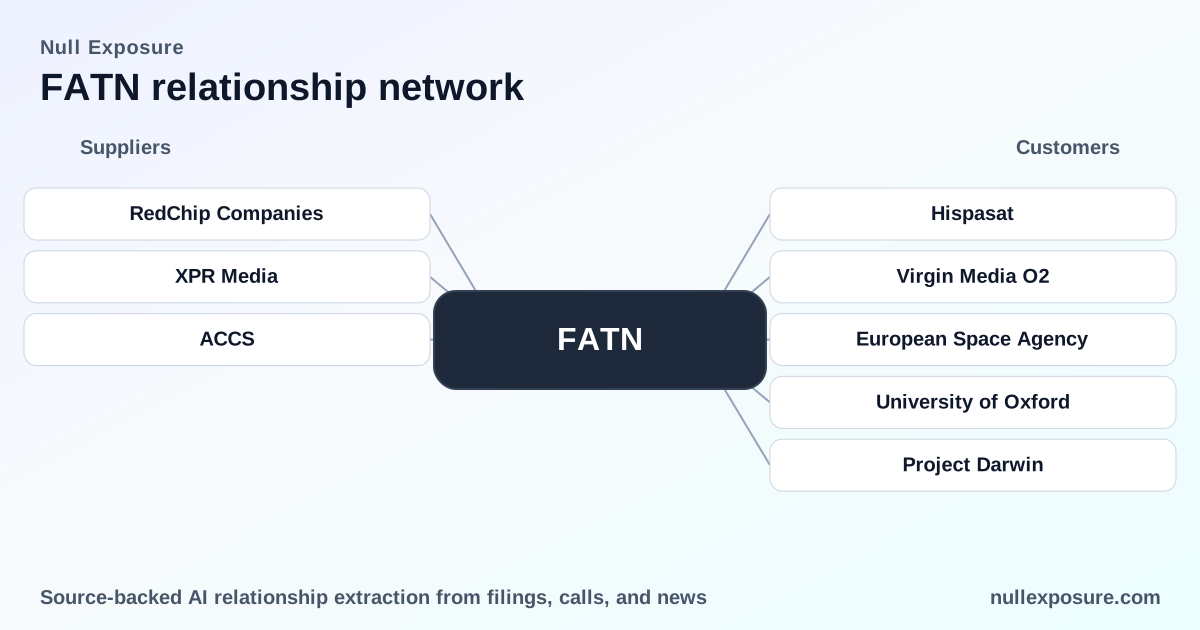
Below are every supplier/partner relationship identified in public reporting and press distribution for FATN. Each entry is a plain-English summary followed by the original source context.
RedChip Companies — investor events and IR distribution
FatPipe uses RedChip Companies to host investor-facing events and distribute executive commentary; RedChip is listed as hosting an exclusive event featuring FatPipe’s CEO and Chairman and identified FatPipe as a RedChip client in March 2026. This relationship functions as investor relations and market communications support rather than a technology supplier. Source: Visalia Times-Delta and several press releases distributed across regional outlets (RedChip Companies press mentions, March 2026 — e.g., https://www.visaliatimesdelta.com/press-release/story/10883/fatpipe-jackpot-digital-and-ndt-pharmaceuticals-interviews-to-air-on-the-redchip-small-stocks-big-moneytm-show-on-bloomberg-tv/).
XPR Media — press-release distribution partner
XPR Media appears as the distributor for one of FatPipe’s investor webinars and Q&A announcements in December; the entry indicates XPR Media handled press distribution for investor communications. This is a standard PR/distribution relationship that amplifies corporate announcements to retail and regional outlets. Source: News-Leader press-release listing (December 2026 distribution notice — https://www.news-leader.com/press-release/story/16589/join-fatpipes-exclusive-live-investor-webinar-and-qampa-session-on-december-16/).
ACCESS Newswire — press distribution attribution
Several press releases indicate the original release was “View the original press release on ACCESS Newswire,” identifying ACCESS Newswire as a distribution channel for FatPipe announcements. This confirms FatPipe’s use of wire services to reach investors and media. Source: Times Record News press release pointing to ACCESS Newswire (press distribution, March 2026 — example: https://www.timesrecordnews.com/press-release/story/12301/fatpipe-ceo-publishes-letter-to-shareholders/).
What these relationships signal about FatPipe’s operating model
The supplier relationships disclosed are concentrated in investor communications and press distribution rather than core infrastructure or cloud-provider partnerships. Treat these as company-level signals about FatPipe’s market-facing posture and not as indicators of product-supply chain risk.
- Contracting posture: FatPipe contracts with external investor-relations and press-distribution vendors to amplify corporate messaging, indicating a proactive IR strategy and willingness to outsource market communications. This is consistent with small-cap public companies that need external reach.
- Concentration: The visible supplier list is narrow and skewed to PR/IR services; there is no public evidence in these sources of high-volume third-party technology vendors or large cloud partners in these particular records. Concentration in communications vendors suggests low operational supplier diversity in the disclosed dataset, not necessarily across product engineering or hosting.
- Criticality: PR and wire services are strategically important for retail/SMB investor engagement and liquidity, but they are not critical to product delivery or service uptime. The disclosed relationships therefore represent market-facing criticality rather than technical dependency.
- Maturity: Use of established PR distributors (ACCESS Newswire, XPR Media, RedChip) signals a mature approach to public company communications and investor outreach, which supports credibility with small-cap investors and brokers.
Investment implications and a short risk checklist
FatPipe’s supplier footprint in the public record is dominated by communications partners rather than technology vendors, which has direct implications for investors evaluating operational risk and shareholder engagement.
- Positive: Visibility and investor engagement. FatPipe’s recurring use of investor webinars and wire services demonstrates an active investor-relations program that supports transparency and retail visibility; this supports liquidity and coverage among small-cap investors.
- Neutral: Low operational supplier disclosure. Absence of major cloud or OEM supplier disclosures in these press-distribution results does not equal absence of product dependencies — it highlights the limits of this public record segment. Investors should seek additional filings or direct disclosures for vendor concentration on hosting, components, or channel partners.
- Risk: Ownership concentration and governance. Company-level metrics show ~55% insider ownership and under 1% institutional ownership, which concentrates control and elevates governance risk and strategic direction sensitivity to insiders’ decisions.
- Financial signal: Small scale with improving margins. The company reports positive operating margins and slight YoY growth in revenues and earnings, but market cap and float are small (Shares outstanding ~13.9M; float ~6.2M), which increases volatility and liquidity risk.
Use this checklist when doing deeper diligence:
- Confirm hosting and cloud-provider contracts and SLAs.
- Request a channel and reseller concentration schedule.
- Reconcile revenue mix: on-prem appliances versus recurring subscriptions.
If you want a more detailed supplier-risk profile or vendor concentration report for FATN, access research and alerts at https://nullexposure.com/ — we track event-driven disclosures and supplier signals across small-cap software companies.
Final takeaways and recommended next steps
FatPipe runs a classic small-cap infrastructure-software commercial model: recurring-license revenue supported by targeted investor outreach. The supplier relationships visible in public press distribution are focused on IR and PR, not on technical supply chains; that distinction matters for operational due diligence. Investors should prioritize vendor and hosting transparency and monitor insider ownership dynamics when modeling downside risk and governance scenarios.
For continuing updates, detailed relationship tracking, and direct supplier-risk briefings on FATN, visit https://nullexposure.com/ and request the FatPipe supplier and disclosure pack. Conduct vendor-level diligence to confirm product delivery dependencies and channel concentration before adjusting position sizing.