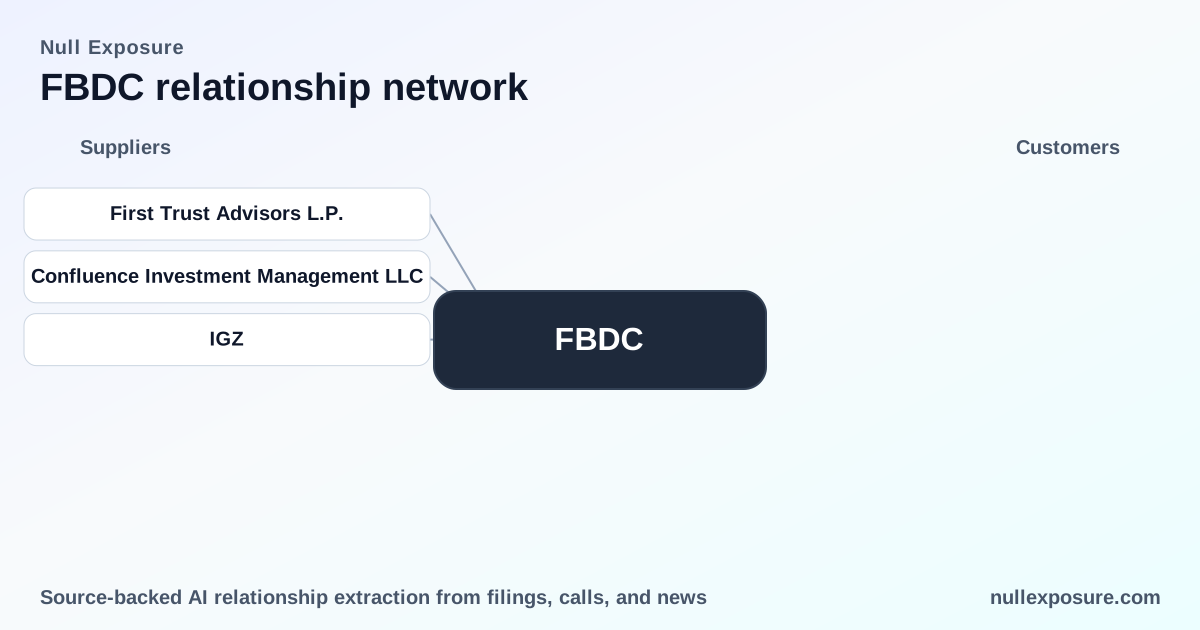
FBDC supplier snapshot: how the fund is run, who gets paid, and what investors should watch
FBDC operates as an exchange-traded vehicle built around specialty finance and BDC exposure, monetizing through advisory and sub-advisory fee streams plus the routine trading/market-making activity that supports an ETF wrapper. Management fees and sub-advisory contracts are the primary revenue mechanism; control of the investment mandate and distribution sits with First Trust Advisors as the advisor and Confluence as the investment sub‑advisor, while listing and market mechanics are routed through NYSE Arca. For investors and operators evaluating commercial relationships, the economics are straightforward: fees flow to the advisor ecosystem, while operational and regulatory control is concentrated in a small set of external suppliers. Explore full supplier coverage at Null Exposure: https://nullexposure.com/.
How FBDC makes money and where operational leverage lives
FBDC’s economics are anchored in two simple lines: advisory income (the fee paid to First Trust Advisors L.P.) and sub-advisory income (the fee paid to Confluence Investment Management LLC for portfolio management). These contracts determine net yield to the ETF and therefore directly influence investor demand and AUM growth. Secondary, but meaningful, revenue drivers for the service ecosystem include acting as the fund’s distributor, creation/redemption support, and exchange listing liquidity that affect spreads and turnover.
Operational characteristics that matter to counterparties and investors:
- Contracting posture: The fund is vendor-managed; FBDC outsources portfolio management and advisory responsibilities to registered advisors rather than running an in-house investment team. That creates a supplier relationship model where the advisors possess pricing power over key components of the fund’s economics.
- Concentration: A small number of suppliers (notably First Trust and Confluence) are functionally critical; this increases vendor concentration risk for operations and continuity.
- Criticality: Advisory and sub‑advisory agreements are mission-critical — loss or change of either supplier would materially affect strategy execution and fee capture.
- Maturity and recent activity: The relationship structure and CUSIP changes in FY2025 indicate recent reorganization and operational adjustments, suggesting the fund is in an active phase of mandate and ticker-level transition rather than being a long-settled wrapper.
These characteristics define where counterparty risk sits and what to pressure-test in diligence: fee schedule stability, contract duration and termination terms, role clarity between advisor and sub-advisor, and the fund’s exchange/listing arrangements. Learn more about supplier risk frameworks at Null Exposure: https://nullexposure.com/.
What the filings and press releases say — every supplier relationship in the record
Below are plain-English summaries of each relationship record surfaced in the supplied results, with direct source references for verification.
-
First Trust Advisors L.P. — The fund’s named investment advisor is First Trust Advisors L.P., which is described as a federally registered investment advisor serving as the Fund’s investment advisor in the July 23, 2025 press release concerning an upcoming CUSIP change (BizWire via Lethbridge Herald, July 23, 2025: https://markets.financialcontent.com/lethbridgeherald/article/bizwire-2025-7-23-first-trust-announces-upcoming-cusip-change-for-ft-confluence-bdc-and-specialty-finance-etf).
-
First Trust Advisors L.P. — The June 30, 2025 reorganization announcement likewise identifies First Trust Advisors as the fund’s investment advisor, confirming continuity of advisory responsibility during the reorganization (BizWire via Redlands Daily Facts, June 30, 2025: https://markets.financialcontent.com/redlandsdailyfacts/article/bizwire-2025-6-30-first-trust-announces-completion-of-first-trust-specialty-finance-and-financial-opportunities-fund-reorganization-into-ft-confluence-bdc-and-specialty-finance-income-etf).
-
Confluence Investment Management LLC — Confluence is repeatedly named as the SEC-registered investment sub-advisor to FBDC (and related fund tickers), indicating that portfolio management authority and day-to-day security selection are delegated to Confluence (BizWire via Daily Breeze, May 6, 2025: https://markets.financialcontent.com/dailybreeze/article/bizwire-2025-5-6-first-trust-announces-results-of-special-meeting-of-shareholders-relating-to-the-reorganization-of-first-trust-specialty-finance-and-financial-opportunities-fund-with-and-into-ft-confluence-bdc-and-specialty-finance-income-etf).
-
Confluence Investment Management LLC — Coverage in the July 23, 2025 CUSIP-change announcement reiterates Confluence’s role as investment sub-advisor to the Fund and the rebranded ETF vehicle (BizWire via Lethbridge Herald, July 23, 2025: https://markets.financialcontent.com/lethbridgeherald/article/bizwire-2025-7-23-first-trust-announces-upcoming-cusip-change-for-ft-confluence-bdc-and-specialty-finance-etf).
-
Confluence Investment Management LLC — The June 30, 2025 reorganization completion release references Confluence as sub-advisor to FGB and the new ETF structure, reinforcing the operational shift executed during the reorganization (BizWire via Redlands Daily Facts, June 30, 2025: https://markets.financialcontent.com/redlandsdailyfacts/article/bizwire-2025-6-30-first-trust-announces-completion-of-first-trust-specialty-finance-and-financial-opportunities-fund-reorganization-into-ft-confluence-bdc-and-specialty-finance-income-etf).
-
Confluence Investment Management LLC — An earlier adjournment notice from April 21, 2025 also identifies Confluence as sub-advisor to both FGB and FBDC, evidencing consistent public disclosure across the reorganization process (BizWire via Daily Breeze, April 21, 2025: https://markets.financialcontent.com/dailybreeze/article/bizwire-2025-4-21-first-trust-announces-adjournment-of-special-meeting-of-shareholders-relating-to-the-reorganization-of-first-trust-specialty-finance-and-financial-opportunities-fund-with-and-into-ft-confluence-bdc-and-specialty-finance-income-etf).
-
NYSE Arca — The fund’s exchange mechanics are referenced in the context of a reverse share split and a CUSIP change expected to be effective at market open on or about August 4, 2025; the press release ties the trading and listing timetable to NYSE Arca’s calendar and regulatory requirements (BizWire via Lethbridge Herald, July 23, 2025: https://markets.financialcontent.com/lethbridgeherald/article/bizwire-2025-7-23-first-trust-announces-upcoming-cusip-change-for-ft-confluence-bdc-and-specialty-finance-etf). The entry also notes an inferred NYSE Arca symbol contextually linked to listing mechanics.
Commercial implications and where to focus diligence
- Counterparty concentration is the single biggest operational risk. With advisory and sub-advisory duties concentrated in First Trust and Confluence, contract terms and succession planning are decisive value drivers for FBDC.
- Fee economics are the control lever. Small changes in advisory or sub-advisory fees will materially alter distributable yield and could drive AUM flows. Insist on clarity about fee waterfalls and how distributions to First Trust and Confluence are structured.
- Regulatory and listing events are active risks. The FY2025 reorganization and CUSIP change signal transition risk; verify transfer mechanics, shareholder communications, and any short windows for operational failures that could affect liquidity.
If you are evaluating counterparty exposure for portfolio or operational risk decisions, get the complete supplier map and contract summaries at Null Exposure: https://nullexposure.com/.
Final assessment and recommended next steps
FBDC is a fee-driven ETF-like vehicle whose economics, continuity, and performance hinge on a compact supplier set: First Trust Advisors as the advisor, Confluence as sub-advisor, and NYSE Arca for market access and listing mechanics. That concentration creates clear levers — and single points of failure — for investors and counterparties. Prioritize reviewing advisory and sub-advisory agreements, termination and change-of-control provisions, and the operational playbook for CUSIP/ticker transitions. For a deeper supplier-level breakdown and contract flagging, visit Null Exposure and request the supplier dossier: https://nullexposure.com/.