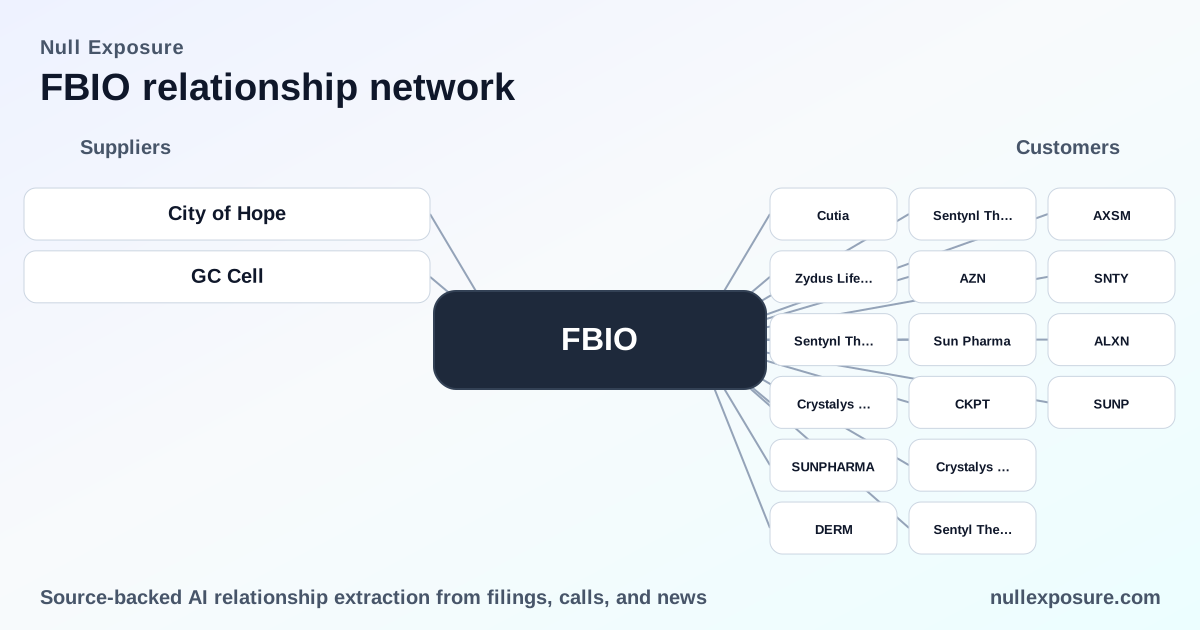
Fortress Biotech (FBIO) — Supplier relationships and operational exposure investors should price in
Fortress Biotech operates as a specialty biopharma platform that develops and commercializes pharmaceutical and biotech products through a mix of in‑house programs, licensing deals, and partner-led commercialization. The company monetizes through product sales (often routed through partner Journey), licensing and collaborative development agreements, and royalty flows; its balance sheet and revenue profile are therefore tied as much to third‑party manufacturing and partner execution as to internal R&D. Market cap is modest (≈ $95.9M) and the company runs a high‑leverage operational model that concentrates risk in suppliers and partners. For a concise supplier intelligence view, visit https://nullexposure.com/.
Why supplier relationships matter for Fortress: concentrated manufacturing, partner monetization
Fortress outsources the majority of its preclinical, clinical and commercial manufacturing and routinely structures product commercialization through partners. This produces two structural dynamics investors must price in: concentration risk where a single manufacturer can control supply for existing revenue streams, and counterparty risk where partner commercialization (e.g., Journey) and licensing revenue flows determine cash conversion. Company disclosures explicitly state reliance on third parties for manufacturing and warn that several commercialized products are produced by a single manufacturer — a contract‑level vulnerability that is material and critical to revenue continuity.
- Contracting posture: Fortress adopts a supplier‑outsourced model and relies heavily on third‑party manufacturers and external contractors for clinical and commercial supply.
- Concentration and criticality: Several products are produced by a single manufacturer, creating a single‑point failure that can materially reduce revenues if supply is interrupted.
- Maturity and dependency: The business leverages licensing and partner commercialization, implying operational maturity in dealmaking but dependency on counterparties for execution and inventory management.
Key supplier and partner relationships investors need to track
Fortress’s publicly visible supplier/partner ties in our results are limited but strategically significant. Below are the relationships identified in public reporting, with plain-English summaries and source attribution.
City of Hope — Helocyte/Triplex licensing (FY2022)
Helocyte (a Fortress subsidiary) holds an exclusive worldwide license to Triplex from City of Hope, an asset originating from City of Hope research; that licensing arrangement underpins Helocyte’s Triplex development program and is core to ongoing clinical activity. According to a company news release reported on Yahoo Finance, Helocyte secured that exclusive license in 2015 and continues to reference City of Hope as the originator of Triplex (reported in FY2022).
Source: Yahoo Finance press coverage of Helocyte licensing history (reported March 2026).
City of Hope — investigational product supply for Triplex clinical work (FY2021)
Clinical reporting around a Phase 2 trial shows that the investigational Triplex product used in at least one study was supplied by Don Diamond, Ph.D., a City of Hope professor, and City of Hope was directly involved in providing the investigational material for the trial in adults co‑infected with HIV and CMV. This operational linkage means City of Hope has been a direct supplier of investigational product in at least some Triplex studies.
Source: EATG news report on Phase 2 initiation and clinical sourcing (reported FY2021).
GC Cell — collaboration on cosibelimab plus Immuncell‑LC (FY2024)
Fortress announced a collaboration to explore combining cosibelimab with GC Cell’s Immuncell‑LC, an autologous CIK T cell therapy platform, as part of its oncology development strategy. This is a strategic development collaboration rather than a pure manufacturing vendor relationship, but it creates a supplier/partner dependence around product development, clinical comparators, and potential co‑commercialization dynamics.
Source: QuiverQuant news coverage referencing a July 2024 collaboration announcement (reported FY2024).
What those relationships imply for investors and operators
The three results point to two categories of supplier exposure: academic/collaborator supply for clinical programs (City of Hope) and company‑to‑company collaborative development and combination therapy relationships (GC Cell). Investors should treat these as operational levers that can both unlock value and introduce execution risk.
- Clinical supply vulnerability: City of Hope’s role as a supplier of investigational Triplex product creates a chain where academic centers supply trial material; any breakdown in that supply pathway would slow enrollment and regulatory timelines.
- Strategic collaboration risk/reward: The GC Cell collaboration expands therapeutic scope via a combination approach, increasing upside if clinical data support safety and efficacy but also creating dependency on external manufacturing and cell‑processing logistics.
Company disclosures further reinforce the practical consequence: Fortress relies predominantly on third parties to manufacture most clinical and commercial supplies, and several commercial products are produced by a single manufacturer, making supply continuity a critical risk to revenue.
Operational checklist for investors and operating teams
Active monitoring and targeted diligence will materially reduce surprise and give operators levers to manage risk.
- Confirm manufacturing redundancy clauses and alternative qualified suppliers for any product produced by a single manufacturer; track inventory levels for Journey‑sold products tied to that manufacturer.
- Review contractual protections: termination rights, supply continuity obligations, lead times, and indemnities in agreements with academic suppliers and collaborators.
- Monitor milestone and royalty mechanics: understand how license income and royalty payments are structured, and how decreases (as noted historically on Qbrexza royalties) affect COGS and margins.
- Track clinical supply logistics for Triplex: donor‑site dependencies, cell processing, and chain‑of‑custody handled by City of Hope or other third parties.
- For GC Cell collaboration, validate commercialization and manufacturing pathways for cell therapies, which require specialized facilities and create higher operational friction than small‑molecule supply.
Bottom line — price a platform reliant on partners and a concentrated supply chain
Fortress Biotech is a partner‑driven biopharma platform whose near‑term performance is tightly coupled to third‑party manufacturers, academic suppliers, and collaborative partners. Key investment risks are supply concentration and partner execution; key value drivers are license milestones, successful clinical readouts for Triplex and cosibelimab combinations, and sustained commercialization via Journey and other partners. For a rapid supplier‑risk briefing and ongoing monitoring, visit https://nullexposure.com/.
Investors should prioritize diligence on manufacturing contracts, inventory buffers, and the contractual terms governing collaborations and licensing. Operators should prioritize diversification of supply and stronger contractual continuity provisions. For supplier‑level intelligence and periodic updates on FBIO counterparties, return to https://nullexposure.com/ — the place to track these relationships continuously.