Fortress Biotech (FBIOP) — supplier relationships and operational constraints investors must price in
Fortress Biotech monetizes primarily through licensing, development-stage product sponsorship and royalties tied to its in-licensed assets and affiliated subsidiaries. The company operates as a capital-light orchestrator: it licenses intellectual property, outsources development and manufacturing, and retains commercialization and royalty upside where assets advance. For investors evaluating Fortress’s preferred securities and counterparty exposure, the crucial dynamics are the degree of third-party dependence, license counterparties, and the concentration of manufacturing and clinical services. Learn more about supplier mapping and counterparty risk at https://nullexposure.com/.
The business model in plain terms: orchestrator, not manufacturer
Fortress’s economics are driven by upfront and milestone licensing events, development spend allocated to third parties, and downstream royalties or sales participation if products commercialize. That model keeps fixed capital low but transfers execution risk to external manufacturers and contract research organizations. The company’s financials underscore this operating posture: negative EBITDA and net losses alongside modest revenue highlight reliance on asset transactions and milestone timing rather than steady product cash flow.
Who Fortress lists as a supplier or partner
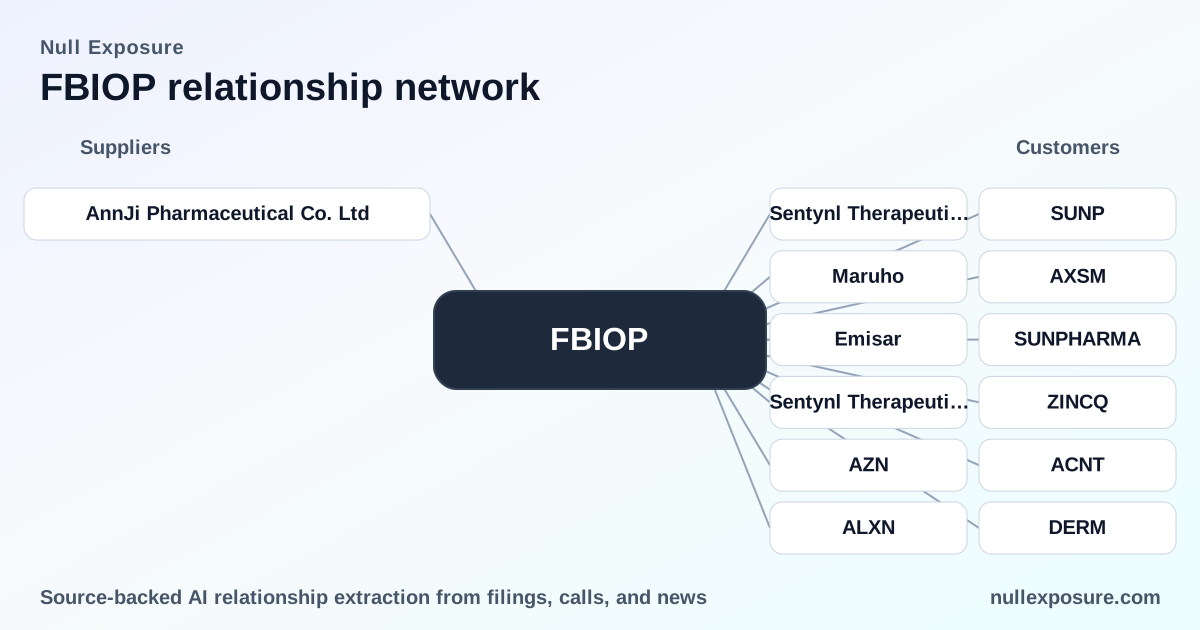
AnnJi Pharmaceutical Co. Ltd — an IP licensor to an affiliated platform
In Fortress’s FY2024 Form 10-K the company notes that in February 2023 Avenue announced the license of intellectual property rights underlying AJ201 from AnnJi Pharmaceutical Co. Ltd. This is a licensing relationship where IP for a development asset (AJ201) moved to an affiliated commercial/development platform. Source: Fortress Biotech FY2024 Form 10-K (filed 2024).
What the filing’s supplier and contractor constraints reveal about operational risk
Fortress’s disclosures make two structural dependencies explicit: outsourced manufacturing and heavy use of clinical/service providers. These are company-level signals rather than relationship-specific claims.
- The 10-K states the company relies predominantly on third parties to manufacture the majority of its preclinical, clinical and expected commercial supplies, and that it relies solely on third parties to manufacture certain commercialized products. This establishes a contracting posture of deep outsourcing rather than captive manufacturing, which creates supply-chain and single-source risk.
- The filing also details reliance on contract research organizations, site management organizations, clinical data managers and investigators for preclinical and clinical work, and describes R&D costs driven by payments to third parties for studies and trial materials. That confirms operational dependence on external development partners for clinical execution.
Taken together, these disclosures produce clear business-model characteristics investors should price:
- Contracting posture — outsourced and supplier-dependent. Fortress’s model shifts execution risk to vendors and licensors rather than absorbing it internally. Investors should expect variability from third-party performance and contract terms.
- Concentration risk — potential for single or few vendors to matter. The filing’s wording about relying “predominantly” on third parties and “solely” on third parties for some products implies potential single-source suppliers for critical components.
- Criticality — supplier performance is mission-critical. Manufacturing and CRO failure directly delays development milestones and revenue triggers; these vendors are central to Fortress’s path to value realization.
- Maturity — developmental and transaction-driven revenue profile. The company’s financial profile and licensing activity indicate revenues are milestone and transaction-dependent, not recurring commercial cash flows.
Key relationship takeaways and investment implications
-
AnnJi/ AJ201 licensing: The transfer of AJ201 IP into Avenue is a strategic licensing move that centralizes development rights within Fortress’s affiliated platform rather than with the original licensor. This consolidates control of the asset within Fortress’s ecosystem but also places responsibility for development and commercialization on Fortress-managed entities and their vendors. Source: FY2024 Form 10-K.
-
Operational exposure to third-party manufacturers and CROs: Fortress’s reliance on external manufacturers and CROs is explicit in its filings; this is a primary operational risk factor that affects timing of milestones, regulatory filings, and potential revenue recognition. Source: FY2024 Form 10-K excerpts on manufacturing and clinical outsourcing.
Financial context that frames supplier risk
Fortress’s latest public metrics put supplier risk into sharper relief: market capitalization roughly $73.6 million, trailing revenue around $62.3 million, and negative EBITDA and EPS. When a company has constrained market value and is loss-making, delays or cost overruns at third-party manufacturers or CROs can quickly compress cash runway and jeopardize milestone-driven financing. Investors must price both probability of successful execution and counterparty reliability into valuation.
Practical due-diligence checklist for investors and operators
For investors and operators evaluating Fortress relationships, prioritize the following checks:
- Confirm manufacturer identity, capacity, and regulatory standing (FDA/EMA inspection history, certifications, redundancy plans).
- Review contract length, termination rights, lead times, and supply exclusivity to quantify single-source concentration.
- Verify clinical vendor performance metrics (recruitment rates, data quality reviews, prior track record on similar indications).
- Ask for insurance and indemnity terms relevant to manufacturing defects or trial-related liabilities.
- Monitor license economics and milestone schedules tied to assets like AJ201 to anticipate cash inflows or shortfalls.
These steps translate Fortress’s disclosure into actionable oversight for counterparties and holders of FBIOP preferred shares. For structured supplier monitoring and counterparty mapping, see practical tools at https://nullexposure.com/.
Bottom line: priced execution risk, not just pipeline upside
Fortress Biotech’s model creates asymmetric outcomes: successful vendor execution and timely milestones can generate outsized returns on licensed assets; conversely, supplier failure or clinical delays rapidly erode value given the company’s shallow capitalization and reliance on milestone cash flows. The AnnJi licensing event is an example of Fortress centralizing IP within its platform, but the company’s public disclosures make clear that success depends on external manufacturers and CROs.
For investors and corporate operators, the critical question is not whether Fortress can source assets, but whether its vendor network can reliably execute to commercial milestones. Track manufacturing contracts, CRO performance and license payment schedules closely — and if you need a structured supplier risk assessment, start your inquiry at https://nullexposure.com/.