FB Bancorp (FBLA) — supplier relationships, operating posture, and investor implications
FB Bancorp is a regional community bank that earns revenue primarily from net interest margin on loans and deposits, supplemented by fee income and selective branch or bank acquisitions. Recent public filings and press coverage show the company relied on external legal, transfer-agent, and capital-marketing partners to execute its IPO and growth transactions; operationally, it outsources a majority of data processing functions, which shapes vendor concentration and operational risk. For a concise, searchable view of these counterparties and company-level signals, visit the NullExposure homepage: https://nullexposure.com/.
How FB Bancorp converts community banking into shareholder value
FB Bancorp monetizes customer deposits by extending a mix of commercial, residential and HELOC loans and collecting associated interest spread and fees. The firm’s business model is classic regional banking: deposit-gathering, credit origination, and selective inorganic growth, with recent activity tied to capital markets actions (an offering) and M&A. Financial metrics show modest profitability relative to peers (Profit Margin ~2.5%, Return on Equity ~1.23%), indicating a capital-light growth profile that relies on careful credit management and occasional strategic acquisitions.
The supplier map — who the bank contracts and why it matters
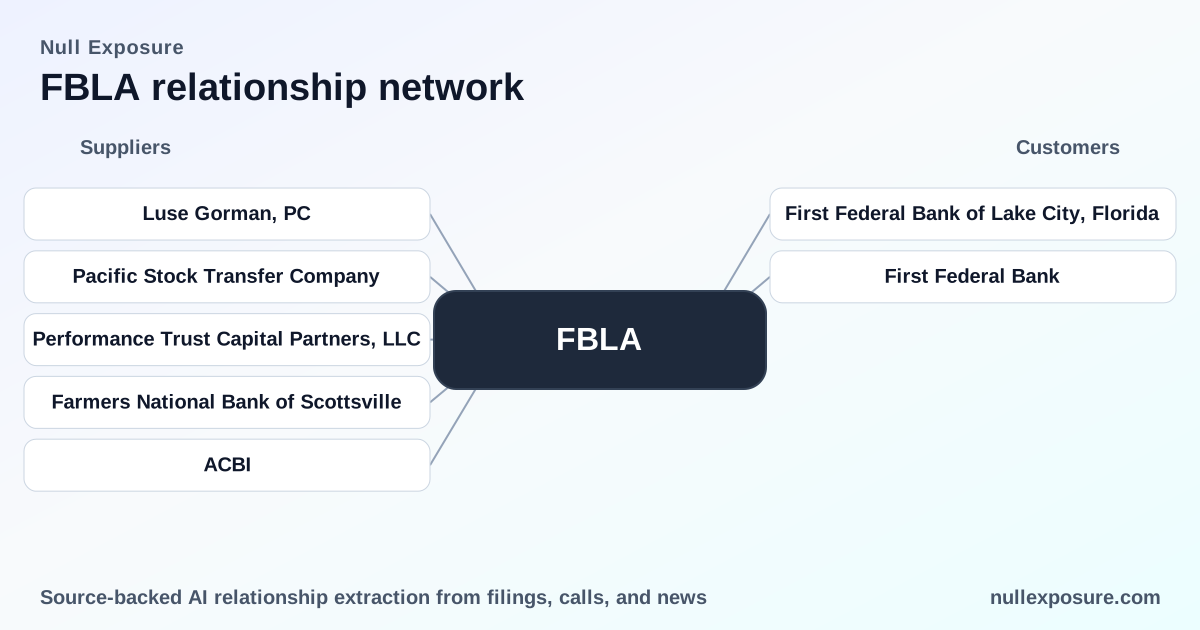
Below are the supplier and counterparty relationships identified in public news coverage and filings. Each entry is a plain-English description followed by the source.
-
Luse Gorman, PC — legal counsel to the Company and the Bank. The firm acted as outside legal counsel in connection with FB Bancorp’s public offering and corporate matters, providing regulatory and securities expertise that supports capital-market transactions. According to a Biz New Orleans press item referencing FY2024, Luse Gorman served as legal counsel to the company and the bank. (Biz New Orleans, FY2024)
-
Pacific Stock Transfer Company — transfer agent handling Direct Registration System (DRS) statements and interest payments. Pacific Stock Transfer managed post-offering shareholder record-keeping and distribution logistics, a critical administrative role for newly public or restructured equity positions. The firm was named as the company’s transfer agent responsible for mailing DRS book-entry statements and interest checks, per a Biz New Orleans news item tied to FY2024. (Biz New Orleans, FY2024)
-
Performance Trust Capital Partners, LLC — marketing agent for the stock offering. Performance Trust led marketing and distribution efforts in the bank’s stock offering, indicating reliance on boutique capital-markets intermediaries for retail and institutional placement. A Biz New Orleans report for FY2024 documents Performance Trust’s role as marketing agent, with Silver, Freedman, Taff & Tiernan LLP serving as counsel to Performance Trust. (Biz New Orleans, FY2024)
-
Farmers National Bank of Scottsville — acquisition target in a previous M&A transaction. The company’s historical activity includes the purchase of Farmers National Bank of Scottsville for approximately $52 million, reflecting a growth-through-acquisition strategy used to expand footprint and loan/deposit scale. A Banking Exchange article referencing FY2020 reported this acquisition transaction. (Banking Exchange, FY2020)
-
Atlantic Capital Bank — source of branch acquisitions. FB Bancorp’s historical expansion included acquiring ten branches from Atlantic Capital Bank in an April transaction, reflecting management’s willingness to grow deposit and branch networks via asset and branch transfers. This activity is documented in a Banking Exchange news feed covering FY2020. (Banking Exchange, FY2020)
For continued access to curated counterparty intelligence and supplier signal summaries, see the NullExposure homepage: https://nullexposure.com/.
Operating constraints and what they tell investors
Public disclosures and excerpts yield three company-level signals that shape operational risk and strategic posture:
-
Government-backed securities exposure is embedded in the asset mix. The bank invests in Federal Agency and mortgage-backed securities (FHLB, FNMA, GNMA, FHLMC) and SBI/SBA instruments, signaling a conservative fixed-income allocation that increases liquidity and reduces pure credit risk while also heightening sensitivity to interest-rate movements. This is a company-level investment signal from the firm’s disclosures.
-
Third-party services are characterized as immaterial from a breach standpoint. Management states that services and programs provided by third parties have not experienced material security breaches, which is an operational assurance investors can treat as a positive signal of vendor controls and incident history rather than a guarantee against future events.
-
Data processing is largely outsourced to external providers. The bank outsources a majority of its data processing requirements, which implies a vendor-dependent operating model: this reduces internal capital and fixed-cost intensity but increases operational reliance on third parties for critical processing, reconciliation, and customer-facing systems. Outsourcing raises questions about vendor concentration, contract terms, SLAs, and contingency plans — key items for due diligence.
These constraints combine into a clear vendor posture: FB Bancorp runs a lean internal IT footprint and leverages external specialists for capital market executions and shareholder services, while holding a conservative securities portfolio to manage balance-sheet risk.
Investment implications and risk priorities
-
Capital markets readiness is supported by established external partners. Use of experienced legal counsel (Luse Gorman) and a marketing agent (Performance Trust) indicates the bank can access capital and run offerings with external expertise, which reduces execution risk for future raises.
-
Operational continuity depends on third parties. The transfer agent and outsourced data processors are operationally critical; contract robustness and vendor diversification are material to ongoing service levels and regulatory compliance.
-
M&A is a demonstrable growth lever. Prior purchases of branches and whole-bank assets reflect a management track that supplements organic loan growth with targeted acquisitions, which influences future capital needs and integration risk.
-
Balance-sheet tilt toward government-backed securities provides liquidity but interest-rate sensitivity. The investment mix reduces credit volatility but increases duration and market-value exposure if rates shift materially.
Bottom line and next steps for investors
FB Bancorp’s supplier roster reflects a bank that leverages specialist external partners for capital transactions and back-office functions while using acquisitions to grow physical footprint. Vendor dependence is a strategic choice that delivers scalability but requires active vendor-risk oversight. For investors evaluating counterparty and operational risk, the priority checklist includes reviewing vendor contracts, transfer-agent arrangements, legal counsel continuity, and the bank’s contingency planning for outsourced processing.
For a centralized hub of supplier intelligence and relationship signals, visit the NullExposure homepage: https://nullexposure.com/.
Key takeaway: FB Bancorp is externally enabled for capital markets and shareholder administration, growth-driven by M&A, and operationally reliant on outsourced processing — investors should weight these factors against the bank’s conservative securities holdings and modest profitability when assessing upside and execution risk.