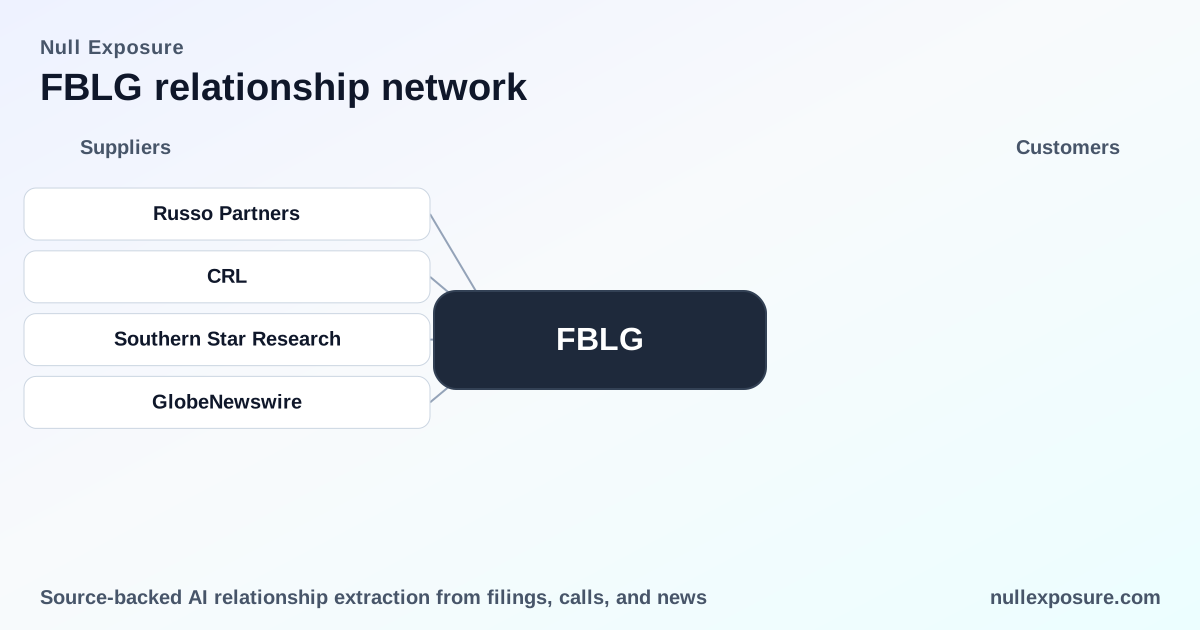
FibroBiologics (FBLG) — supplier relationships and what they mean for investors
FibroBiologics develops fibroblast-based regenerative therapies and currently monetizes through intellectual property, clinical-stage assets, and partnership/licensing channels rather than product revenue. The company is early-stage, reporting no revenue and negative EBITDA, and its value proposition to investors is driven by patent expansion, successful clinical manufacturing, and the ability to execute outsourced trials that validate lead assets for downstream commercial deals.
Want a quick read of supplier and partner exposure for clinical-stage biotechs? Visit https://nullexposure.com/ for curated supplier profiles.
What the company’s operating model buys you — and what it costs
FibroBiologics is a classic clinical-stage biotech: no product revenue and a capital-intensive development path. Market capitalization is roughly $19.1 million, trailing financials show negative EBITDA and negative EPS, and the company relies on external partners for core capabilities—manufacturing and CRO services—rather than owning large internal facilities.
- Contracting posture: the firm relies on long-term third-party manufacturing and CRO relationships to produce cell banks and run trials, which transfers near-term capital expenditures to suppliers but concentrates operational risk in those external partners.
- Concentration and criticality: a relatively small set of external providers handle mission‑critical functions (cGMP manufacturing and trial management), so supplier performance directly gates clinical timelines and investor value realization.
- Geographic posture: the company has an explicit APAC operational footprint for planned clinical activity, which introduces regulatory and logistics considerations distinct from U.S.-centric trials.
- Maturity: relationships are active but early-stage—manufacturing and trial engagements are in execution for Phase 1/2 assets rather than long-standing commercial supply agreements.
These characteristics create upside through de‑risking clinical milestones and patents, and downside via supplier disruptions, manufacturing delays, or regulatory setbacks.
Supplier and partner map — who’s on the record (FY2026 coverage)
Below are the relationships captured in public filings and press coverage in FY2026, each summarized in plain English with the primary source.
-
Russo Partners — investor relations and media services. FibroBiologics uses Russo Partners as its external investor relations and media contact for multiple press releases in FY2026, which carried notifications on patents, conference presentations and financial results. See the GlobeNewswire distribution and related notices in February–March 2026 (e.g., FibroBiologics press release distributed 2026-02-24 via GlobeNewswire / Russo Partners: https://www.globenewswire.com/de/news-release/2026/02/24/3244079/0/en/FibroBiologics-Reports-Full-Year-2025-Financial-Results-and-Provides-Corporate-Update.html).
-
Charles River — third‑party cGMP manufacturing of cell banks. Management publicly stated that Charles River completed and released the CYWC628 master and working cell banks under FDA cGMP standards and that those banks passed safety testing, indicating reliance on Charles River for upstream clinical supply work (FibroBiologics CEO letter and press release, 2026-01-07; distributed via GlobeNewswire / SahmCapital: https://www.globenewswire.com/news-release/2026/01/07/3214533/0/en/FibroBiologics-CEO-Issues-Letter-to-Shareholders.html).
-
Southern Star Research — CRO managing the CYWC628 trial in APAC. Southern Star Research is contracted to run the Phase 1/2 trial for CYWC628 in Australia and is responsible for full trial management across APAC coverage, a critical operational relationship for the company’s diabetic foot ulcer program (FibroBiologics press release, 2026-03-05: https://www.globenewswire.com/news-release/2026/03/05/3250162/0/en/FibroBiologics-Completes-Site-Onboarding-for-Phase-1-2-Clinical-Trial-for-CYWC628-for-the-Treatment-of-Refractory-Diabetic-Foot-Ulcers.html; additional coverage at Bitget, 2026-03: https://www.bitget.com/amp/news/detail/12560605241060).
-
GlobeNewswire — primary press distribution channel. FibroBiologics uses GlobeNewswire to distribute corporate updates, patent announcements and financial results in FY2026, making GlobeNewswire the primary conduit for the company’s public communications and IR cadence (example distribution, 2026-02-05 patent notice: https://www.globenewswire.com/news-release/2026/02/05/3232987/0/en/FibroBiologics-Announces-Issuance-of-Canadian-Patent-Covering-Novel-Fibroblast-Based-Treatment-for-Cachexia.html).
Why these relationships matter to investors — an operational read
- Manufacturing and trial delivery are value drivers. The successful release of the CYWC628 master and working cell banks and active site onboarding in Australia are material milestones. Delivery of cGMP supplies and CRO performance will directly influence clinical timelines and the company’s ability to commercialize or license assets.
- Geographic spread increases logistical and regulatory complexity. Running key trials in APAC means FibroBiologics must coordinate cross‑border supply chains and regulatory submissions, which is efficient but raises risk of delay if a single partner underperforms.
- Public relations consistency is intentional. Repeated Russo Partners and GlobeNewswire activity shows a coordinated investor communications strategy designed to highlight patents and clinical progress—useful as a signal of management focus on de‑risking assets for potential partners or acquirers.
Explore supplier exposure across small-cap biotech names at https://nullexposure.com/ to compare counterparties and concentration risks.
Operational constraints as company‑level signals
The company disclosures and related press material collectively signal the following operating model constraints:
- Long‑term third‑party reliance: FibroBiologics expects to depend on external manufacturing and service providers for the foreseeable future, shifting capex but creating vendor concentration risk.
- APAC operational footprint: Planned Phase 1/2 activities and CDMO responsibilities are located outside the U.S., introducing non‑U.S. regulatory pathways and logistics to the program.
- Role split between manufacturers and service providers: The firm treats CMOs/CDMOs as manufacturers and CROs as service providers; both roles are critical and active in program execution.
- Active relationship stage focused on manufacturing and clinical delivery: Current relationships are execution‑oriented rather than commercialization contracts.
These are company-level constraints that shape FibroBiologics’ execution risk and investor monitoring priorities.
Practical implications and recommended monitoring for investors
- Monitor manufacturing readouts and lot release data (cGMP certificates and stability testing) and CRO enrollment metrics; these operational data points are the nearest‑term de‑risking events.
- Track patent filings and their jurisdictions (recent U.S. and Canadian patents were announced in early 2026), because IP expansion increases licensing leverage.
- Watch for partner diversification or long‑term supply agreements that would lower concentration risk; absence of such agreements keeps downside skewed to supplier disruptions.
If you want a deeper supplier risk profile or a side‑by‑side of counterparties across the sector, visit https://nullexposure.com/ for organized supplier intelligence.
Bottom line
FibroBiologics is an early‑stage, IP- and milestone-driven biotech that outsources critical manufacturing and trial operations. The company’s short‑term investor case rests on manufacturing reliability, CRO execution in APAC, and patent-led value creation; failure in any of these external relationships would materially affect timelines and valuation. For investors evaluating exposure to supplier risk in small-cap biotechs, focus on the next manufacturing lot releases, trial enrollment cadence, and any move from short-term contracts to multi‑year supply agreements.
Learn more about supplier concentration and counterparties at https://nullexposure.com/.