Franklin BSP Realty Trust (FBRT): Why the external advisor defines the investment case
Franklin BSP Realty Trust (FBRT) operates as a mortgage REIT that originates, acquires and manages commercial real‑estate debt, monetizing via interest income on a diversified loan portfolio and by capturing spread between asset yields and financing costs. FBRT outsources virtually all day‑to‑day operations and investment management to an external advisor and collects investor capital while paying management fees and reimbursements, creating a fee‑driven operating structure where counterparty relationships and contract terms directly shape returns and operational risk.
If you evaluate supplier exposure for capital allocation or counterparty risk, focus first on the advisory relationship and its contractual terms — they determine both cost structure and operational control. For an executive summary and ongoing coverage, visit the NullExposure homepage: https://nullexposure.com/.
Operational model and how FBRT converts it into cash FBRT’s balance sheet and income statement reflect a business model that is asset‑centric but manager‑dependent. The company originates and holds mortgage debt and recognizes interest, but the actual sourcing, underwriting, portfolio management and administrative functions are performed by a third‑party advisor under an Advisory Agreement. FBRT’s monetization therefore has two explicit components: net interest spread from its loan book and a stable, fee‑sensitive expense base driven by the advisor’s compensation and reimbursements. That alignment concentrates operational and execution risk outside of the company’s payroll and inside the advisory contract.
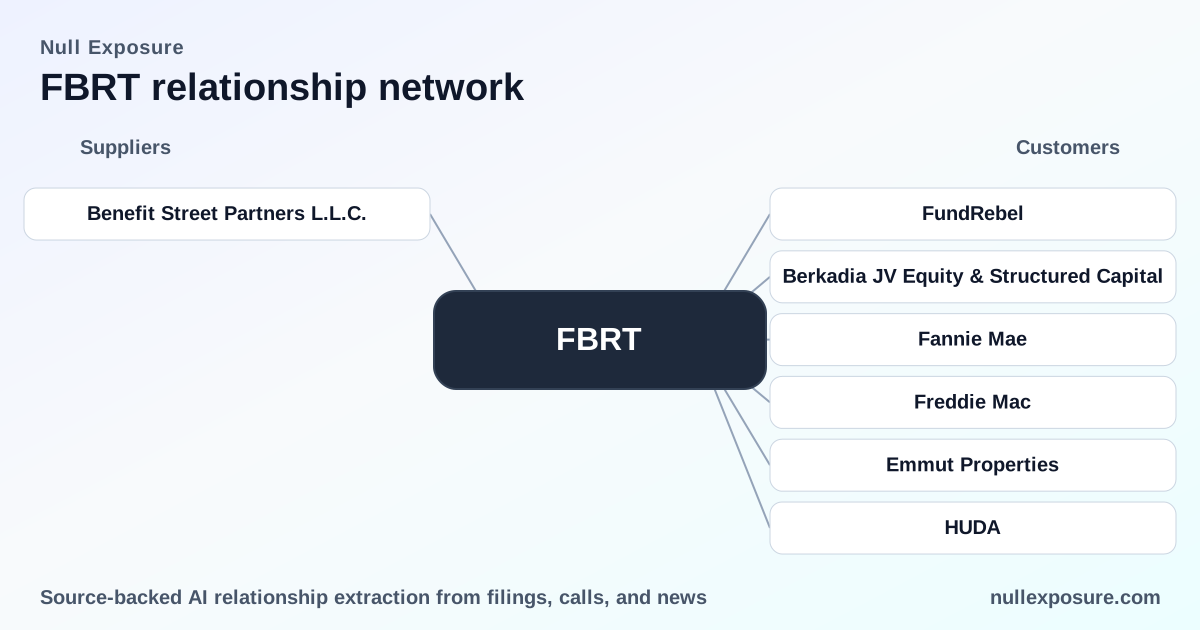
The supplier ledger: who runs FBRT’s day‑to‑day business Benefit Street Partners L.L.C. — FBRT is externally managed by Benefit Street Partners L.L.C., a wholly owned subsidiary of Franklin Resources, Inc., which serves as the company’s advisor and executes portfolio strategy and operations on FBRT’s behalf. This relationship is documented in recent reporting and market commentary. (Source: Yahoo Finance article on FBRT, March 2026.)
A complete account of relationships disclosed Benefit Street Partners L.L.C.
- FBRT is externally managed by Benefit Street Partners L.L.C., a wholly owned subsidiary of Franklin Resources, Inc., which performs the firm’s investment management and operational functions. (Source: news report, Yahoo Finance, March 2026.)
What the advisory contract signals tell investors The company’s disclosures around the Advisory Agreement provide the clearest, company‑level signals about contracting posture, concentration, criticality and maturity:
-
Long‑term, auto‑renewing contract posture. The amended Advisory Agreement had an initial three‑year term, was automatically renewed for an additional one‑year period on January 19, 2025, and continues to auto‑renew yearly unless either party elects not to renew. This structure creates predictability in the relationship while embedding rollover risk into a one‑year cadence. (Source: company advisory agreement disclosure, FY2025 filing.)
-
Operational criticality and single‑point dependency. FBRT discloses it has no employees and relies on the Advisor to manage day‑to‑day operations. That makes the advisory relationship operationally critical rather than a convenience supplier — loss or disruption of advisory services would be an immediate operational event. (Source: company filing, FY2025.)
-
Service‑provider posture with fee and reimbursement mechanics. The advisory arrangement characterizes the advisor as a service provider receiving a monthly asset management fee (one‑twelfth of 1.5% of stockholders’ equity) plus reimbursement of costs tied to operations, excluding certain executive salaries. That fee schedule fixes a predictable expense line that scales with equity, shaping net income sensitivity to capital changes. (Source: advisory agreement disclosure, FY2025.)
-
Relationship stage: renewing. The agreement’s auto‑renewal designates a renewing relationship stage, which reduces transactional renegotiation frequency but keeps FBRT exposed to periodic renewal negotiation outcomes. (Source: company filing, FY2025.)
Collectively, these signals indicate a concentrated and mature outsourcing model: FBRT trades internal operating flexibility for a predictable, contractually defined advisor role that is central to both execution and cost dynamics.
Financial context that matters for supplier risk FBRT’s public financial profile provides context for how supplier economics feed into investor returns. The company reports market capitalization, book value and profitability metrics that show an established REIT: reported MarketCapitalization of about $732 million, Price/Book below 1 (PriceToBookRatio: 0.614) and a trailing P/E of 14.02. Dividend distributions and yield are part of investor expectations — FBRT lists DividendPerShare and an Ex‑Dividend date in its disclosure schedule. These figures indicate a capitalized business for which advisor fees are a material operating line and where changes in management fees or operational disputes would have direct P&L and valuation implications. (Source: FBRT public disclosures and latest quarter data, FY2025/2026.)
Key risk and governance considerations for relationship management
- Concentration risk: No employees and near‑total reliance on an external advisor create a single counterparty dependency that is both strategic and executional. Mitigate via contractual protections and contingency planning.
- Fee structure sensitivity: The fixed percentage management fee scales with stockholders’ equity, so capital raises or writedowns will change the dollar cost of management; monitor both fee mechanics and reimbursement practices.
- Renewal and negotiation windows: Auto‑renewal reduces renegotiation frequency but concentrates leverage at renewal times; active oversight of renewal clauses and termination rights is essential.
- Disclosure transparency: Public filings explicitly state the advisor relationship and its terms; investors should prioritize filings for any changes to the advisory arrangement.
Where to go next For investors building an exposure thesis around FBRT, the central question is whether the advisor’s incentives and contract terms align with shareholder outcomes: does the fee and reimbursement structure preserve sufficient net spread after operational costs, and is governance adequate given the advisor’s critical role? Review the FY2025 advisory agreement language and monitor renewal notices and any affiliate disclosures from the advisor’s parent. For a deeper supplier risk analysis and relational mapping, see the NullExposure homepage: https://nullexposure.com/.
Conclusion and action steps FBRT is a mortgage REIT whose investment outcome is defined almost as much by its external advisor contract as by its loan portfolio. The advisory relationship is critical, long‑term in posture, fee‑based and renewing — and therefore the primary vector of supplier risk and operational concentration. Investors and operators should prioritize contract language, renewal timing, fee mechanics and contingency arrangements in their diligence.
Explore more supplier relationship intelligence and practical monitoring tools at NullExposure: https://nullexposure.com/.