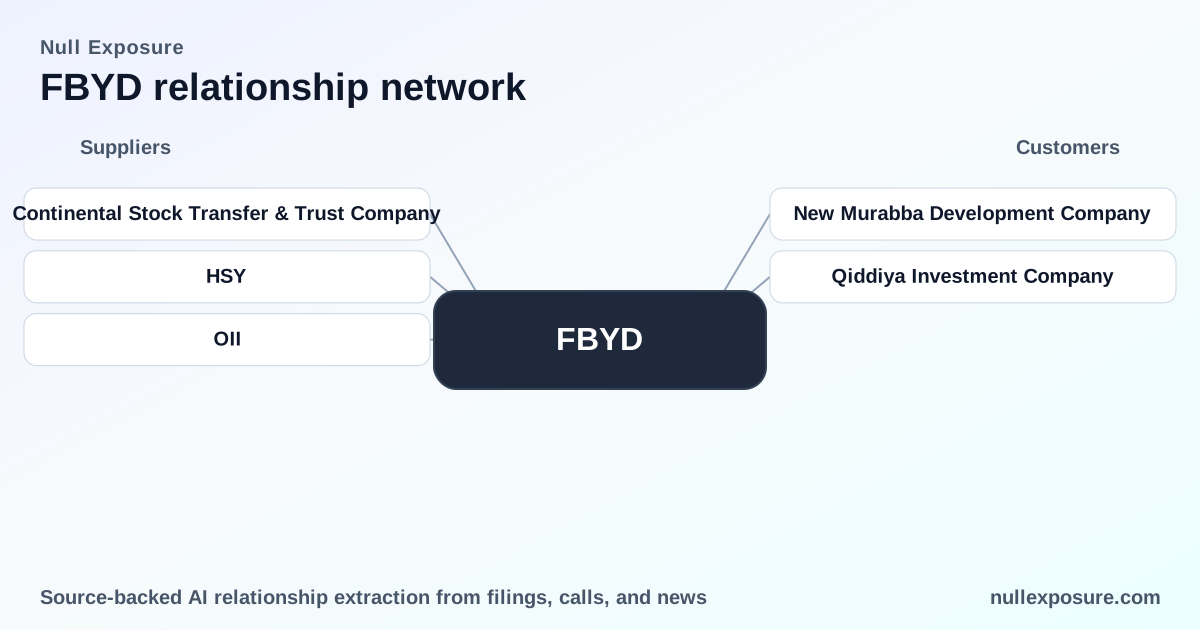
FBYD supplier map: where Falcon’s Beyond ties its operating model to partners
Falcon’s Beyond Global, Inc. operates as an experiential entertainment company that monetizes through branded attractions, ticketing, retail partnerships, licensing agreements, and post-acquisition service continuity. The company generates revenue from gate receipts and retail at its experiential venues, secures incremental licensing fees from brand partners, and captures aftermarket service and support revenue when it acquires legacy attraction vendors. For investors evaluating supplier exposure, the critical takeaway is that revenue-driving customer experiences sit atop a thin technology and third‑party services layer that is both operationally critical and modest in absolute spend. For a structured supplier intelligence briefing, visit https://nullexposure.com/.
What Falcon’s supplier posture looks like to an investor
Falcon’s Beyond runs a hybrid operating model: front‑end, consumer-facing operations (attractions, retail, licensed experiences) are tightly integrated with back‑end third‑party technology and service providers that support bookings, ticketing and asset logistics. Key characteristics that drive supplier risk and opportunity:
- Contracting posture: The company uses a mixture of commercial licensing deals and service/support relationships. Licensing partners expand revenue reach, while service providers deliver critical infrastructure for bookings and attraction uptime.
- Concentration and criticality: Core ticketing and hotel booking systems rely on third parties; while individual supplier spend is moderate, the operational impact of an outage is high because it directly affects revenue capture and guest experience.
- Maturity and ramp of relationships: Falcon’s has both mature operational suppliers (transfer agent, OEM support) and nascent commercial partners (brand licensing deals). The company tends to integrate acquired vendors into its service model to preserve continuity and retain customers.
- Cost profile: Historical cybersecurity remediation costs were modest but non-trivial—a reported $0.3 million incremental cost in 2023—suggesting supplier and vendor security investments reside in the $100k–$1M band for one-time incidents, with ongoing incremental spend expected.
These signals indicate a supplier ecosystem that is operationally essential but financially concentrated in smaller bands—lower absolute spend but higher functional importance. For more supplier-level detail on Falcon’s Beyond, see https://nullexposure.com/.
Supplier relationships you need to know (plain English)
Below are the supplier and partner relationships reported in public sources with concise takeaways and source citations.
Continental Stock Transfer & Trust Company
Falcon’s uses Continental Stock Transfer & Trust Company as its transfer agent, responsible for administering the company’s stock dividend and shareholder recordkeeping. According to a CityBiz report (March 2026), Continental administers Falcon’s stock dividend program and handles transfer agent duties.
The Hershey Company (HSY)
Falcon’s entered a global licensing agreement to create Hershey‑themed experiential attractions and retail experiences, positioning branded retail and guest experiences as a direct revenue stream tied to a premium consumer brand. A CityBiz article (March 2026) describes the Hershey licensing agreement as the basis for Hershey‑branded attractions and retail offerings.
Oceaneering Entertainment Systems (OES / OII)
Following Falcon’s acquisition of Oceaneering Entertainment Systems, Falcon’s committed to supporting all legacy OES products and to maintain existing personnel and technology as the original equipment manufacturer (OEM) continuity. Blooloop reported (March 2026) that Falcon’s will provide ongoing support for legacy OES products and keep continuity of service for existing installations.
What these relationships imply about supplier risk and opportunity
Each relationship maps to distinct investor concerns:
- Transfer agent (Continental): Administrative and compliance exposure is routine and low operational risk; continuity here is standard corporate practice and does not drive guest experience.
- Brand licensing (Hershey): This is a revenue multiplier that leverages a major consumer brand to increase foot traffic and retail spend; execution and co‑branding contracts determine revenue share and margin capture. Brand partners can materially amplify top-line growth when integrated into attractions and retail.
- OEM support (Oceaneering): The acquisition and assumption of OEM support is strategic verticalization—Falcon’s converted a supplier into an in‑house service line to protect installed base revenue and control maintenance economics. This reduces external dependency for critical attraction hardware while creating a service revenue stream.
Across the board, the most material supplier risk is operational—ticketing, booking and attraction uptime—not headline spend levels. Public disclosures also show that Falcon’s expects ongoing cybersecurity investments following remediation costs, indicating that vendor security controls and contractual requirements for third parties are an active management focus.
For investor tools that map supplier criticality and contractual posture, visit https://nullexposure.com/ for additional supplier intelligence and cross‑reference reports.
Company‑level constraints that shape supplier strategy
Public constraint excerpts reveal how Falcon’s manages supplier relationships at the corporate level:
- Materiality: The company disclosed that there were no known events creating a material indemnification liability as of December 31, 2024 and 2023, giving investors confidence that indemnification exposure has been assessed and tracked as immaterial in those periods.
- Third‑party service reliance: Falcon’s explicitly states reliance on third parties for substantial portions of IT, booking and ticketing infrastructure and requires these providers to certify security measures and to report breaches promptly—this is an operational control baked into contracting posture.
- Indemnification posture: Standard commercial indemnities exist in ordinary course agreements with customers, vendors and other parties—Falcon’s accepts and issues contractual indemnities as part of normal business.
- Spend band and incident costs: Management reported $0.3 million of one‑time cybersecurity costs in 2023 related to consultants and data recovery, and they expect additional security spend going forward; this signals a recurring allocation for risk reduction in the low‑to‑mid six‑figure range per material incident.
These constraints together paint a company that treats supplier and vendor risk management as an operational priority, while accepting normal commercial indemnities and modest transactional spend levels.
Bottom line and actionable next steps
Falcon’s Beyond presents a hybrid supplier picture: brand partnerships (high upside, revenue-driving), administrative suppliers (low risk), and acquired OEM support (operationally strategic). Investors should prioritize operational due diligence on the ticketing and booking vendor stack, licensing contract economics, and the integration plan and margin profile for acquired service lines.
Actionable next steps:
- Review licensing agreements and revenue share mechanics for major brand partners to quantify margin impact.
- Validate continuity and SLAs for booking and ticketing systems that are critical to revenue capture.
- Assess post‑acquisition integration costs and service margins for OEM support lines.
For a consolidated supplier risk brief and relationship scoring for Falcon’s Beyond, consult our platform at https://nullexposure.com/. If you’d like a tailored supplier risk memo for FBYD, start with our homepage and request the Falcon’s supplier dossier via https://nullexposure.com/.