FBYY supplier profile: what operators and investors need to know
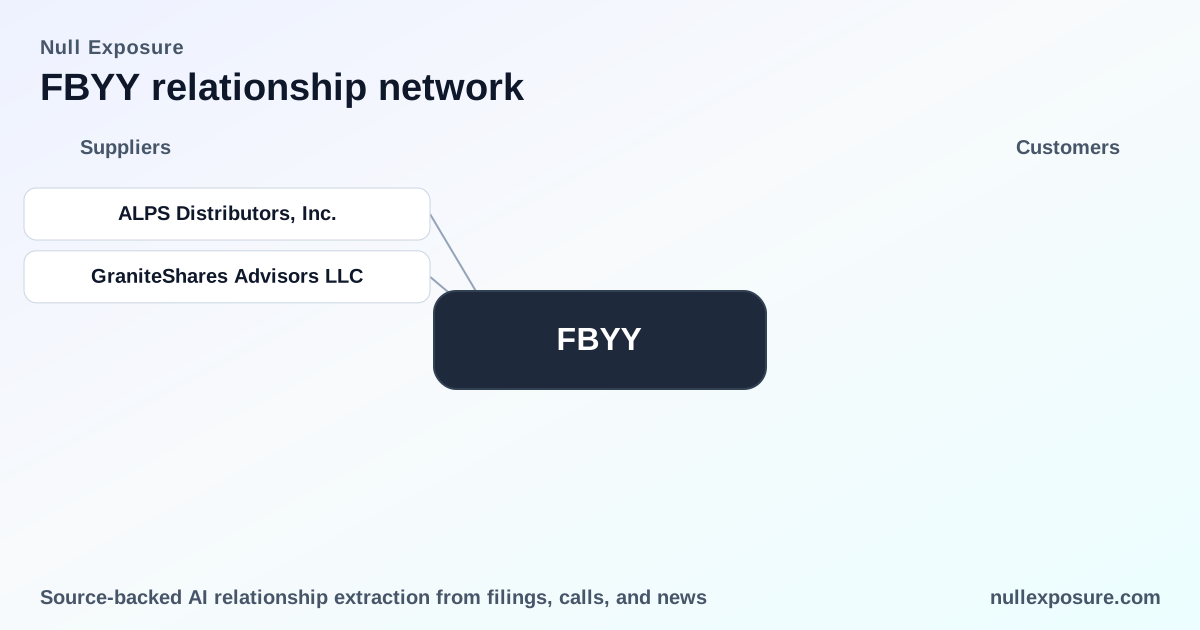
FBYY operates as a sponsored exchange-traded fund product that generates revenue through advisor and distribution relationships tied to fund management and operating fees; GraniteShares Advisors LLC serves as the fund advisor and has contractually capped fund operating expenses, while ALPS Distributors, Inc. handles fund distribution and weekly distribution announcements. The commercial model is simple: the fund’s economics flow from advisory fees and distribution arrangements, with explicit fee-waiver mechanics used to control headline expense ratios. Learn more about how supplier relationships shape exposure at https://nullexposure.com/.
Why this matters to investors and operators: supplier contracts determine fee exposure, revenue stability, and market access for the fund. The relationships below give direct insight into who executes the product, who communicates distributions to investors, and who has stepped in to manage expense volatility.
How FBYY’s business operates and makes money
FBYY is an ETF-style product sponsored and advised by GraniteShares with distribution handled by a third party; the sponsor collects advisory and management fees, while the distributor executes placement and retail communications. Revenue is concentrated in advisory and management fees but is explicitly managed via contractual fee waivers that cap the fund’s operating expenses at stated levels. That combination creates a clear top-line driver (management fees) and a visible margin control mechanism (fee waivers).
- Commercial concentration: the product uses named, well-known industry partners for distribution and advisory custody of manager duties.
- Contracting posture: evidence shows a proactive, contract-based waiver of fees to hold expenses at an investor-facing cap, indicating sponsor willingness to subsidize near-term economics to support product competitiveness.
- Operational criticality: distribution and fee management are core to the product’s market access and cost competitiveness, making these supplier relationships operationally central to the fund’s performance and investor appeal.
Explore supplier traces and governance implications in depth at https://nullexposure.com/.
Who’s involved: supplier relationships and what they do
Below are every supplier relationship present in the available records, each summarized in plain English with source pointers.
ALPS Distributors, Inc.
ALPS Distributors is named as the distributor for the fund and is responsible for facilitating the fund’s public distribution and related investor communications; the entity is cited in multiple press releases announcing the fund’s weekly distributions in February 2026. According to a GlobeNewswire release dated February 19, 2026, the funds are distributed by ALPS Distributors, Inc., with a subsequent GlobeNewswire announcement on February 26, 2026 repeating the distributor attribution. (Source: GlobeNewswire press releases, Feb 19 and Feb 26, 2026 — https://www.globenewswire.com/news-release/2026/02/19/3241047/ and https://www.globenewswire.com/news-release/2026/02/26/3245503/).
GraniteShares Advisors LLC
GraniteShares Advisors LLC functions as the fund advisor and has contractually agreed to waive fees and/or pay certain operating expenses so that the fund’s total annual operating expenses do not exceed 1.15% (exclusive of specified exceptions). This contractual cap is disclosed in a GraniteShares press release distributed via GlobeNewswire on February 26, 2026. (Source: GlobeNewswire press release, GraniteShares Advisors LLC, Feb 26, 2026 — https://www.globenewswire.com/news-release/2026/02/26/3245503/).
What the relationships reveal about operating posture and maturity
The public disclosures present a few clear operational signals:
- Sponsor commitment via contractual fee waivers. GraniteShares’ explicit agreement to waive fees and cover operating expenses up to a stated cap is a strong indicator of proactive margin management and a willingness to subsidize fund economics to maintain competitive net expense ratios for investors. This functions as a marketing and retention lever that directly impacts fund net yield and investor returns.
- Delegated distribution model. Use of ALPS Distributors as the named distributor signals a standard industry model: product design and management remain with the sponsor/advisor, while an established distributor handles marketing and shareholder servicing. That split concentrates economic control with the sponsor and execution risk with the distributor.
- Scarcity of other contractual constraints in the record. There are no additional supplier constraints recorded in the available items, which limits visibility on exclusivity, contract term length, or termination provisions; this is a company-level signal that additional diligence will be required to review underlying contracts for concentration and lock-in risk.
Investment implications: what buyers and operators should watch
- Cost control is explicit and material. The 1.15% expense cap is a concrete economic parameter that influences net yield and competitive positioning; investors should treat that as a key covenant when modeling fund economics.
- Distribution dependency is operationally meaningful. ALPS’ role in announcements and distribution places front-line investor access and communications under a single named distributor, which concentrates go-to-market risk.
- Disclosure gaps require contract review. Public press releases confirm roles and fee mechanics but lack detail on contract duration, exclusivity, and termination terms; underwriters and counterparty teams should request the advisory and distribution agreements for full counterparty risk assessment.
Quick takeaways
- Sponsor-sponsored fee cap reduces headline expense volatility and supports investor-facing net yields.
- Distributor-driven market access centralizes execution with ALPS Distributors, amplifying the importance of that operational relationship.
- Limited public constraint detail means counterparties should prioritize direct contract review before drawing firm conclusions about long-term supplier lock-in or concentration risk.
For a deeper look at how supplier contracts influence product economics and for cross-checks across the broader sponsor universe, visit https://nullexposure.com/.
Next steps for operators and investors
Operators should secure copies of the advisory and distribution agreements to validate duration, clawback, and termination provisions. Investors should incorporate the 1.15% expense cap into net return scenarios and stress-test outcomes under alternative fee structures.
To access an expanded analysis and comparative supplier mapping, go to https://nullexposure.com/.
(Disclosure: this commentary synthesizes publicly announced distributor and advisor relationships and their stated fee mechanics as reflected in GraniteShares’ GlobeNewswire releases from February 2026.)