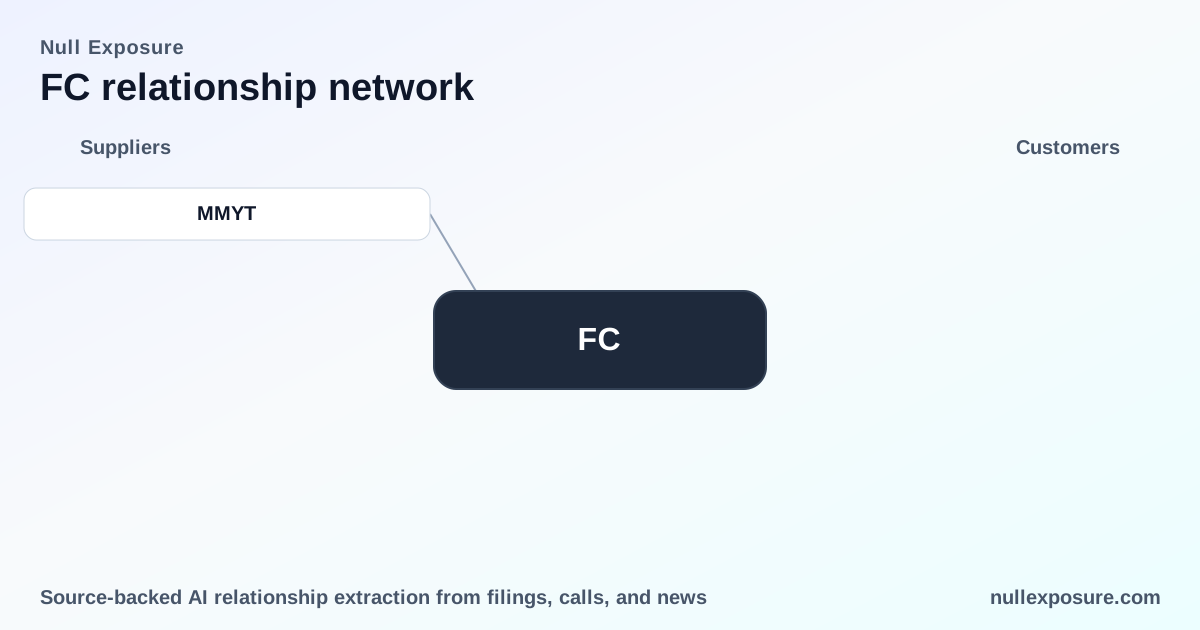
FranklinCovey (FC): Supplier posture, contracts, and what investors should price in
FranklinCovey sells leadership development, training materials, and consulting services and monetizes through course and workshop fees, recurring training licenses, and the sale and distribution of physical and digital learning products. Its operating model relies on a mix of technology partners for internal automation and independent logistics providers for kitting, warehousing, and fulfillment—costs that show up as recurring operating expense rather than capital investment. For investors, the key question is whether supplier decisions are reducing structural costs and operational friction or increasing concentration and execution risk. Learn more about supplier intelligence and due diligence at https://nullexposure.com/.
What the public record shows about FC’s supplier posture
FranklinCovey’s disclosures and press coverage present a clear, actionable portrait of supplier risk and control:
- Low supplier concentration at the company level. Management states it is “not dependent upon any one vendor” for training materials because raw materials are readily available, which signals a broadly diversified supply base and limited single-vendor leverage (company fiscal disclosures covering FY2023–FY2025).
- Warehousing is outsourced to a third-party service provider and carries a material operational role but limited financial concentration. The company has a warehousing services agreement for product kitting, warehousing, and order fulfillment at a facility in Des Moines, Iowa, and has expensed roughly $2.0M, $2.2M, and $2.7M for that contract in FY2025, FY2024, and FY2023 respectively—placing the relationship in the $1M–$10M annual spend band (company filings, fiscal years ended August 31, 2023–2025).
- Contract maturity and negotiation runway exist now. The warehousing contract expired October 31, 2025, and the company was in the process of renewing it at the time of the filing, which creates an immediate negotiation point and potential cost-saving or continuity risk (company filing excerpts).
These points combine into a coherent signal: operationally critical services such as warehousing are outsourced and recurrently purchased, but they are financially immaterial relative to corporate revenues and not concentrated with a single supplier. That dynamic creates bargaining flexibility for FC but also requires active vendor management to protect fulfillment reliability.
The one disclosed partner in the public scrape: Make
FranklinCovey’s CIO reported a targeted automation deployment with Make that swapped out an expensive legacy system and compressed HR workflows.
- FranklinCovey implemented Make to replace a legacy system, eliminating a $60,000-per-year software line and compressing HR workflows from 30 days to two hours, yielding “hundreds of thousands of dollars” in savings and permitting staff to focus on higher‑value work (InfotechLead report, March 9, 2026).
According to that March 2026 article, the company’s digital transformation and AI investments are driving customer additions and execution efficiency—Make is presented as a small but clearly beneficial vendor-level move. Source: InfotechLead (March 9, 2026).
How to interpret the Make example versus the warehousing relationship
The Make engagement and the warehousing contract together illuminate FC’s supplier strategy:
- Technology choices are efficiency-driven and modular. The Make implementation demonstrates an active program of replacing legacy spend with lightweight SaaS/automation tools to reduce operating expense and shorten internal lead times—this reduces fixed-cost legacy burdens and shifts spend to more granular, replaceable suppliers (InfotechLead, March 2026).
- Logistics are steady, outsourced, and potentially renegotiable. The warehousing contract is operationally important but financially moderate; with the contract recently expiring and renewal in process, FC has an immediate opportunity to extract better terms or build contingency plans (company filings for fiscal years ended August 31, 2023–2025).
- Net effect for investors: lower structural tech costs plus manageable logistics spending. The automation trend improves margins over time; the warehouse outsourcing presents a recurring cost line that can be optimized through negotiation or alternative providers.
For additional vendor-level intelligence and structured supplier diligence tools, visit https://nullexposure.com/.
Risk factors and what to probe in diligence
When evaluating FC as an investment or partner, focus on the following supplier-sensitive risks and questions:
- Continuity risk for fulfillment: Confirm SLA language, disaster recovery and disaster recovery site options, and inventory control procedures in the renewed warehousing contract (company filings indicate the Des Moines facility handles kitting, warehousing, and fulfillment).
- Cost trajectory and elasticity: Track whether the recorded $2.0M–$2.7M annual spend is trending up with volume or can be compressed via renegotiation; if volumes rise materially, fixed-fee structures could shift. The company disclosed those amounts in FY2023–FY2025 filings.
- Tech vendor lock-in versus flexibility: The Make example shows substitution of legacy systems; examine whether new SaaS/automation contracts include exit costs or data portability constraints. The public report credits Make with substantial runtime savings (InfotechLead, March 2026).
- Concentration monitoring: While management declares no dependency on a single supplier for training materials, verify the supplier roster for single-source components (e.g., specialty paper or printing for physical materials) during procurement diligence.
Investor takeaways — what matters for valuation and operations
- Operational leverage through automation is real and measurable. The Make deployment eliminated a line item and compressed process time materially; this is a positive margin signal for an operator focused on service delivery (InfotechLead, March 2026).
- Fulfillment is outsourced, not owned, and currently negotiable. The warehouse contract’s expiration on October 31, 2025 creates a short window where the company can lock in more favorable economics or contingency provisions (company filings covering FY2023–FY2025).
- Financial exposure is modest but not negligible. Warehousing spend sits in the $1M–$10M band—enough to matter operationally yet small enough that vendor failure would be disruptive but unlikely to be existential.
If you want structured supplier risk scoring and a dashboard for relationship diligence, check the platform at https://nullexposure.com/.
Final recommendation
FranklinCovey demonstrates disciplined supplier management: it actively reduces legacy tech cost and outsources fulfillment to keep capital light. For investors, the immediate focus should be on contractual terms and SLAs in the renewed warehousing agreement and on the scalability and lock‑in characteristics of new automation tech. Those two levers determine near-term margin trajectory and operational resilience.
To commission deeper supplier mapping or continuous monitoring for FC and comparable names, start a diligence engagement at https://nullexposure.com/.