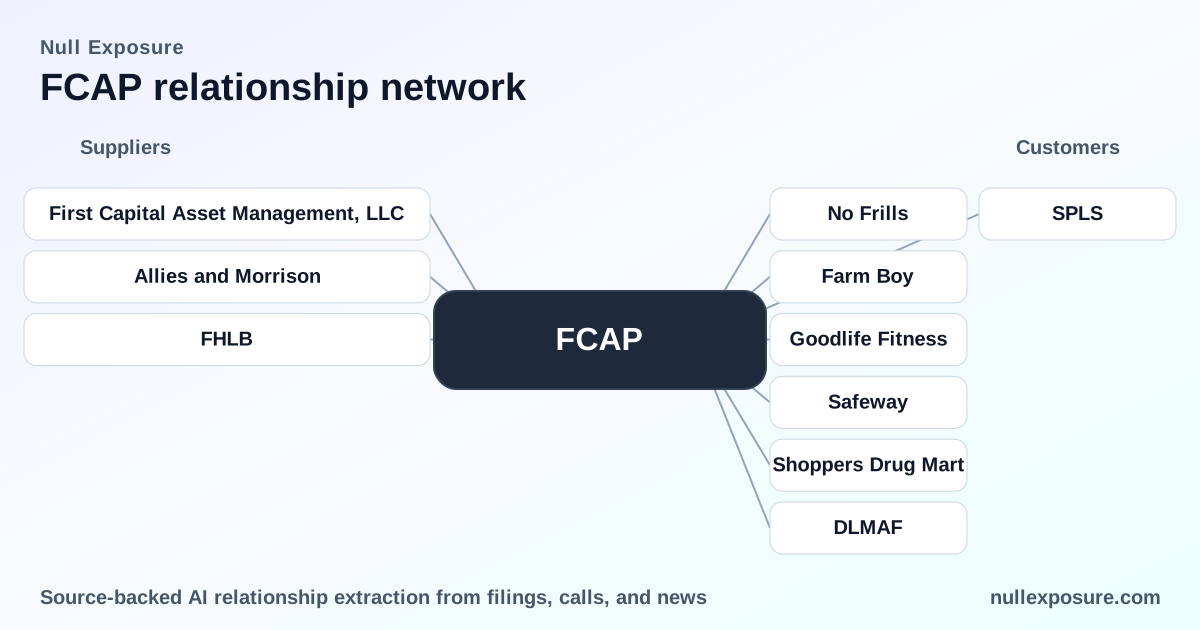
First Capital Inc (FCAP): Supplier relationships, funding posture, and what investors should price in
First Capital, Inc. operates as the bank holding company for First Harrison Bank, monetizing through net interest margin on originated loans, securities income, and fee-based banking services, while returning capital via a modest dividend. The franchise combines strong operating margins and a high profit margin with a funding model that has relied historically on short-term wholesale advances alongside customer deposits. For investors and operators evaluating supplier and counterparty exposure, the mix of external managers, development partners and government-backed funding relationships defines both runway and risk.
Explore deeper supplier intelligence at https://nullexposure.com/ to convert these relationship signals into actionable diligence.
Quick commercial profile that matters to counterparties
First Capital is a regional banking holding company headquartered in Corydon, Indiana, and trades on NASDAQ under FCAP. Key financial signals: market capitalization roughly $151 million, trailing P/E ~10.2, return on equity ~11.8%, and dividend yield ~2.64% (latest figures through Q3 2025). These figures signal a profitable, mature regional lender with conservative balance sheet performance but limited equity scale—important context when judging supplier credit and pricing negotiations.
The supplier and partner relationships investors should know
First Capital Asset Management, LLC — external manager for financing initiatives
First Capital uses an external manager, First Capital Asset Management, LLC, that brings senior credit structuring expertise to tailor financing for growth, recapitalizations and acquisitions. According to MarketBeat instant alerts in FY2026, this external management arrangement is a named element of the company’s capital strategy and public communications. (MarketBeat, FY2026: instant alerts dated Feb–Mar 2026; see company commentary.)
Allies and Morrison — strategic development/architectural partner on large projects
First Capital has engaged Allies and Morrison in a development context where the bank and partners acquired and transformed a large brownfield site; the relationship surfaced in coverage of UK retail-sales-focused mixed-use projects dating back to FY2021. This reflects First Capital’s participation in multi-party real-estate ventures where third-party architects and development firms are material to execution. (RENX coverage, FY2021.)
FHLB (Federal Home Loan Bank) — historical funding counterparty and line item in disclosures
First Capital’s disclosures list advances from the FHLB and related funding programs as part of its funding mix; filings and market commentary have referenced FHLB stock and advances in the composition of securities and borrowings. A Quiver Quant summary of First Capital’s Q3 2025 results references FHLB items in the company’s reported securities and borrowing categories. (Quiver Quant news recap, FY2025.)
BTFP / Federal Reserve (contextual funding program) — short-term advance usage and program wind-down
Company disclosures indicate usage of the Federal Reserve’s Bank Term Funding Program (BTFP) and related short-term fixed-rate advances to meet liquidity needs; these advances had short average terms and the program ceased making new loans effective March 11, 2024. That operational pattern is a material historical funding behavior even if the program itself is terminated per the company’s filings (disclosure language covering the BTFP, FY2024).
What these relationships reveal about operating constraints and sourcing posture
The relationship evidence and the company’s own disclosures produce a clear set of operating characteristics relevant to supplier diligence:
- Contracting posture: short-term liquidity orientation. The company utilized short-term fixed-rate bullet advances and variable-rate advances to serve daily liquidity and asset growth. This implies suppliers and funding partners should price for short tenor exposure and quick turnover.
- Counterparty mix includes government-backed funding. Disclosures explicitly reference the FHLB and the FRB’s BTFP, which signals reliance on government-sponsored credit facilities as part of contingency and working capital strategies.
- Materiality of credit loss is low at the company level. First Capital reports expected credit losses on held-to-maturity securities as immaterial, suggesting limited provisioning pressure from that portfolio segment in the referenced periods.
- Relationship maturity and stage vary. The BTFP relationship is documented as terminated when the program closed to new loans, indicating tactical use of programmatic liquidity rather than a long-term structural dependency.
- Spend scale signal: large but targeted advances. A disclosed advance line figure (combined FHLB and BTFP advances) indicates aggregate wholesale funding in the hundreds of millions historically—this is a company-level signal of occasional large-scale funding needs rather than routine operating spend.
These constraints should be read as company-level operating signals except where the disclosure explicitly names a counterparty (FHLB and BTFP), in which case the government-counterparty characteristic and termination status are attributable to those named relationships.
Explore supplier-level profiles and risk scoring for FCAP relationships at https://nullexposure.com/ for a structured diligence workflow.
Risk and opportunity implications for investors and operators
The relationship map and constraints translate into a set of pragmatic investment implications:
- Liquidity & funding flexibility are central operational levers. Short-term wholesale advances reduce duration mismatch but raise roll-over and refinancing considerations in stressed markets.
- Government-backed channels reduce counterparty credit risk but add program dependency risk. Access to FHLB/BTFP-style facilities lowers funding costs in certain environments while creating sensitivity to program availability and policy changes.
- External managers enable targeted capital actions without expanding permanent headcount. Using an external asset management partner for structured financing gives First Capital flexibility to pursue recapitalizations and acquisitions without materially increasing internal operating leverage.
- Real-estate and development partnerships introduce execution and concentration risk. Activities tied to large brownfield transformations require active project governance and increase exposure to local market cycles.
Operational decision makers and investors should weight these dynamics alongside valuation: the stock trades at a modest multiple (trailing P/E ~10.2) with book value around $39.55 per share—a profile that balances steady earnings with moderate growth expectations.
Bottom line and recommended next steps
First Capital is a profitable, regionally focused bank that monetizes through lending and fee income while selectively using external managers and government-backed funding to execute strategic moves. The core supplier exposures are strategic (external asset management), project-focused (development partners), and funding-related (FHLB and historical BTFP usage). Each relationship carries distinct implications for liquidity, counterparty risk, and execution.
For investors and operators requiring a deeper read on how these relationships affect credit, counterparty concentration, and operational resiliency, review the full supplier intelligence and relationship histories available at https://nullexposure.com/. Schedule a supplier diligence briefing through our platform at https://nullexposure.com/ to convert these signals into an executable risk plan.