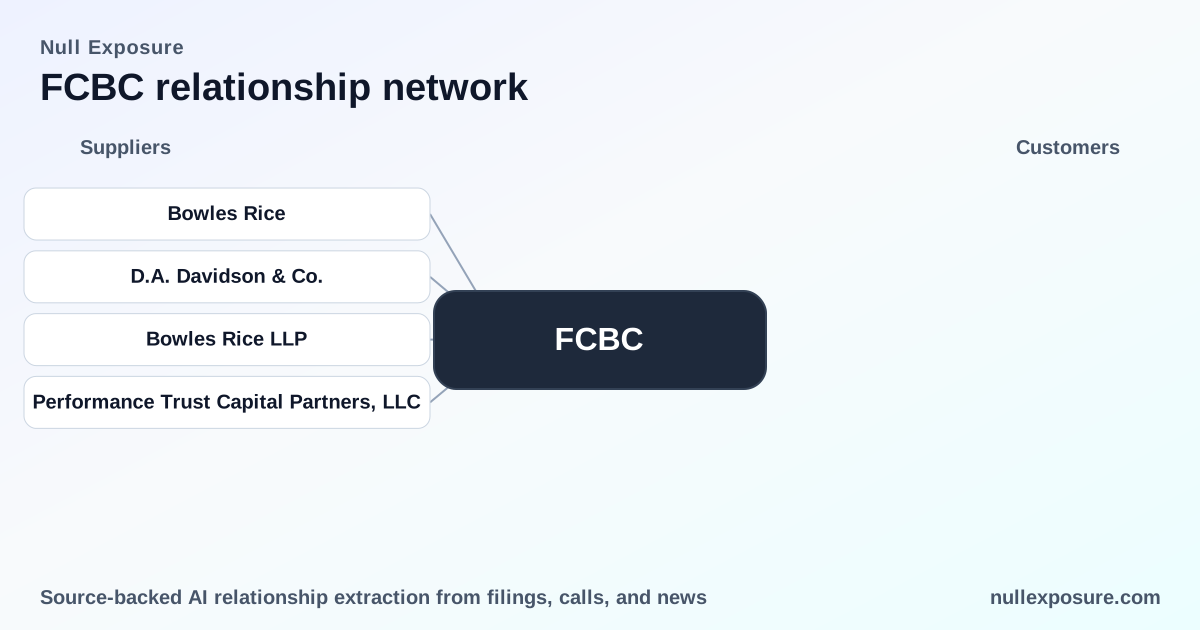
First Community Bancshares (FCBC): supplier relationships that reveal strategy and operating posture
First Community Bancshares is a regional banking holding company that monetizes primarily through traditional banking spreads and fee income: it collects deposit funding, originates loans and investments, and earns net interest margin supplemented by service fees and transactional revenue. With roughly $742 million market capitalization and $167 million in trailing revenue, FCBC runs a classic community-bank model while selectively using M&A and external advisors to extend its footprint. For investors and operators, supplier relationships around legal and financial advisory services — coupled with short-term funding signals — illuminate capital strategy and operational dependencies. Learn more at https://nullexposure.com/.
What these supplier ties tell investors about FCBC's operating model
FCBC’s supplier activity is concentrated in transactional advisory and legal counsel for its recent acquisitions, rather than a sprawling vendor ecosystem. That pattern is consistent with a bank pursuing measured growth through deals while keeping core operations in-house or with standard industry providers.
- Advisory and counsel are mission-critical during M&A: external financial advisors and law firms show the company relies on third parties for deal execution and regulatory navigation.
- Funding and liquidity posture skews short-term: evidence that borrowings in 2024 were retail repurchase agreements points to a contracting posture that is nimble but sensitive to short-term funding markets.
- Third‑party services are operational supports, not business-critical platforms: excerpts noting endpoint monitoring and a third-party benefits administrator suggest outsourcements for risk management and HR rather than revenue-facing dependencies.
These signals should be interpreted as company-level operational characteristics: FCBC runs an acquisitive but conservative regional-bank playbook with a short-term funding tilt and standard third-party service relationships. For a structured supplier risk view, visit https://nullexposure.com/ for our platform analysis.
Relationships, one by one — who provided services and when
Bowles Rice / Bowles Rice LLP
Bowles Rice served as legal counsel to First Community in multiple announced transactions, including the 2025 acquisition of Hometown Bancshares and the 2022 merger with Surrey Bancorp. According to GlobeNewswire and subsequent press coverage, Bowles Rice LLP was explicitly retained as legal counsel for these deals (GlobeNewswire, 2022; GlobeNewswire, 2025; Banking-Gateway, 2026).
D.A. Davidson & Co.
D.A. Davidson & Co. acted as financial advisor to First Community on its recent acquisitions, including the 2025 Hometown Bancshares transaction reported in press releases and media coverage. The company acknowledged D.A. Davidson’s advisory role in the 2025 transaction announcements (GlobeNewswire, 2025; Banking-Gateway, 2026).
Performance Trust Capital Partners, LLC
Performance Trust Capital Partners served as financial advisor to First Community on the Surrey Bancorp transaction announced in late 2022; the company named Performance Trust in its 2022 press release as the advisor on that merger (GlobeNewswire, 2022).
Each relationship is transactional and event-driven: law firms and boutique investment banks were engaged for specific M&A activities rather than as ongoing platform suppliers. These engagements were disclosed publicly in company and media announcements in FY2022 and FY2025 (GlobeNewswire; Banking-Gateway).
How the supplier mix constrains operations and strategy
Three supplier-related constraints from FCBC’s disclosures are material when read together:
- Contracting posture — short-term funding focus. FCBC disclosed that total borrowings for 2024 were comprised entirely of short‑term retail repurchase agreements, indicating a funding profile that is flexible but sensitive to short-term market liquidity.
- Counterparty type — government facilities as a backstop. The company explicitly relies on lines of credit from the Federal Home Loan Bank and the Federal Reserve Discount Window to meet liquidity demands, signaling preparedness for stress but exposure to central-bank access terms.
- Relationship role — service provider support for non-core functions. The company uses third parties for endpoint monitoring/incident response and a third‑party administrator for the employee health plan, reflecting outsourced operational risk controls and benefit administration rather than vendor concentration on revenue-critical systems.
These constraints are company-level signals rather than attributes of any single supplier. They together imply a bank that is acquisitive and operationally conventional: deal-driven advisory spend, short-term funding mechanics, and standard outsourced supports.
Operational and investment implications
Investors and counterparties should weigh the following practical takeaways:
- Acquisition strategy validated by advisors. Repeated use of boutique financial advisors and a single legal firm across deals indicates an organized M&A approach; this supports revenue growth ambitions but introduces integration and execution risk during rollups (GlobeNewswire; Banking-Gateway).
- Liquidity profile requires monitoring. Reliance on retail repurchase agreements and access to FHLB/FRB facilities makes funding sensitivity a near-term risk variable; monitor repo market spreads and central bank collateral/access conditions.
- Limited vendor concentration on revenue platforms. Current disclosed suppliers are advisory and administrative; there is no evidence of dependence on a single critical operational platform, reducing the chance of outsized vendor operational risk.
Key data points to keep handy: market capitalization ~$742M, trailing revenue $167M, profit margin ~29% and forward P/E ~8.5, which together frame the valuation context for assessing the impact of supplier-driven M&A expenses and funding choices.
For deeper supplier analytics and integration risk scoring, see our platform at https://nullexposure.com/.
Actions for investors and operators
- Review upcoming liquidity disclosures and repo position detail ahead of quarterly reports; funding structure is the single largest supplier-related operational risk.
- Ask management for post-merger integration plans and legal expense run-rates; advisory relationships indicate continued deal activity that will affect capital allocation.
- Confirm cybersecurity and benefits SLA terms with the third-party providers to ensure operational continuity.
Bottom line: read supplier ties as corroboration of strategy
The supplier footprint around First Community Bancshares is focused and transaction-oriented: law firms and investment banks enable a deliberate M&A program, while short-term borrowing and government facility reliance define the funding posture. That combination frames FCBC as a regional bank pursuing inorganic growth with a conservative but liquidity-sensitive funding strategy. Investors should watch repo exposure and deal execution metrics as the principal supplier-linked risk signals.
If you want a tailored supplier risk brief or continuous monitoring for FCBC, explore our service at https://nullexposure.com/ — we track these relationships and constraints on an ongoing basis.