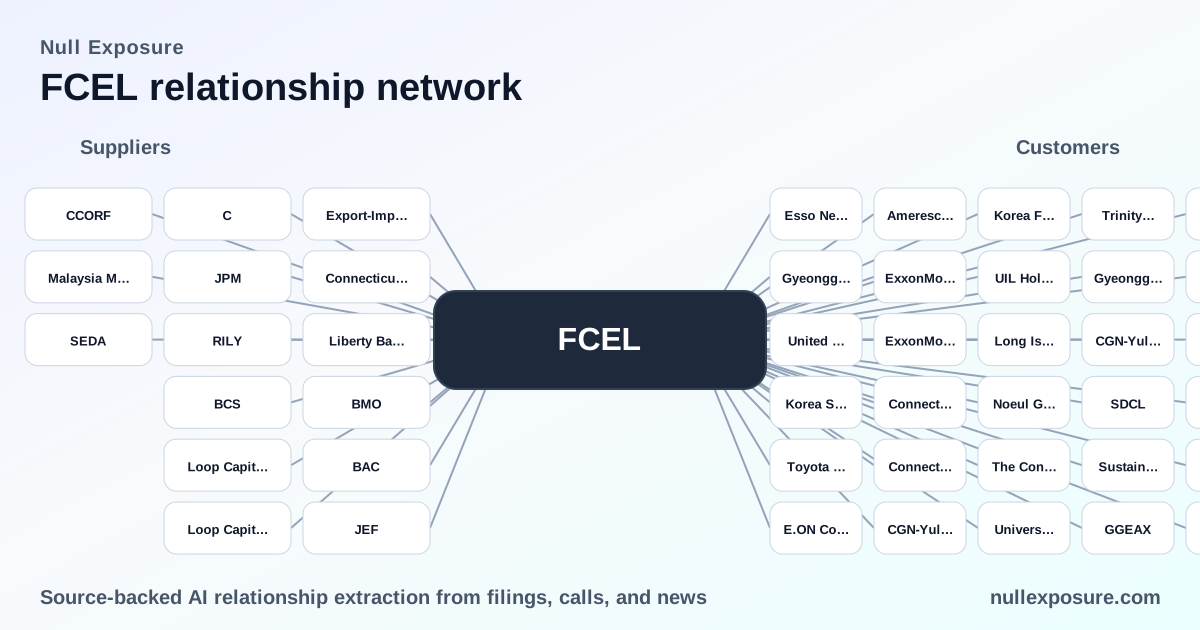
FuelCell Energy (FCEL): Who funds and distributes the company's growth — a supplier-side read for investors
FuelCell Energy designs, builds and operates stationary carbonate fuel cell plants and monetizes through equipment sales, long‑term service agreements (LTSAs) and project financing for distributed baseload power generation. Revenue mix combines product sales, recurring service contracts and externally financed project structures, and the company leverages both government and capital‑markets counterparties to underwrite deployment risk and preserve liquidity. For investors evaluating supplier relationships, the right question is how those counterparties affect project delivery, financing flexibility and dilution risk.
Read more company relationship signal intelligence at NullExposure.
Why these counterparties matter to operators and allocators
FuelCell's commercial model is execution‑intensive: it sells modules, installs them under multi‑year LTSAs, then carries ongoing service obligations while project debt or equity supports upfront capital. That structure creates three dependency vectors: project finance partners that reduce balance‑sheet capital needs, sales/distribution agents that influence equity issuance and banks/lenders that shape working capital and back‑leverage for projects. The listed relationships show FuelCell is actively managing all three vectors.
- Project finance: government export credit and regional green banks provide non‑dilutive debt support that de‑risk large module deliveries.
- Capital markets: a broad syndicate of sales agents supports an at‑the‑market equity program used to fund growth and operations.
- Industrial partnerships: engineering and local manufacturing partners extend geographic reach in Asia and APAC.
If you are evaluating supplier counterparty risk, note that FuelCell reports $59.8 million of unconditional purchase commitments, signaling mid‑scale supplier spend and nontrivial operational procurement exposure.
Explore full relationship signals and supplier risk scoring at NullExposure.
What the regulatory and contractual footprint signals about operating posture
FuelCell discloses an open market sales framework and public financing activity that together define its contracting posture: an active ATM equity program and project‑level debt arrangements are central to liquidity management. The company sources parts globally, which creates supply‑chain complexity and geopolitical exposure, while several IT and shared services are outsourced, establishing third‑party service risk.
Key company‑level operating signals:
- Contracting posture — framework agreements: the company uses an ongoing Open Market Sale Agreement to raise equity over time, reflecting a flexible but dilutive capital strategy.
- Counterparty mix — government involvement: FuelCell has a history of government assistance and works with government lenders for project finance, which strengthens project bankability.
- Geographic sourcing — global: raw materials and parts are sourced worldwide, increasing exposure to tariffs, trade actions and logistics disruption.
- Service reliance — third‑party providers: critical IT and shared services are managed by vendors, adding operational dependency outside the company.
- Spend profile — mid‑range procurement: $59.8 million of purchase commitments as of FY2025 indicates significant supplier commitments in the $10–100M band.
These signals imply a company that is scaling through financed projects and market access, with material counterparty concentration in capital markets and government financing channels that influence both execution and dilution.
Who FuelCell actually works with — the relationship roll call
Below are every relationship listed in public filings and press coverage; each line covers that counterparty in plain English with the source cited.
Export‑Import Bank of the United States (EXIM)
FuelCell closed a project debt financing (the 2024 EXIM Financing) with EXIM to support obligations under an LTSA supplying 42 upgraded carbonate fuel cell modules to a customer referenced as GGE. According to FuelCell's FY2025 Form 10‑K, EXIM provided project debt to underwrite delivery and operations risk.
Connecticut Green Bank
Connecticut Green Bank acts as a lender in the Derby senior back‑leverage financing, positioned alongside commercial lenders to support that project’s capital structure. This role is disclosed in FuelCell's FY2025 Form 10‑K.
Liberty Bank
Liberty Bank is the administrative agent, lead arranger and a lender under the Derby Senior Back Leverage Credit Agreement, providing senior back‑leverage credit in connection with project financing. The FY2025 Form 10‑K names Liberty Bank in that credit agreement.
Jefferies
Jefferies is a principal sales agent on FuelCell's amended Open Market Sale Agreement (ATM), which the company uses to place common stock into the market and preserve liquidity. Multiple news reports (TradingView and The Globe and Mail, Dec 2025) list Jefferies among the syndicate.
B. Riley Securities
B. Riley Securities is part of the ATM sales agent syndicate that FuelCell expanded to increase capacity to $200 million, serving as a distribution channel for potential equity raises. Press coverage in late‑December 2025 documents B. Riley’s inclusion.
Barclays / Barclays Capital
Barclays is a named sales agent on the amended ATM, providing another distribution arm for equity issuances under the expanded $200 million capacity. The Globe and Mail and TradingView reporting in Dec 2025 reference Barclays' role.
BMO Capital / BMO Capital Markets
BMO Capital Markets is a sales agent in the ATM syndicate and appears repeatedly in press accounts describing the December 2025 amendment that increased the program size. TradingView and other news sources list BMO Capital Markets among the counterparties.
BofA Securities
BofA Securities joined the syndicate of sales agents for FuelCell’s ATM program and is named in December 2025 reports detailing the expansion to $200 million capacity. The Globe and Mail and Sahm Capital coverage note BofA Securities' role.
Citigroup
Citigroup is included in the syndicate of ATM sales agents, helping distribute any at‑the‑market issuances under the amended agreement; this is documented in late‑December 2025 press coverage.
JPMorgan / J.P. Morgan Securities
J.P. Morgan terminated its participation as a sales agent effective December 24, 2025; the company removed references to J.P. Morgan from the amended ATM agreement, altering the syndicate composition. This exit is reported in The Globe and Mail and TradingView coverage.
Loop Capital / Loop Capital Markets
Loop Capital Markets is listed among the sales agents participating in the amended ATM and contributes to distribution capacity for potential equity sales, per December 2025 press reports (TradingView and Sahm Capital).
Canaccord Genuity
Canaccord Genuity is part of the ATM syndicate and is cited in coverage describing the expanded at‑the‑market arrangement to $200 million capacity in late‑December 2025.
Malaysia Marine and Heavy Engineering
FuelCell has a joint development agreement with Malaysia Marine and Heavy Engineering to co‑develop large‑scale hydrogen production systems, intended to expand FuelCell’s market presence across Asia, New Zealand and Australia. This partnership is noted in industry reporting in early 2026 on strategic APAC expansion (Simply Wall St, FY2026 commentary).
SDCL (Sustainable Development Capital LLP)
FuelCell and SDCL are collaborating on deployment of fuel cell systems at scale, combining FuelCell’s technology with SDCL’s financing and operating expertise to pursue up to 450 MW of systems; this partnership was reported in 2026 coverage of project deployments (Intellectia.ai, FY2026).
Investment implications and practical takeaways
- Capital structure is execution‑driven: FuelCell uses project debt (including EXIM) and an expanded ATM equity facility to fund module deliveries and service obligations — a dual lever that supports growth but pressures equity when markets are weak.
- Government and regional lenders improve bankability: EXIM and Connecticut‑area financing arrangements lower project sponsor risk and make large module deployments feasible for third‑party customers.
- Distribution breadth mitigates single‑point failure in equity raises: the ATM syndicate spans major global banks and boutique underwriters; J.P. Morgan’s exit reshapes distribution but leaves a diversified group in place.
- Supply chain and third‑party service exposure are material: global sourcing and outsourced IT/service providers are company‑level operational constraints that investors must price into project timelines and margin forecasts.
For a deeper read into how these counterparties translate into supplier risk and creditability scoring, visit NullExposure to see our vendor‑level analyses and alerts.
Final action points for investors and operators
- Monitor ATM utilization and sales agent activity as near‑term indicators of dilution risk and liquidity management.
- Treat EXIM and regional lender participation as credit enhancement for large projects; verify contractual liens and back‑leverage arrangements in diligence.
- Track execution timelines with Malaysia Marine and SDCL partnerships as signals of geographic expansion and potential revenue upside.
For ongoing coverage and supplier risk scoring tailored to investors and operators, go to NullExposure.