First Commonwealth Financial (FCF): how supplier ties shape operations and risk
First Commonwealth Financial is a regional bank that earns through net interest margin on commercial and consumer lending plus fee income from deposits and payment services, supported by a branch and ATM footprint concentrated in the Mid‑Atlantic. Its operating model relies on outsourced infrastructure for core processing and ubiquitous card networks for customer access, and that combination shapes counterparty concentration and operational criticality for investors. For a concise supplier-focused view and ongoing monitoring, visit https://nullexposure.com/.
What the company does and how suppliers factor into revenue
First Commonwealth monetizes traditional banking flows: interest income from loans, deposit margins, and transaction fees collected via payments and ATM usage. Outsourced services — notably a contracted core processing system and the bank’s relationships with national payment networks for ATM connectivity — are integral to daily operations and customer experience. The company’s financials show profitable operations (ROE ~10.3%, profit margin ~31.4% on the latest trailing figures), which depend on stable back‑office processing and uninterrupted access to card networks.
Key business model drivers: core processor uptime and service levels; payment network availability and fees; branch/ATM usability; capital allocation (e.g., recent share repurchase authorization). These drivers translate into supplier risk vectors that investors must watch.
Visit https://nullexposure.com/ for supplier analytics and alerts on FCF relationships.
Supplier relationships: the visible names and what they mean
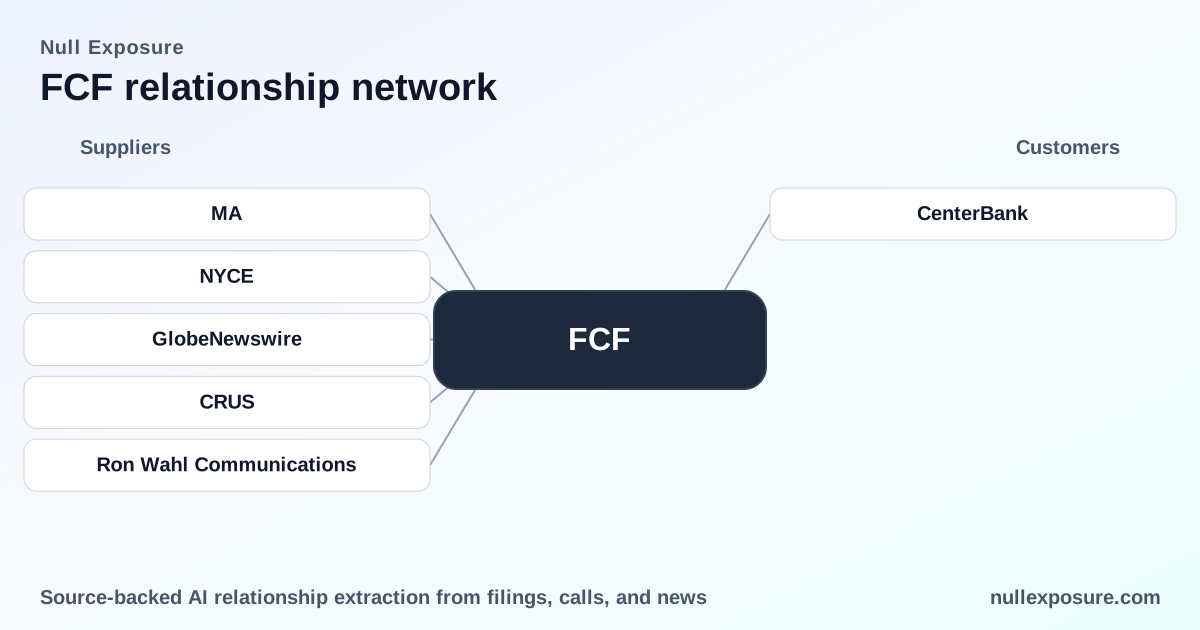
Below are every supplier/partner referenced in public reporting and news captured for FCF. Each relationship summary is concise, with the cited source.
MasterCard (MA)
All of First Commonwealth’s ATMs participate in MasterCard/Cirrus networks, which enables nationwide cash access for customers and supports fee income from off‑us transactions. This is reported in a MarketScreener item summarizing the company’s FY2025 disclosures. (MarketScreener, FY2025)
NYCE
First Commonwealth routes ATM transactions through the NYCE network as well as national card schemes, ensuring regional and national ATM interoperability for customers and preserving transaction fee channels. This is described in the same MarketScreener coverage of FY2025 disclosures. (MarketScreener, FY2025)
Cirrus (CRUS)
Cirrus is listed alongside MasterCard as the network for First Commonwealth’s ATMs, providing an additional nationwide rail for cash access and cross‑network acceptance that supports deposit stickiness and fee generation. (MarketScreener, FY2025)
GlobeNewswire / press distribution
A press release distributed via GlobeNewswire and relayed by QuiverQuant announced corporate actions such as a new $25 million share repurchase program, a capital allocation decision that impacts supplier funding dynamics indirectly through balance sheet management. The QuiverQuant item explicitly cites GlobeNewswire in FY2025. (QuiverQuant relaying GlobeNewswire, FY2025)
Ron Wahl Communications
Ron Wahl Communications appears as the media relations contact cited in the company press distribution, indicating the vendor used for investor and media communications when announcing corporate actions. This contact detail comes from QuiverQuant’s relay of the GlobeNewswire release in FY2025. (QuiverQuant relaying GlobeNewswire, FY2025)
What the public constraints and disclosures say about supplier risk
The company‑level signals in recent disclosures frame how to evaluate supplier exposure:
- Service provider posture is explicit. First Commonwealth contracts with an external vendor for its core processing system to maintain customer and account records and support CRM for substantially all deposit and loan customers. That contract establishes a single‑vendor dependency for critical back‑office functionality.
- Mature third‑party relationships exist. The firm notes an ongoing auditor relationship in place since 2019, which the company describes as an established, multi‑year engagement — a signal of contractual maturity and institutional continuity in assurance services.
- Hedge and financial risk reported as immaterial. The company disclosed that cash flow hedges were highly effective at year‑end and that hedge ineffectiveness was immaterial, which reduces the probability of supplier‑driven valuation shocks from hedging counterparties in the period cited.
These are company‑level constraints derived from FY2024–FY2025 reporting and they translate into practical sourcing signals: critical core processing outsourced, stable assurance relationships, and limited reported hedge ineffectiveness. Investors should treat the core processor as a critical single point of failure until vendor diversification or contract redundancy is evidenced.
Operational implications for investors and operators
- Concentration and criticality: Core processing is a concentrated, critical vendor relationship that underpins deposits, loan servicing, and CRM. Operational disruption at that vendor would have outsized impact on FCF servicing and revenue recognition.
- Network dependence is transactional but broad: Use of MasterCard/Cirrus/NYCE gives the bank broad ATM accessibility and preserves fee income and customer experience; these are commodity rails but essential for retail liquidity and off‑us revenue.
- Communications and capital actions are outsourced: Use of GlobeNewswire and retained media relations firms for announcements suggests standardized external channels for disclosure and investor communications, which is typical but merits monitoring for timing and control issues.
- Maturity reduces onboarding risk but not concentration risk: A mature auditor relationship reduces transitional assurance risk, while the mature status of other vendors (where disclosed) indicates operational stability — it does not eliminate single‑vendor concentration.
Practical checklist for ongoing monitoring
- Track contract renewal dates and termination rights for the core processing vendor; prioritize disclosures that mention vendor changes.
- Monitor interchange and network fee trends on MasterCard/Cirrus/NYCE rails, as higher network fees compress net transaction margins.
- Watch capital allocation moves (repurchases or dividends) announced through GlobeNewswire and similar channels for implications on funding flexibility to support vendor SLAs.
- Validate continuity of auditor and third‑party assurance arrangements to assess control environment stability.
Final takeaways and suggested next steps
- First Commonwealth operates with a mix of outsourced critical infrastructure and broad payment‑network access; that combination is operationally efficient but creates a concentration risk centered on its core processor.
- ATM network participation (MasterCard/Cirrus/NYCE) secures customer access and transactional revenue, while press distribution and media relations vendors handle investor messaging.
- Company disclosures signal mature supplier relationships and immaterial hedge ineffectiveness but do not remove the need for active monitoring of vendor contracts and network cost trends.
For investors and operators who require timely alerts and deeper supplier mapping for FCF, explore monitoring tools and relationship analytics at https://nullexposure.com/. For tailored supplier risk reports and automated alerts tied to vendor events and contract milestones, begin at https://nullexposure.com/.