How FTI Consulting (FCN) is turning advisory reach into recurring cyber services revenue
FTI Consulting sells high-value professional services — advisory, restructuring, litigation support, and increasingly cyber incident response — and monetizes through time-and-materials and fixed-fee engagements with corporate and government clients. The firm’s economics combine stable consulting margins with episodic, high-margin crisis work, and its supplier relationships for cybersecurity technology and incident response are becoming a strategic amplifier of that capability rather than a simple cost line.
If you evaluate supplier risk or opportunity around FTI, start with the clear shift: FTI is embedding third-party security platforms into client-facing services to accelerate delivery and scale coverage across a global customer base. For a quick tour of the implications, see our supplier intelligence hub: https://nullexposure.com/
FTI at a glance: what matters for supplier evaluation FTI Consulting reported trailing revenue of $3.789 billion and EBITDA of $463.6 million for the latest 12 months, with a market capitalization near $5.0 billion and a trailing P/E around 19.7 (latest quarter year-end 2025). Profitability is healthy for professional services (operating margin ~9.4%, net margin ~7.15%), and the firm is scaling cybersecurity offerings as a higher-margin client solution. These are scale signals that change how supplier relationships — especially with cyber vendors — are contracted and deployed.
Why supplier relationships now change the investment calculus FTI’s model uses third-party technology partners to extend field capabilities and reduce time-to-resolution for clients. That changes vendor relationships from back-office procurement to client-facing critical infrastructure: uptime, integration, incident SLAs, and data handling policies directly affect revenue recognition and client satisfaction. Investors and operators should therefore treat key cyber vendors as strategic partners, not commodity suppliers. Learn more about supplier risk and operational signals at https://nullexposure.com/.
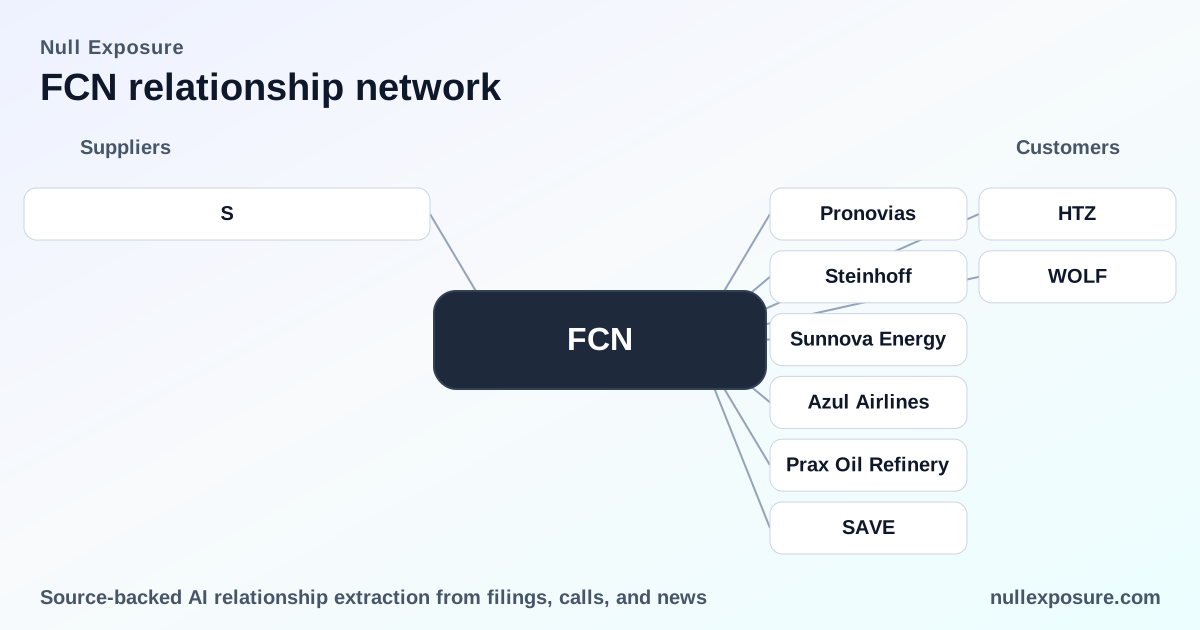
What the data shows — the SentinelOne relationship According to a SentinelOne press release dated March 9, 2026, FTI selected SentinelOne’s Singularity XDR platform to bolster its cyber readiness and incident response services globally, enabling faster investigations and proactive threat management across FTI’s customer portfolio. This is a commercially public, supplier-type engagement where SentinelOne provides the security platform that FTI integrates into service delivery. (Source: SentinelOne press release, March 9, 2026.)
Constraints and what they reveal about FTI’s operating posture FTI discloses that, “Where appropriate, we engage reputable third-party vendors to provide cybersecurity-related services, including security monitoring, risk evaluations, penetration testing, audit, and incident response services, which are aligned with internationally accepted frameworks.” That corporate disclosure is a company-level signal that:
- Contracting posture is deliberate and vendor-forward: FTI explicitly uses third-party cyber vendors as part of client offerings rather than keeping all capabilities in-house. That implies negotiated, service-oriented contracts with SLAs and co-branding or resale elements.
- Concentration risk is moderate but managed: The disclosure does not name a single exclusive provider, suggesting FTI maintains a multi-vendor approach. However, public announcements like the SentinelOne selection indicate FTI will form deeper ties with select platform providers for specific offerings.
- Criticality is high for client-facing services: Cyber platforms are embedded in revenue-generating, time-sensitive incident response; a vendor outage or contract dispute could disrupt billable work and client trust.
- Maturity of the relationship strategy is advanced: The language and press activity indicate FTI has formalized vendor engagement as a strategic capability, not an ad-hoc procurement function.
Relationship-level detail (every relationship in the results)
- SentinelOne — FTI selected SentinelOne’s Singularity XDR for its incident response and cyber readiness services, enabling faster threat detection and investigations for FTI’s global client base. According to the SentinelOne press release from March 9, 2026, the platform is being used to accelerate incident response and enhance cyber offerings across FTI’s portfolio. (Source: SentinelOne press release, March 9, 2026.)
Note: the company-level constraint about engaging reputable third-party cybersecurity vendors describes FTI’s overall supplier posture rather than a single contractual clause tied to a specific vendor.
What this means for investors and operators FTI’s public pairing with SentinelOne is not just a tech procurement — it’s a go-to-market decision that affects revenue delivery, client retention, and operational risk. Practical implications:
- Revenue alignment: Embedding XDR into service propositions speeds delivery and can increase billable utilization, supporting higher margin outcomes on cyber engagements.
- Operational reliance: As FTI moves from advisory to incident execution at scale, vendor SLAs, data residency, and integration roadmaps become material to continuity and regulatory compliance.
- Negotiation leverage: FTI’s scale and global footprint give it commercial leverage, but exclusive dependence on a single vendor for core client-facing services would increase concentration risk; current signals indicate a selective multi-vendor approach.
- Due diligence for counterparties: For partners and customers, validate MDR/XDR coverage and evidence of operational playbooks where FTI integrates third-party tooling into billable workflows.
Actionable takeaways for supplier due diligence
- Ask for contractual details: SLA terms, failover plans, data handling and ownership, and co-sell versus reseller arrangements. Those specifics determine how supplier failure propagates to revenue loss.
- Monitor public product adoption announcements: Press releases like the SentinelOne statement are early indicators that FTI will rely on that supplier in client-facing scenarios.
- Evaluate vendor consolidation risk: Track whether FTI broadens its vendor set or deepens exclusive integrations; both affect negotiation power and operational fragility.
If you want a focused supplier-risk brief on FTI’s cyber partnerships, start here: https://nullexposure.com/
Conclusion — implications for portfolio and operations FTI Consulting is scaling cybersecurity as a revenue-creating capability by integrating third-party platforms into its client workstream. That strategy improves speed-to-value for clients and supports margin expansion, but it elevates vendor operational risk into a revenue risk. For investors, monitor supplier announcements, vendor concentration, and contractual protections; for operators, prioritize SLA and incident playbook alignment. For deeper supplier intelligence tailored to enterprise and portfolio needs, visit https://nullexposure.com/ and request a focused briefing.