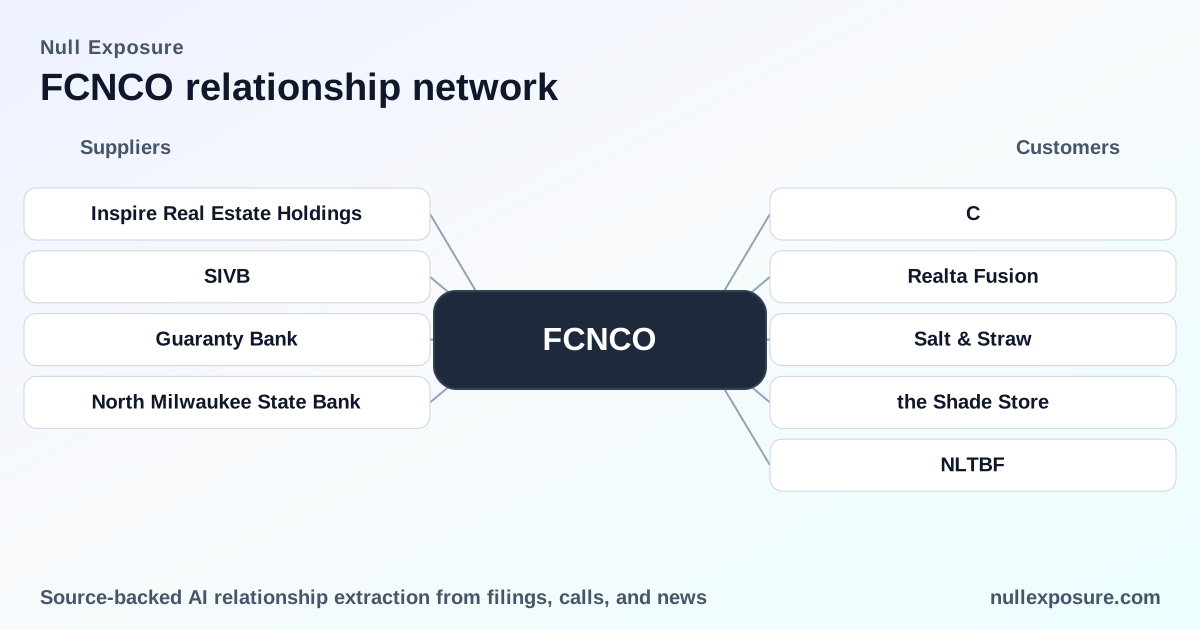
FCNCO (First Citizens) — Supplier and counterparty footprint investors should price into credit and strategic decisions
First Citizens BancShares operates as a regional bank holding company, monetizing through net interest margin on loans funded predominantly by customer deposits, income from investment securities and fee businesses, and occasional balance-sheet maneuvers such as acquisitions of failed banks. FCNCO is a preferred equity instrument tied into that banking franchise; the underlying operating model is deposit-centric and acquisition-enabled, not a trading or market‑making business. For investors and operators underwriting supplier exposure or counterparty risk, the most important dynamics are funding concentration, long‑dated acquisition obligations, and the bank’s track record of taking over failed institutions.
Learn more about supplier profiles and counterparty exposure at https://nullexposure.com/.
How First Citizens structures its funding and contractual posture
First Citizens funds itself primarily through deposits, which are the core economic engine of the business. According to the company’s reporting, deposits represented approximately 81% of total funding at December 31, 2024, establishing a funding profile that is concentrated and fundamentally deposit‑driven rather than wholesale‑funding reliant.
A company‑level constraint set conveys several actionable signals for investors:
- Contracting posture is long‑term for acquisition financing — the SVB-related Purchase Money Note carries a principal of $36.07 billion, accrues interest at 3.50% per annum and has no scheduled principal payments, embedding a long-duration liability on the balance sheet (this contract is explicitly tied to the SVBB acquisition).
- Funding concentration is high and operationally critical — heavy dependence on core deposits increases sensitivity to local and sectoral deposit flows.
- Brokered deposits are immaterial (<1%), signaling a low reliance on more volatile brokered funding.
- Spend evidence shows large securities and regulatory charges — purchases of investment securities and FDIC assessment charges (a $64 million special assessment in 2023 plus an additional ~$11 million accrual in 2024) indicate both meaningful asset purchases and regulatory cost exposure.
These constraints together shape counterparty and supplier diligence: prioritize counterparties that tolerate long-term balance‑sheet commitments and can withstand concentration‑risk shocks.
What the relationship list reveals — concise takeaways for each counterparty
-
Inspire Real Estate Holdings — First Citizens purchased the 250 University Avenue office building in Palo Alto for $82 million, acquiring the asset from Inspire Real Estate Holdings as part of the bank’s real estate and branch strategy. This transaction is reported by The Real Deal (August 13, 2025).
Source: The Real Deal, “First Citizens Bank buys Palo Alto office for $82 million,” Aug 13, 2025. -
Silicon Valley Bank (SIVB) — First Citizens completed a large, operationally transformative acquisition of Silicon Valley Bank assets and deposits: the bank bought approximately $167 billion of assets and $119 billion of deposits following SVB’s collapse in 2023, and financed the deal in part via a Purchase Money Note with a principal amount of $36.07 billion carrying a 3.50% interest rate and no scheduled principal payments. This obligation creates a long‑term contractual linkage between First Citizens and the SVB transaction.
Source: The Real Deal reporting on the transaction (Aug 13, 2025) and the company’s acquisition disclosures (SVBB Acquisition Purchase Money Note, post‑2023 acquisition). -
Guaranty Bank — In an earlier failed‑bank takeover, First Citizens assumed all deposits and purchased $892.6 million of assets from Guaranty Bank when federal authorities closed the institution; this is a precedent for First Citizens’ role as a consolidator in failed‑bank scenarios.
Source: Journal Sentinel / JSONline, coverage of the Guaranty Bank transaction (May 5, 2017). -
North Milwaukee State Bank — As part of legacy failed‑bank activity, First Citizens also absorbed North Milwaukee State Bank when it was shut down in March 2016, reinforcing the bank’s operational history of taking deposit books and assets from failed regional peers.
Source: Journal Sentinel / JSONline coverage of the 2016 takeover (reporting on failed Wisconsin banks).
Strategic implications for investors and supplier managers
First Citizens’ supplier and counterparty posture is shaped by three interlocking realities:
-
Concentration and criticality: With deposits representing roughly 81% of funding, counterparties exposed to First Citizens are effectively tied to a deposit‑funded balance sheet. That funding concentration is a strength in stable cycles but amplifies idiosyncratic deposit flight risk in stress scenarios. Counterparties should underwrite the bank as a deposit‑centric counterparty with high operational criticality.
-
Long‑dated contractual commitments from acquisitions: The SVB Purchase Money Note is a material, long‑term liability and changes the bank’s funding and interest‑rate sensitivity profile. This obligates counterparties and suppliers to model extended funding and interest expense stress on First Citizens’ cash flow rather than expecting quick amortization or refinancing.
-
Regulatory and one‑off cost volatility: The bank has incurred sizable FDIC assessment charges (a $64 million special assessment in 2023 and an additional ~$11 million accrual in 2024) and shows evidence of large investment securities purchases. Suppliers with pricing or performance tied to regulatory outcomes should embed contingencies for episodic assessments and larger liquidity draws.
These attributes recommend two operational stances: 1) price tenor and liquidity buffers conservatively when contracting with First Citizens, and 2) monitor deposit trends and regulatory developments closely as primary early‑warning signals.
Learn more about evaluating counterparty concentration and long‑term contractual risk at https://nullexposure.com/.
Practical next steps for investors and operators
- For credit or supplier underwriting, require covenant or contract language that reflects the bank’s long-term acquisition liabilities and deposit concentration; stress test pricing under prolonged deposit outflow and higher funding cost scenarios.
- For strategic sourcing and supplier allocation, prioritize counterparties that can accept payment and settlement flexibilities if FDIC‑related charges or large securities purchases increase near‑term cash strain.
- Maintain active monitoring of deposit composition and FDIC interactions; brokered deposits are low today (<1%), but a rapid shift to wholesale funding would materially change risk profiles.
Bottom line
First Citizens is a deposit‑funded regional bank that has grown through failed‑bank takeovers and now carries long‑dated acquisition debt tied to the SVB transaction; its supplier footprint reflects asset purchases and integration of failed institutions. Investors and operators should underwrite counterparties for funding concentration, long contractual duration, and episodic regulatory costs. For a deeper read on supplier relationships and to benchmark counterparty exposure across portfolios, visit https://nullexposure.com/.