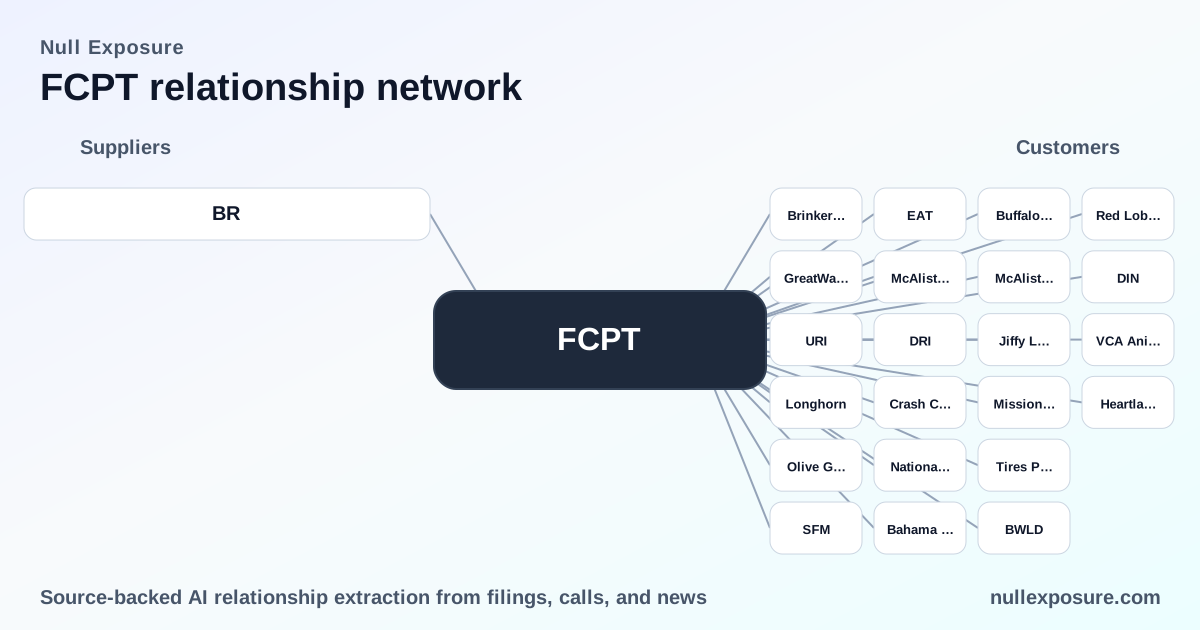
Four Corners Property Trust (FCPT): supplier relationships, capital posture, and what investors need to know
Four Corners Property Trust operates as a single-tenant retail REIT that acquires and manages restaurant and retail properties across the United States and monetizes through long-term triple-net leases that generate stable rental cash flow and support a recurring dividend. The company’s monetization thesis is straightforward: own high-quality, single-tenant real estate leased to resilient restaurant operators, extract secure rental income, and use public capital markets to finance accretive acquisitions and return cash to shareholders.
For a deeper look at supplier and service-provider relationships that underpin that model, visit NullExposure for procurement and counterparty intelligence: https://nullexposure.com/
How the company runs the business and why supplier relationships matter
FCPT’s operating model is built around a concentrated asset class (single-tenant retail/restaurant), standardized lease mechanics (NNN leases), and an externally-facing capital markets posture. That combination produces a business model with clear characteristics:
- Contracting posture: Relies on standardized, scalable vendor and service contracts—property management, transfer-agent services, and capital-market counterparties—so operational continuity depends more on counterparty reliability than bespoke integrations.
- Concentration and criticality: Asset concentration in single-tenant retail increases counterparty criticality at the tenant level, while supplier relationships (title, transfer agents, property services) are operationally critical but more replaceable than tenant cash flows.
- Maturity and predictability: As a listed REIT with a track record of acquisitions and dividend distributions, FCPT demonstrates mature processes for investor communications, tax reporting, and capital formation.
- Capital-market dependence: The company actively uses public equity and secured capital to fund growth, which creates regular interaction with banks, sales agents, and transfer agents.
If your investment analysis values transparency into counterparty roles—especially investors, transfer agents, and banks—NullExposure provides targeted supplier intelligence: https://nullexposure.com/
The supplier relationships you need to know
Below I document every supplier/service-provider relationship disclosed in the available records and summarize the practical implication for investors.
Broadridge Corporate Issuer Solutions — transfer agent for shareholder tax reporting
Broadridge served as FCPT’s transfer agent for 2025 and is responsible for issuing IRS Form 1099‑DIV to holders of common stock for distributions paid during the year. According to a company notice distributed via Business Wire and republished on FinancialContent (Jan 23, 2026), Broadridge provided dividend tax reporting services for shareholders holding the stock in their names during 2025. This is a standard transfer-agent arrangement supporting investor recordkeeping and tax compliance.
Source: Business Wire notice as posted on FinancialContent (Jan 23, 2026).
What the constraints and public filing language tell investors about risk and capital strategy
Company-level filing language indicates that FCPT authorized an equity distribution capacity covering up to $500.0 million of gross sales of common stock that can be executed either directly by the company through a consortium of banks acting as sales agents or by a consortium of banks as forward sellers on behalf of forward purchasers. This language is consistent with a shelf-registration or at-the-market equity program and conveys several investor-relevant signals:
- Active use of public equity for funding and liquidity. The authorization for up to $500 million of equity sales signals a willingness to access the public market for capital when acquisition or balance-sheet needs arise.
- Capital flexibility with potential dilution. The program structure provides flexibility to raise equity opportunistically, which supports growth but introduces dilution risk for existing shareholders.
- Mature banking relationships. The involvement of a consortium of banks as sales agents and possible forward sellers indicates established capital markets counterparties and the operational capability to execute incremental equity raises quickly.
- Contracting posture consistent with REIT peers. This is a conventional capital-market posture for a growing REIT that needs optionality to fund acquisitions and manage leverage.
These are company-level signals drawn from filing language; they are not attributed to any specific named bank or intermediary.
Investment implications — growth, yield, and counterparty operational risk
FCPT’s core investment case—stable cash flow from single-tenant lease income—rests heavily on tenant credit and disciplined capital allocation. Supplier relationships like Broadridge (tax reporting) are low operational risk but high functional importance: failure or transition could temporarily disrupt investor communications or tax reporting but would not impair underlying lease cash flows.
On the capital side, the shelf/ATM-style authority for up to $500 million signals growth optionality at the cost of potential dilution, and it highlights the company’s reliance on bank syndicates and sales agents to execute equity programs. Investors should weigh:
- Dividend stability: The company’s dividend profile is supported by high operating margins and recurring rent, but the availability of equity capital makes dividend smoothing feasible if needed.
- Liquidity and execution risk: Equity programs are only as effective as the market window and bank syndicate execution; adverse market conditions could limit access or increase cost of capital.
- Operational continuity: Service providers such as transfer agents are replaceable but central to investor relations; consistent vendor engagements reduce execution risk.
For a portfolio manager focused on counterparty exposure and supplier concentration across REITs, NullExposure provides searchable reports and relationship mapping: https://nullexposure.com/
Bottom line and actions for investors
Four Corners Property Trust is a market-oriented, capital-markets-savvy REIT that monetizes through NNN lease income and supplements growth with opportunistic equity issuance. Key takeaways: FCPT’s supplier relationships are operationally straightforward (transfer agents, banks) but critically support investor communications and capital formation; the company’s authorized equity program up to $500 million demonstrates an aggressive but conventional capital posture. Monitor tenant credit quality and timing of any equity issuance for the clearest near-term impact on valuation and yield.
If you evaluate supplier risk as part of investment due diligence, explore NullExposure to see mapped supplier relationships and contract-level signals used by institutional investors: https://nullexposure.com/