Fidelity D&D Bancorp (FDBC): Supplier relationships that shape liquidity, M&A execution and local footprint
Fidelity D & D Bancorp operates as the holding company for a regional bank focused on deposit-taking, lending and trust services across northeastern Pennsylvania; it monetizes via net interest margin, loan and lease income, and fee-based trust and service businesses. For investors evaluating counterparty exposure and operational resiliency, the supplier map is compact and local: a small portfolio of membership investments, short-term liquidity providers, and transactional advisors for occasional M&A. Learn how these relationships influence balance-sheet flexibility and transaction execution and explore more supplier intelligence at https://nullexposure.com/.
Why these suppliers matter to investors: liquidity, membership and execution risk
FDBC’s supplier set reads like a regional bank’s playbook: membership stakes in system banks, short-term borrowing lines for day-to-day liquidity, and outside counsel/advisors for discrete strategic transactions. The 2024 Form 10-K discloses several instructive signals:
- Short-term borrowing posture is material. The filings describe overnight balances with Federal Home Loan Bank lines and correspondent federal funds as part of daily liquidity management, and management used proceeds—$29.1 million—to pay down short-term borrowings to replenish borrowing capacity while improving net interest spread. This implies an operational reliance on accessible credit lines rather than long-term syndicated financing.
- Geographic concentration is high. Leased property disclosures and branch footprint are concentrated in the Commonwealth of Pennsylvania, indicating local market exposure and counterparty concentration for real-estate related supplier relationships.
- Spend scale is modest but meaningful. Secured borrowing agreements related to sold loan participations carried a combined value of roughly $6.2 million at year-end 2024, which places these third‑party credit relationships in a $1–$10 million spend band—enough to be operationally relevant, but not large enough to create systemic counterparty risk for a bank this size.
- Third-party service roles are transactional. The company originates direct finance leases through auto dealerships and the residual values are guaranteed by those dealerships, signaling service-provider arrangements with embedded credit guarantees rather than open-ended vendor exposure.
Together, these constraints sketch a bank that operates with tight local counterparty networks, dependence on membership liquidity facilities, and ad hoc external advisors for strategic deals—a profile investors should weigh against capital adequacy and deposit stability.
Visit https://nullexposure.com/ to see how these relationship signals compare across regional banks.
Relationship-by-relationship: who supplies FDBC and what that means
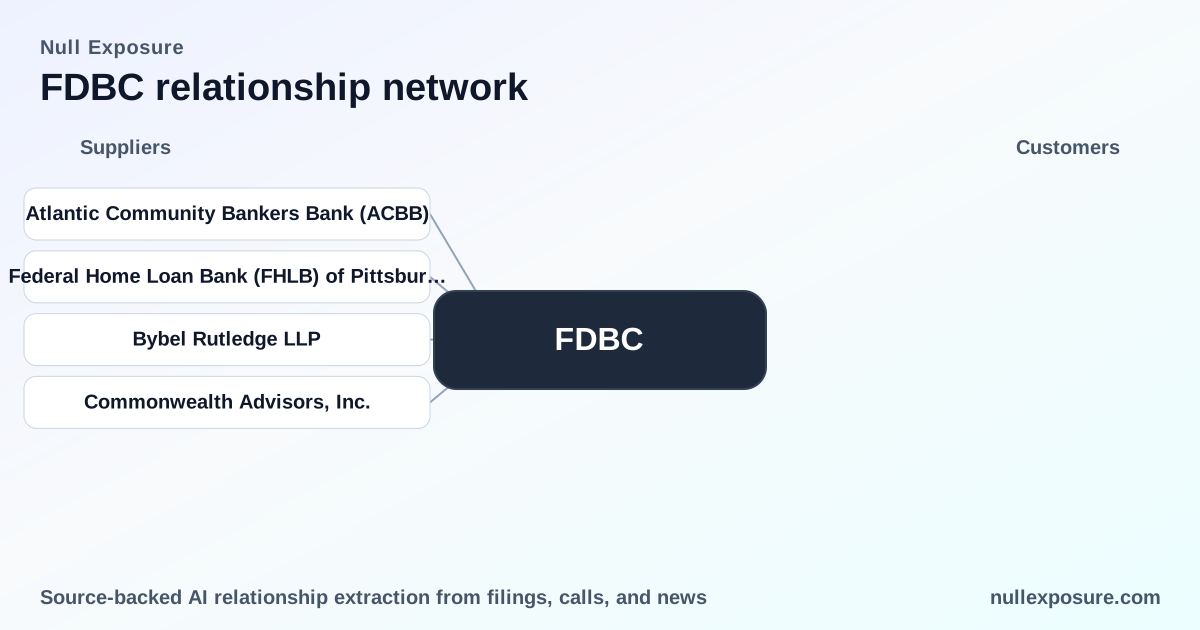
Atlantic Community Bankers Bank (ACBB)
FDBC holds a small investment in Atlantic Community Bankers Bank stock, recorded at $82,000 as of December 31, 2024 and 2023, indicating a modest equity stake consistent with cooperative banking relationships rather than a principal counterparty exposure. According to the company’s 2024 Form 10-K, ACBB stock totaled $82 thousand as of December 31, 2024. (2024 Form 10-K)
Federal Home Loan Bank (FHLB) of Pittsburgh
FDBC maintains the stock required for FHLB membership; that investment is carried at cost because no market value is available, and the FHLB functions as a primary source of short-term liquidity via lines of credit. The 2024 Form 10-K states that investment in FHLB stock is required for membership and is carried at cost, and management references use of FHLB lines for overnight liquidity and short-term funding. (2024 Form 10-K)
Bybel Rutledge LLP
Bybel Rutledge LLP served as legal counsel to Fidelity D & D Bancorp in the firm’s acquisition of MNB Corporation, reflecting the bank’s use of external counsel for corporate transactions. This engagement is documented in a GlobeNewswire press release announcing the acquisition on December 10, 2019. (GlobeNewswire, Dec 10, 2019)
Commonwealth Advisors, Inc.
Commonwealth Advisors, Inc. acted as financial advisor to FDBC for the same MNB acquisition, underscoring that the bank leverages boutique advisory partners for deal structuring and financial analysis. This engagement is also described in the December 10, 2019 GlobeNewswire release. (GlobeNewswire, Dec 10, 2019)
How these relationships drive risk and opportunity
- Liquidity and funding flexibility are provider-dependent. The explicit use of FHLB lines and correspondent overnight facilities places the bank in a conservative but short-term funding posture—effective for daily liquidity management but sensitive to abrupt funding market stress. Management’s allocation of $29.1 million of proceeds to pay down short-term borrowings demonstrates active balance-sheet management to preserve borrowing capacity (2024 Form 10-K).
- Local concentration amplifies regional cyclicality. With branches, leased properties and many counterparties confined to Pennsylvania, FDBC’s supplier risks are intertwined with local economic cycles and real estate markets; investors should treat supplier disruption in-region as proportionally more impactful than for a geographically diversified bank.
- Transactional supplier relationships for M&A are episodic but critical. Legal and financial advisors are used selectively for acquisitions; these suppliers are operationally critical at the moment of transaction, but not material to everyday operations. The 2019 MNB transaction shows the bank will engage recognized external specialists when strategic opportunities arise (GlobeNewswire, Dec 10, 2019).
- Scale of borrowing relationships is moderate. The documented $6.2 million in secured borrowing agreements related to sold loan participations reflects a mid-range third-party exposure—large enough to require oversight, but not on the scale of systemic counterparties.
Practical takeaways for investors and operating partners
- Monitor FHLB access and pricing. Given FDBC’s reliance on Federal Home Loan Bank facilities for short-term liquidity, investor focus should center on FHLB membership conditions, collateral availability and margining trends that would affect funding cost and availability.
- Underwrite local cyclical risk. Supplier concentration within Pennsylvania increases sensitivity to regional economic troughs—stress-test scenarios should reflect localized deposit and loan-performance shocks.
- Treat M&A advisors as single-use operational dependencies. Legal and financial advisor quality matters for execution; track incumbent advisor relationships if you are evaluating the bank’s future transactional cadence.
For a comparative view of supplier signals across similar regional banks, visit https://nullexposure.com/.
Final assessment and next steps
FDBC’s supplier landscape is compact, dominated by membership-based liquidity providers (FHLB), modest cooperative investments (ACBB), and transactional advisors for M&A. That structure supports nimble balance-sheet management but concentrates execution and liquidity risk regionally and in the short term. Investors should prioritize monitoring FHLB lines, short-term borrowing metrics, and local economic indicators.
If you are evaluating counterparty exposure or preparing vendor due diligence for a regional-bank investment, start with a supplier-focused snapshot at https://nullexposure.com/ and compare FDBC’s relationships to peers to surface concentration and liquidity differences.