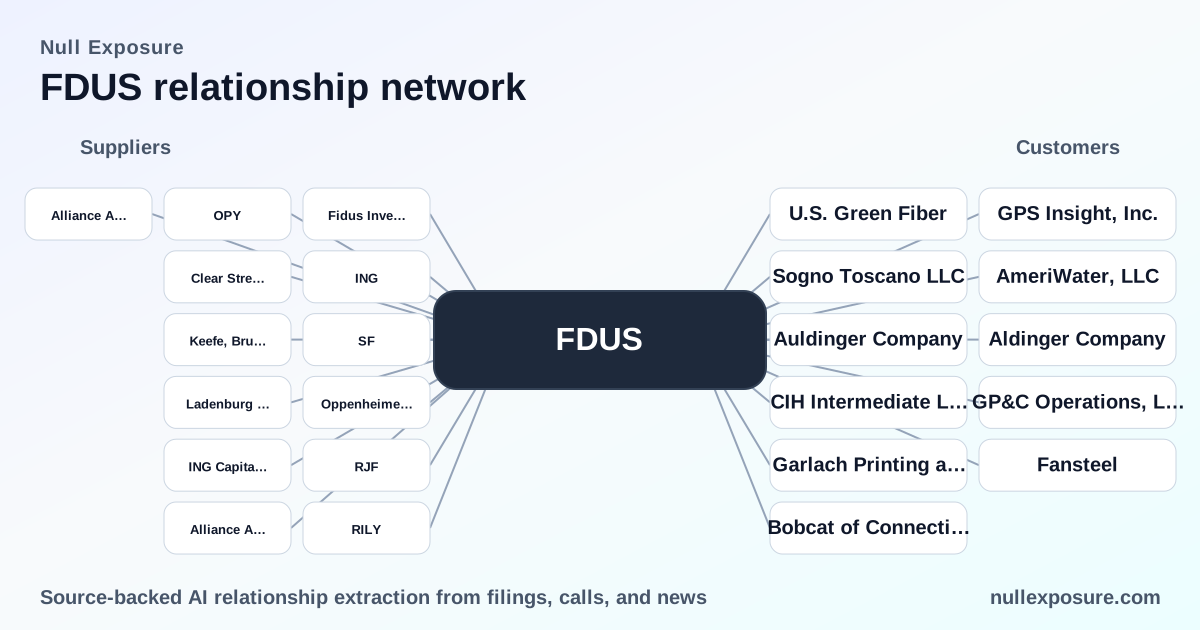
Fidus Investment Corp (FDUS): supplier network and capital markets counterparties investors should track
Fidus Investment Corp is a Nasdaq-listed business development company that earns income by originating and managing debt and equity investments in lower middle-market companies, collecting interest and fees while using the capital markets to fund balance sheet growth. The firm monetizes through portfolio yield and realized capital appreciation, supported by a recurring advisory/administration relationship that supplies operational capacity and a set of underwriters and lenders that provide financing and liquidity. For investors evaluating counterparty risk, the clearest operational dependencies are the investment advisor relationship and the roster of capital-markets partners that underwrite its public note offerings and provide SPV financing. Learn more about supplier analytics and counterparty exposure at https://nullexposure.com/.
How to read FDUS’s supplier map: operating characteristics that matter
Fidus combines an internally directed investment strategy with outsourced operational functions. That hybrid produces several practical constraints:
- Contract posture is mixed: the Investment Advisory and Administration agreements are renewed on an annual basis (short-term contractual posture for advisory services), while certain financing instruments—most notably SBA-guaranteed debentures tied to SBIC activities—have long-term maturities (ten years). This creates a two-speed governance environment: frequent renegotiation of operating terms alongside multi-year funding commitments.
- Critical service dependency: the company depends on an external investment adviser and administrator to run its day-to-day operations, which is a central counterparty for compliance, portfolio management, and even office provisioning. Fidus Investment Advisors, LLC functions as a material service provider.
- Capital markets diversification reduces single-counterparty concentration: Fidus has used a range of book-runners and co-managers for its note issuance, which lowers execution risk but leaves the firm exposed to broader market liquidity cycles when issuing fixed-income securities.
- Government exposure and spending scale: SBIC-related borrowing implies interaction with the SBA and potentially large allowable leverage bands; regulatory caps on SBIC borrowing cap single-fund exposure but also imply high potential borrowing capacity (100m+ band signals in disclosures).
These structural signals imply that investors should monitor both short-term contract renewals (advisory agreements) and longer-dated funding schedules (debentures and SPV credit facilities) to anticipate shifts in cash flow and operating leverage. If you want a deeper counterparty map for investment diligence, visit https://nullexposure.com/ for supplier-level intelligence.
The counterparties: a practical roster investors need to track
Below are all counterparties and partners identified in regulatory and press disclosures tied to FDUS’s supplier and capital-markets activity. Each entry includes a concise, plain-English description and the primary public source.
-
Fidus Investment Advisors, LLC — The registered investment adviser that provides investment advisory, administration and custody-related services to Fidus under formal agreements and supplies operational infrastructure; the relationship is explicitly documented in SEC filings and recent press coverage. According to MarketBeat and SEC exhibit references in FY2026/FY2011 disclosures, the advisor operates as the company’s designated service provider and is central to fund operations. (MarketBeat news alerts, FY2026; SEC registration exhibits incorporated by reference.)
-
Raymond James & Associates, Inc. — Named as a book-runner for a $100 million public offering of 6.75% notes due 2030, Raymond James executed underwriting responsibilities for Fidus’s capital raise. The role was disclosed in a GlobeNewswire press release and QuiverQuant reporting tied to the FY2025 offering. (GlobeNewswire/QuiverQuant press coverage, March 2025 / FY2025.)
-
ING Financial Markets LLC — Served as a book-runner on the same 2025 note offering and is also tied to SPV financing arrangements; ING entities appear across both underwriting and SPV credit facility notices. (QuiverQuant press coverage and GlobeNewswire, FY2025; ING Capital LLC credit facility referenced in Q3 2025 release.)
-
Keefe, Bruyette & Woods, A Stifel Company (and Keefe, Bruyette & Woods, Inc.) — Identified as a lead manager/passive book-runner on the 2025 debt issuance, contributing distribution and execution capacity for Fidus’s notes. (GlobeNewswire/QuiverQuant, March 2025 / FY2025.)
-
Oppenheimer & Co. Inc. — Named as a lead manager/co-manager on the same 2025 note sale, participating in primary-market distribution for Fidus debt. (QuiverQuant/GlobeNewswire reporting, FY2025.)
-
B. Riley Securities, Inc. — Served as a co-manager on the $100 million 6.75% notes and appears in multiple press items describing the underwriting syndicate. (The Globe and Mail / GlobeNewswire, March 2025 / FY2025.)
-
Clear Street LLC — Listed as a co-manager on the 2025 offering, providing execution and distribution support alongside B. Riley. (The Globe and Mail / GlobeNewswire, March 2025 / FY2025.)
-
Ladenburg Thalmann & Co. Inc. — Identified as a co-manager on the March 2025 offering, part of the syndicate that supported Fidus’s note issuance. (GlobeNewswire, March 2025 / FY2025.)
-
ING Capital LLC — Counterparty on an SPV credit facility entered into October 16, 2025; the facility was disclosed in Fidus’s third-quarter 2025 financial results and supports securitization or SPV-level lending structures. (GlobeNewswire Q3 2025 press release, FY2025.)
-
Alliance Advisors IR — Acts as an investor relations contact for Fidus; Alliance Advisors and Alliance Advisors IR are listed in multiple earnings and dividend disclosures as the investor-relations point of contact. (GlobeNewswire and Yahoo/Finance press releases scheduling earnings and announcing dividends, FY2026.)
-
Alliance Advisors — Same IR function identified as the investor relations firm handling communications and disclosure logistics for Fidus in FY2026 press releases. (Yahoo Finance / GlobeNewswire, FY2026.)
Each of these relationships is documented in public press releases or market news tied to Fidus’s FY2025–FY2026 activities, including the March 2025 $100 million note sale and subsequent investor communications through FY2026. The underwriting roster demonstrates broad engagement with mid‑to‑large capital markets dealers, while ING Capital LLC provides a distinct lending line for SPV activity.
What this means for risk and portfolio diligence
- Single most critical supplier: Fidus Investment Advisors, LLC — the external adviser/administrator drives performance, compliance, and day-to-day operations; any change in that relationship would be material. This is an explicit, named service-provider relationship in regulatory exhibits.
- Funding mix creates timing risk: annual advisory renewals introduce negotiation risk to operating cost structure, while long-dated debt and SBA/SBIC activity create multi-year cash-flow commitments that require active capital-markets engagement.
- Market execution risk is distributed: the use of several book-runners and co-managers for the 2025 note offering reduces reliance on any single underwriter, but the firm remains exposed to broader market liquidity and interest-rate conditions when refinancing or issuing notes.
- Government counterparty exposure exists at scale: SBIC/SBA borrowing rules are highlighted in disclosures and establish upper bounds on leverage; these are company-level signals that influence maximum borrowing capacity and regulatory constraints.
If you are evaluating FDUS for allocation or operational counterparty risk, focus on monitoring the Investment Advisory agreement renewals, the schedule of long-dated debentures, and upcoming capital markets activity with the underwriting syndicate. For a structured supplier risk report and continuous tracking, visit https://nullexposure.com/ to see how supplier relationships and financing counterparties move together in real-time.
Final takeaways for investors
- Fidus operates a hybrid model—outsourced operations with active capital markets funding—creating clear points of counterparty concentration and execution risk.
- The Investment Advisor is a single critical service provider documented in SEC exhibits; capital markets partners are diversified but important to refinancing capacity.
- Monitor short-term advisory renewals and long-term debt maturities as the next inflection points for cash flow and yield stability.
For deeper supplier-level diligence and ongoing monitoring of FDUS counterparties, go to https://nullexposure.com/ — the right source for investor-focused supplier intelligence.