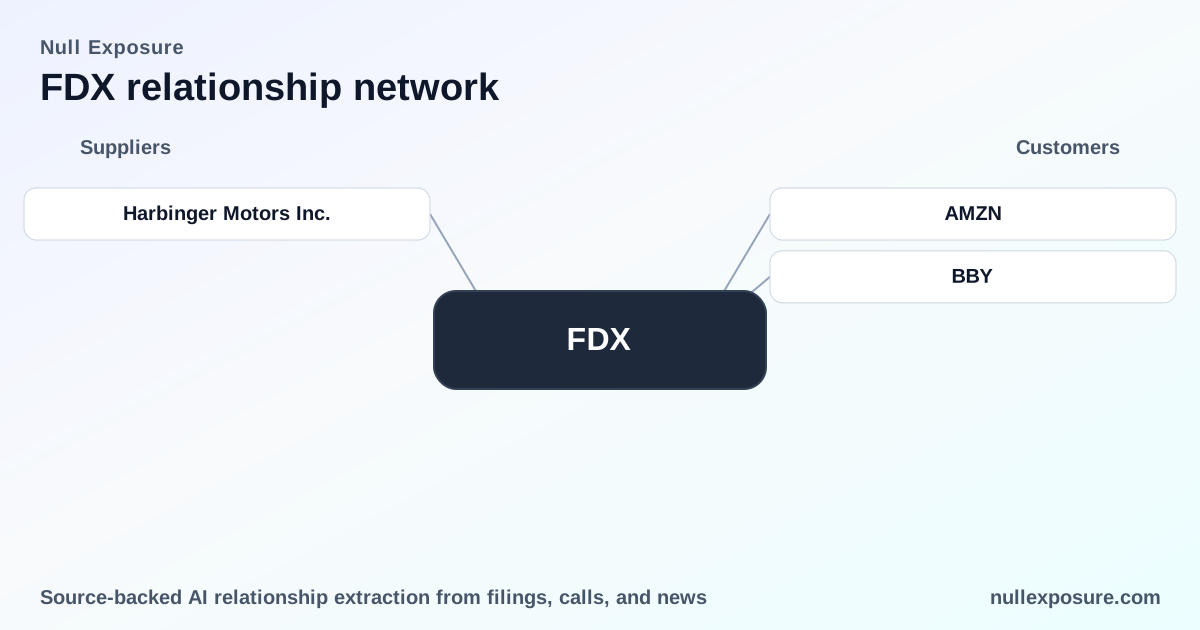
FedEx (FDX) as a Supplier Partner: Strategic posture, commitments, and a new EV bet
FedEx monetizes a global logistics network through integrated shipping, ground and air express, freight operations and a suite of value-added logistics services; its revenue stream is a mix of high-frequency parcel volumes and longer-duration capital commitments (aircraft, real estate, and long-term equipment leases). The company’s supplier footprint reflects that hybrid model: large, capital-intensive commitments coexist with a decentralized base of thousands of independent service providers. For investors and procurement leaders evaluating FedEx as a counterparty or partner, the key questions are how contractual tenor, counterparty type and spend concentration translate into operational risk and strategic optionality. Visit https://nullexposure.com/ for more supplier-risk research and relationship intelligence.
The headline relationship: FedEx and Harbinger Motors — what happened and why it matters
FedEx joined a $160 million financing round for Harbinger Motors Inc. and placed an initial order for 53 Harbinger electric vehicle (EV) chassis, signaling an early procurement commitment tied to fleet electrification and supplier development. An OCBJ news report published March 9, 2026, documents the investment and the initial chassis order (OCBJ, Mar 9, 2026).
- Why this matters: a direct investment combined with an order converts a supplier relationship into a strategic supplier-development play; that structure accelerates adoption of new technology across FedEx’s fleet and aligns supplier incentives.
All supplier relationships in the results — concise coverage
- Harbinger Motors Inc.: FedEx invested in Harbinger’s $160 million raise and placed an initial order for 53 EV chassis, tying capital support to an early procurement commitment (OCBJ, Mar 9, 2026).
How the constraint signals define FedEx’s operating model
FedEx’s public disclosures and related evidence reveal a layered contracting posture and material dependency on third parties:
-
Contracting tenor is long-term for capital assets. The company notes that “the majority of these leases are for terms of five to ten years,” which signals durable fixed-cost commitments for aircraft, property and certain equipment—a capital-intensive backbone that reduces short-term flexibility but secures capacity (company filings as of May 31, 2025).
-
Counterparty base is highly distributed for linehaul and local services. FedEx contracts with approximately 5,700 independent small businesses to execute linehaul and pickup-and-delivery work, indicating a decentralized operational model that outsources labor and last-mile variability while retaining network control (company filings).
-
Third-party relationships are material to results. The company explicitly warns that failure of third-party service providers could have a material adverse effect on operations, underscoring the operational criticality of supplier execution across both logistics and IT functions (company filings).
-
Relationship roles skew to service provision. FedEx engages third-party providers for core operational services—linehaul, pickup-and-delivery, IT infrastructure and application support—so supplier performance ties directly to customer experience and throughput.
-
Maturity and activity are high. Filings indicate active, approved supplier credit flows (suppliers were approved to sell $71 million and $94 million of outstanding payment obligations as of May 31, 2025 and 2024, respectively) and significant aircraft-related deposits ($590 million as of May 31, 2025), showing both an active supplier market and committed future cash outflows (company filings).
Together these constraints describe an operator that mixes large, long-term capital commitments with a high-volume, small-business supplier ecosystem—a configuration that delivers scale and geographic reach but concentrates operational risk in execution and supplier continuity.
What investors and operators should watch next
-
Execution risk in a distributed provider network. A fleet of thousands of independent contractors reduces fixed headcount but increases variability in service quality, labor continuity and regulatory exposure across jurisdictions; monitor claims frequency, regional service outages, and litigation trends tied to independent contractor disputes (company filings).
-
Capital commitment exposure. The company’s deposits on aircraft and long leases create fixed obligations that compress flexibility in a demand downturn; track fleet utilization, aircraft delivery schedules and residual-value assumptions in filings (May 31, 2025 disclosures).
-
Supplier development as strategic lever. The Harbinger transaction is a prototype for how FedEx will secure early access to electrified chassis and emerging供应 (sic) technologies by pairing investment with purchase commitments—this reduces supplier risk for incumbent providers and accelerates fleet modernization (OCBJ, Mar 9, 2026).
-
Payment and liquidity pathways. Approved supplier sales of outstanding payment obligations (tens of millions) indicate FedEx’s active management of payables and supplier liquidity. For suppliers and partners, understanding the approved financing channels and their terms is essential for forecasting working capital flows (company filings).
For a deeper view of counterparty risk frameworks and rolling supplier intelligence, see https://nullexposure.com/.
Practical implications for procurement and credit underwriters
Procurement teams should treat FedEx as a strategic, but complex, counterparty:
- Negotiate clear, long-term performance SLAs for critical routes and asset-backed commitments to match the tenor of FedEx’s leases and capital cycles.
- Require financial covenants or step-in rights for suppliers providing mission-critical services—particularly for small-business contractors whose balance sheets are inherently more volatile.
- Underwriters must price for correlated risk: supplier performance failures propagate quickly through FedEx’s network and can lift customer churn and claims.
These are not theoretical points—FedEx’s filings show this configuration in practice and disclose the potential for material impact from third-party failures (May 31, 2025 disclosures).
Bottom line: what to do with this intelligence
- If you are a buyer or integrator: Treat FedEx as a partner that will leverage strategic supplier investments (e.g., Harbinger) to control technology adoption—structure contracts that capture performance upside while protecting against transition risk.
- If you are an investor: Factor in the dual exposure of stable parcel demand and fixed capital commitments; FedEx’s network strength and institutional backing (market cap ~$83B, revenue roughly $90B TTM) support resilience, but third-party dependency and capital intensity are persistent risk drivers (company data, FY2025 filings).
For continuous monitoring and supplier risk scoring tailored to transportation and logistics relationships, visit https://nullexposure.com/.
FedEx’s move into EV chassis procurement and direct supplier financing is a concrete example of how strategic investments can accelerate operational transformation while embedding the company deeper into suppliers’ capital and execution cycles. That combination creates both strategic advantage and concentrated operational risk—precisely the dynamic investors and operators must price into diligence and contract design. For more supplier-centered intelligence and action-ready recommendations, go to https://nullexposure.com/.