FirstEnergy (FE) — supplier relationships, risks, and what investors should price in
FirstEnergy is a vertically integrated regulated electric utility that monetizes through regulated distribution and transmission rates, merchant and contracted generation, and energy services. The company’s cash flow profile is driven by regulated utility returns plus generation economics supported by a mix of long‑term PPAs and market purchases in PJM; FirstEnergy’s FY2025 revenue run‑rate was roughly $14.9 billion with a market capitalization near $29.9 billion. For investors evaluating supplier exposure, the relevant signal is that supplier arrangements combine long‑dated structural counterparties and shorter tactical contracts, creating a hybrid contracting posture that links operational continuity to a handful of material counterparties. Learn more about how we map these relationships at the NullExposure homepage: https://nullexposure.com/.
Why supplier relationships matter for valuation and downside risk
FirstEnergy operates in a regulated monopoly and competitive generation environment simultaneously. That duality produces distinct supplier risk vectors:
- Regulated utilities depend on counterparties for fuel, contracted generation (PPAs), and critical transmission services; disruption or regulatory hits to those relationships affect both operations and the regulatory narrative.
- Generation economics and collateral exposures introduce merchant‑style counterparty risk into an otherwise stable rate base business; these exposures show up as current liabilities and cash collateral postings.
- The company uses third‑party security and specialty service providers for cyber and other functions, indicating reliance on external expertise for critical security and compliance functions.
From company disclosures: FirstEnergy maintains multiple long‑term PPAs with non‑utility generators under PURPA and holds coal purchase contracts extending through 2027, which demonstrates a preference for multi‑year, predictable supply arrangements to secure generation inputs. Shorter leases and tactical PJM market purchases complement those long contracts for flexibility. FirstEnergy’s FY2024 filings also show $29 million of net cash collateral held from certain generation suppliers as of December 31, 2024, a tangible indicator that supplier credit and collateral are material to balance‑sheet liquidity.
Counterparty snapshots: the specific relationships identified
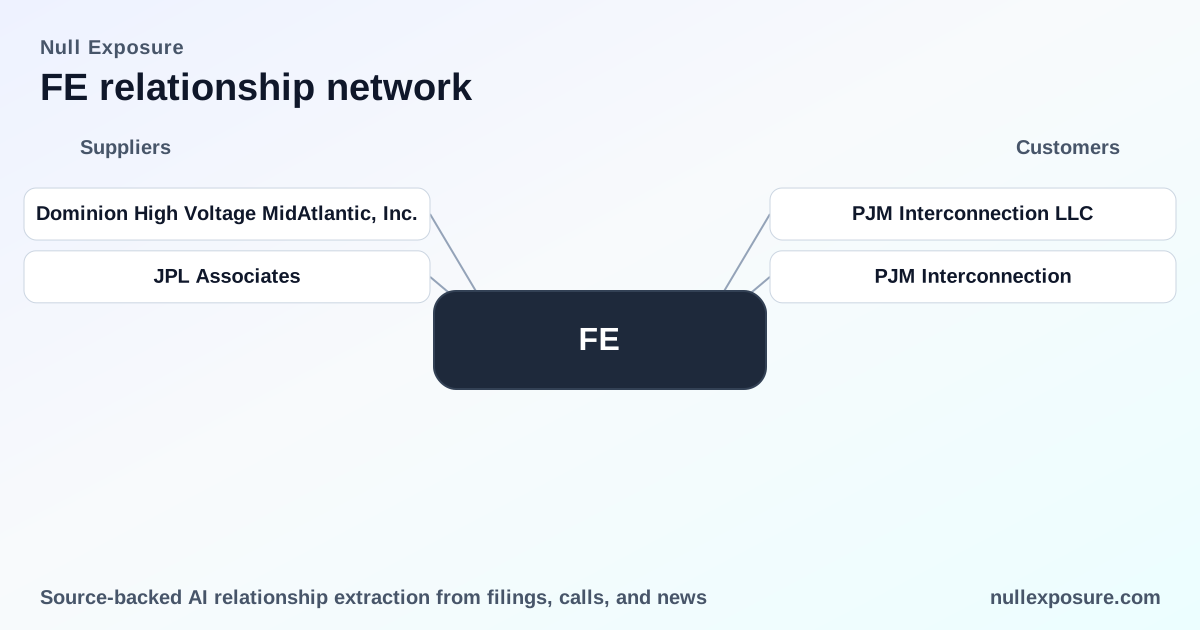
Dominion High Voltage MidAtlantic, Inc.
FirstEnergy Transmission (FET) and Dominion High Voltage MidAtlantic, Inc., together with Transource Energy LLC, formed Valley Link on November 25, 2024, as a holding company to manage projects awarded by PJM and entered into a limited liability agreement governing that collaboration. This is documented in FirstEnergy’s FY2024 Form 10‑K and signals strategic partnership activity in transmission project delivery. (Source: FirstEnergy FY2024 Form 10‑K, 2024 filing.)
JPL Associates
A March 2026 news report described payments that moved through the nonprofit Generation Now, noting that some funds went to JPL Associates to pay for staffing and vendors connected to efforts to influence Ohio House leadership. The article arose in the context of testimony in a public corruption trial and underscores reputational and regulatory risk tied to the company’s historic political spending channels. (Source: WCPO news report, March 2026.)
What the constraints tell investors about operating posture and contract maturity
The company‑level constraints extracted from FirstEnergy’s disclosures present a clear operating profile:
- Contracting posture — mixed but biased to long term. FirstEnergy discloses multiple long‑term PPAs under PURPA and coal supply contracts covering a large portion of near‑term fuel needs, indicating a deliberate tilt toward long‑dated commitments that stabilize generation supply and costs.
- Tactical short‑term arrangements coexist. The company also uses short‑term leases (under 12 months) recognized as straight‑line lease expense and makes PJM market purchases when needed, reflecting operational flexibility and spot exposure.
- Service provider dependence for critical capabilities. FirstEnergy engages third‑party security firms for risk assessments, vulnerability scans, and penetration testing, signaling external dependence for cyber resilience — a critical high‑impact function for utilities.
- Magnitude and concentration of spend. A corporate signal of $29 million in net cash collateral against generation suppliers and a spend band indicator in the $10–100 million range point to counterparty relationships that are financially meaningful to the company’s short‑term liquidity and supplier credit posture.
- Contract maturity profile. Coal contracts and some PPAs extend multi‑years (through 2027 in the coal example), implying contract maturity concentrated in the medium term, which reduces commoditized volatility but locks in fuel price exposure.
These are company‑level signals and should be used to judge enterprise exposure rather than tied to any single supplier unless the disclosure explicitly names that supplier.
Learn how NullExposure parses these dynamics for investors: https://nullexposure.com/.
Investment implications — how to weigh upside and risk
- Reputational/regulatory risk is already priced in to some degree. The JPL Associates reporting and associated legal proceedings linked to political spending create continuing regulatory and reputational overhang that can influence state regulator views and potential penalties. Investors should expect ongoing scrutiny and potential regulatory outcomes to affect cost recovery narratives.
- Counterparty credit and collateral are material. The $29 million of net cash collateral held from generation suppliers is a concrete example of counterparty credit mechanics that can amplify cash‑flow volatility if counterparties default or if collateral calls increase.
- Operational criticality of external service providers. Reliance on third‑party cybersecurity firms elevates vendor risk into the set of factors that determine operational resilience and regulatory compliance; cyber incidents in utilities are value‑moving events.
- Hybrid contracting reduces short‑term volatility but imposes structural commitments. Long‑term PPAs and coal contracts dampen spot exposure but lock the company into fuel and capacity economics that could be challenged by changing regulation or wholesale market dynamics.
Recommended investor actions
- Monitor ongoing litigation and regulatory filings tied to political spending and vendor payments; these remain the highest near‑term catalysts for rating and regulatory outcomes.
- Track counterparty credit trends and collateral movements in quarterly disclosures to understand liquidity and short‑term supplier risk.
- Evaluate the mix of long‑term PPAs and short‑term market purchases as a structural input into generation margin sensitivity under multiple wholesale price scenarios.
For structured relationship mapping and continuous monitoring, visit NullExposure: https://nullexposure.com/.
Conclusion — FirstEnergy operates on a hybrid supplier model with meaningful long‑dated contractual commitments, tactical market exposures, and material counterparty collateral mechanics. Investors should price in the dual realities of regulated stability and merchant‑style supplier risk, with particular attention to regulatory fallout from political‑spending controversies and the credit health of generation counterparties.