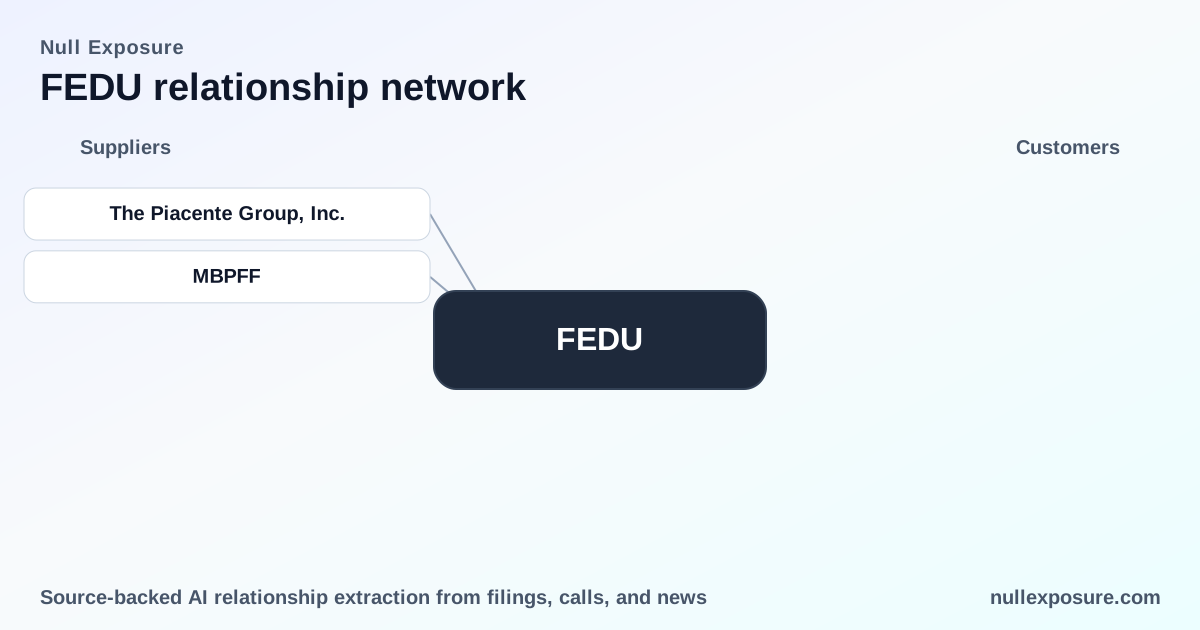
Four Seasons Education (FEDU) — Vendor map and what it means for investors
Four Seasons Education operates a network of after-school mathematics tutoring centers across China and monetizes by selling classroom hours and curriculum packages to parents and students, collecting tuition and ancillary service fees through center enrollments and branded education programs. The company’s economics are driven by student enrollment volumes, per-student pricing, and capacity utilization across its centers; investors should read supplier ties as operational plumbing that affects reporting integrity and public messaging rather than core revenue generation. For a concise supplier-risk snapshot and continuous supplier monitoring, visit https://nullexposure.com/.
How the business makes money and why suppliers matter
Four Seasons Education is a classic consumer-education operator: it sells time and instruction — tuition is the product and recurring enrollment is the revenue engine. Trailing twelve‑month revenue is reported at $261.7 million with gross profit of $56.3 million, indicating education delivery costs dominate the cost base while margin expansion depends on utilization and scale. Public reporting, investor relations and financial audits are therefore non-revenue suppliers whose effectiveness influences capital-market access and investor confidence.
Key financial signals: market cap roughly $23.2 million, a trailing P/E of ~18, and thin institutional ownership (about 3.7%), while insiders hold a meaningful stake (~28.9%), which concentrates governance influence and increases the importance of strong independent controls and third-party auditors to maintain market credibility.
Supplier relationships identified in public records
Below I cover every supplier relationship surfaced in the available results and cite the original mention.
-
The Piacente Group, Inc. — Four Seasons lists The Piacente Group as its investor and media relations contact; the firm provides PR and investor‑relations services for the company. According to a PR Newswire release hosted by The Manila Times (Nov. 26, 2025), contact details for Four Seasons’ investor and media inquiries reference The Piacente Group and named personnel for China and the United States: https://www.manilatimes.net/2025/11/26/tmt-newswire/pr-newswire/four-seasons-education-to-report-first-half-of-fiscal-year-2026-unaudited-financial-results/2231977.
-
MBP (MBPFF) — MBP was named as Four Seasons’ independent registered public accounting firm in a prior corporate announcement; this is the external auditor responsible for the company’s financial statement attestation. Finviz’s company page cites a PR Newswire item that records Four Seasons’ appointment of MBP as its independent registered public accounting firm (appointment reported for FY2017): https://finviz.com/quote.ashx?t=FEDU.
What these relationships mean in plain terms
Both suppliers — a PR/IR firm and an external auditor — are standard service providers for a small, publicly listed education company. The PR firm governs public messaging and investor access; the auditor underpins the integrity of financial reporting. For investors, that combination is low operational concentration risk but high importance for market trust: poor audit outcomes or inconsistent investor communication would have an outsized effect given the company’s small public float and low institutional ownership.
Operational and contractual posture investors should evaluate
With no explicit supplier constraints published in the current relationship results, treat the following as company‑level signals about operating model and supplier risk rather than relationship-specific contractual facts.
- Contracting posture: Four Seasons relies on standard third‑party professional services contracts for PR and audit services rather than embedded, strategic supplier partnerships. This suggests low supplier lock‑in and simple renewal/replace dynamics.
- Concentration: Present evidence shows diversified non-core supplier coverage (PR plus auditor). There is no indication of concentrated single‑supplier dependency for mission‑critical operational inputs such as curriculum delivery or payment processing.
- Criticality: The auditor is high criticality — its role is essential for audited filings and investor confidence. PR/IR is medium criticality, influencing investor relations and market perception, particularly during earnings cycles or regulatory scrutiny.
- Maturity and governance: Both supplier types are mature categories; their selection and independence affect governance signaling. Given outsized insider ownership and light institutional presence, robust, independent auditing and credible investor communications are critical to offset perceived governance concentration.
Risk implications tied to these supplier links
- Audit risk is the primary supplier risk. A reliable external auditor is necessary to sustain investor confidence, particularly when a company has concentrated insiders and a small public float. The MBP appointment (historic) warrants monitoring for auditor continuity, tenure, and any restatement history. Source: Finviz/PR Newswire record (FY2017).
- Communications risk is second-order but actionable. The Piacente Group contract centralizes investor communications; any lapse or poor messaging execution can amplify volatility given limited institutional support. Source: PR Newswire release hosted by The Manila Times (Nov. 26, 2025).
- Operational supplier concentration is low, but absence of additional supplier disclosures means investors should watch for unreported dependencies (e.g., technology or payment vendors) during the next filing or investor update.
For ongoing supplier diligence and alerts on changes to these relationships, see https://nullexposure.com/ — the platform aggregates supplier signals relevant to public companies.
Due diligence checklist for investors and operators
- Confirm current external auditor: review the most recent annual report and 8‑K filings to validate auditor identity and engagement terms; historical appointment is recorded via PR channels. (See Finviz reference above.)
- Review investor‑relations firm engagement: check investor events and press releases to see if The Piacente Group remains the listed contact and whether messaging cadence aligns with governance expectations. (See PR Newswire/Manila Times item.)
- Monitor for changes in institutional ownership and insider transactions, which will alter the weight of third‑party supplier credibility in investor assessments.
Bottom line: actionable takeaways
Four Seasons Education relies on standard professional suppliers—an investor relations firm and an auditor—that are low in operational concentration but high in reputational consequence. For investors, the immediate focus is audit continuity and the quality of investor communications because both materially affect disclosure reliability and market confidence in a firm with significant insider ownership.
If you want continuous tracking of supplier changes, risk flags, and relationship histories for FEDU and comparable issuers, explore our monitoring tools at https://nullexposure.com/. For tailored supplier-due-diligence on education-sector suppliers and audit relationships, start your review at https://nullexposure.com/ and set alerts for material supplier changes.