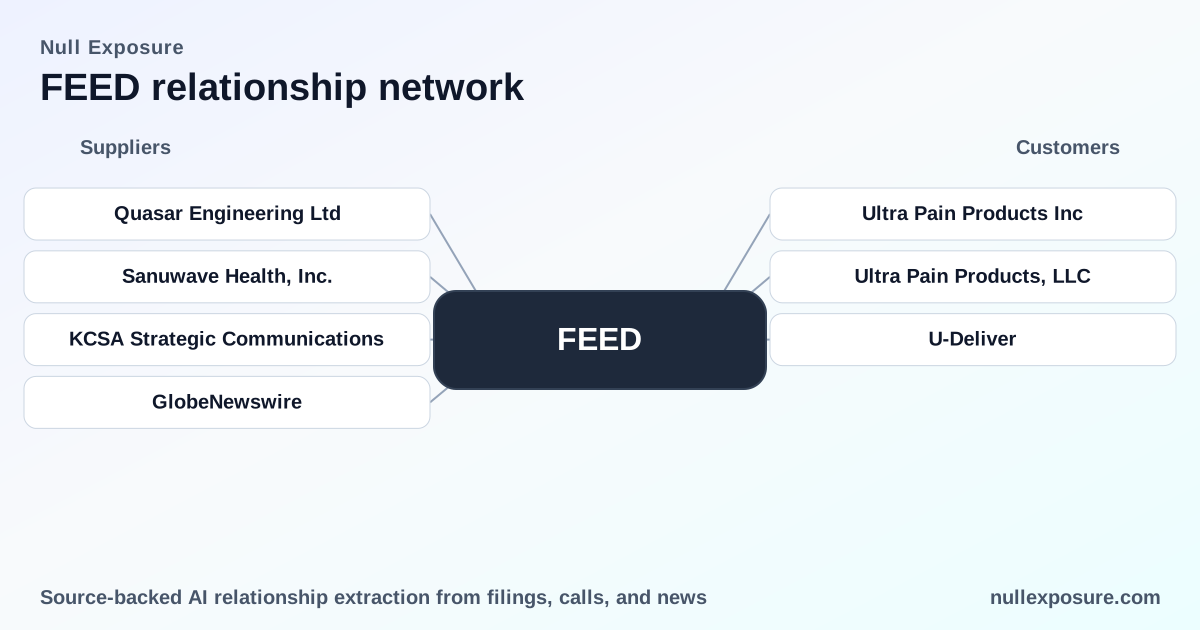
ENvue Medical (FEED): Supplier Relationships and Investment Implications
ENvue Medical operates as a design and commercial organization for medical devices and software, outsourcing manufacturing, certain clinical and R&D tasks, and logistics while monetizing through product sales and related services. The company's revenue model depends on a small set of external manufacturing and service partners to deliver configured systems and proprietary feeding and wound-care consumables, which concentrates operational risk outside the corporate fence and creates supplier-driven margins and timing dynamics for investors. For a concise marketplace view of counterparties and contract posture, visit https://nullexposure.com/.
How ENvue structures work that investors should price in
ENvue does not produce finished goods in-house; instead it contracts for component supply, assembly, and specialized feeding tubes, and licenses technology for manufacturing and distribution. According to the company’s Form 10‑K for FY2024, ENvue’s operating model is outsourcing-first: contract manufacturers and licensed manufacturers are core to product availability and regulatory compliance. This model delivers balance-sheet leverage (lower fixed manufacturing capex) but elevates counterparty concentration and regulatory/certification risk where suppliers and subcontractors operate.
Key company-level signals from filings and disclosures:
- Manufacturer posture: ENvue explicitly contracts out all manufacturing and assembly activities; the company does not self-manufacture finished devices. (FEED 10‑K, FY2024)
- Service providers for R&D and operations: ENvue uses outside consultants for cybersecurity monitoring and subcontracts R&D and clinical trial work, indicating reliance on third-party services for product development and compliance. (FEED 10‑K, FY2024)
- Distribution and logistics: ENvue contracts storage, inventory management, order processing, and shipping in the U.S., demonstrating an outsourced distribution stack. (FEED 10‑K, FY2024)
- Geopolitical / certification exposure in EMEA: The company flagged risks where conflict-related travel or audit restrictions (specifically referencing Israel) could interrupt manufacturing audits and certifications, introducing potential certification suspensions. (FEED 10‑K, FY2024)
These characteristics define the contracting posture (outsourced, partner-dependent), concentration (a short list of named manufacturers), criticality (suppliers are mission-critical for product delivery and regulatory standing), and maturity (relationships include multi-year contracts and license agreements but the company remains commercially young).
Named counterparties and what they do for ENvue
Below are the relationships disclosed in the supplier-focused search, each followed by a plain-English summary and the source context.
Quasar Engineering Ltd
Quasar Engineering was appointed as ENvue’s contract manufacturer for PainShield, UroShield and WoundShield devices and other products in December 2018, serving as a principal assembly and production partner. This is a cornerstone manufacturing relationship that underpins ENvue’s ability to bring multiple device lines to market. According to ENvue’s Form 10‑K (FY2024), Quasar is an appointed contract manufacturer for these product families (FEED 10‑K, FY2024).
Sanuwave Health, Inc.
ENvue executed a license agreement with Sanuwave in March 2020 that covers the manufacture and delivery of WoundShield technology, which shifts manufacturing risk for that product to a third party under license terms. The license positions Sanuwave as a manufacturing and supply channel for wound-care products under ENvue’s brand and IP (FEED 10‑K, FY2024).
KCSA Strategic Communications
KCSA Strategic Communications is listed as the investor relations contact for a March 2026 press release concerning a USPTO notice of allowance for a feeding tube patent, indicating KCSA provides investor‑facing communications and IR coordination. The QuiverQuant news item (March 2026) captured KCSA as the contact for investor inquiries tied to the announcement (QuiverQuant/GlobeNewswire, March 2026).
GlobeNewswire
GlobeNewswire distributed the press release announcing the USPTO notice of allowance for ENvue’s feeding tube patent; GlobeNewswire’s role is press distribution rather than product supply or manufacturing. That press distribution was summarized via a QuiverQuant news post that noted the GlobeNewswire release (QuiverQuant/GlobeNewswire, March 2026).
What these relationships imply for investors
ENvue’s supplier map is compact and functionally segmented: manufacturing and assembly are concentrated with named partners, R&D and clinical activity are commonly subcontracted, and distribution/logistics are handled through third‑party arrangements. This creates several investment-relevant dynamics:
- Operational leverage and margin variability: Outsourcing reduces capital intensity but transfers operational execution and timing control to suppliers; revenue cadence and gross margins will reflect supplier performance and lead-time variability.
- Counterparty concentration risk: The small set of named manufacturing partners implies material dependency on counterparties for product availability and regulatory compliance; a disruption at a single manufacturing partner could have outsized commercial impact.
- Regulatory and geopolitical sensitivity: ENvue explicitly flagged the risk that auditors or certification bodies might be unable to access subcontractor facilities in Israel, which creates direct certification and clearance risk that investors must price into valuation and scenario planning (FEED 10‑K, FY2024).
- Service-driven product development: Subcontracted R&D and external cybersecurity consulting reduce fixed cost but require active vendor management to protect IP and clinical timelines; these are governance points investors should monitor in reporting.
If you want a concise map of counterparties and supplier risk exposure to share with your team or investment committee, review our supplier analytics at https://nullexposure.com/.
Risk framing and monitoring priorities
Focus monitoring on three actionable signals: supplier performance metrics (on-time delivery, defect rates), regulatory/audit access (especially for facilities in EMEA/Israel), and contract renewal or exclusivity clauses with named manufacturers and licensors. Investor updates should demand visibility into supplier audit outcomes and contingency plans—the company’s outsourcer-dependent model makes supplier transparency a valuation driver.
For a tailored supplier counterparty report and structured monitoring playbook, see our resources at https://nullexposure.com/.
Bottom line for investors
ENvue’s business model is deliberately asset-light and partner-dependent, which accelerates commercial scalability but concentrates execution and regulatory risk with a limited set of suppliers. Quasar and Sanuwave are core manufacturing partners; KCSA and GlobeNewswire support market communications. Active monitoring of supplier audits, contract terms, and geopolitical exposure—particularly related to certification access in EMEA/Israel—should be central to any investment thesis or operational diligence on FEED.